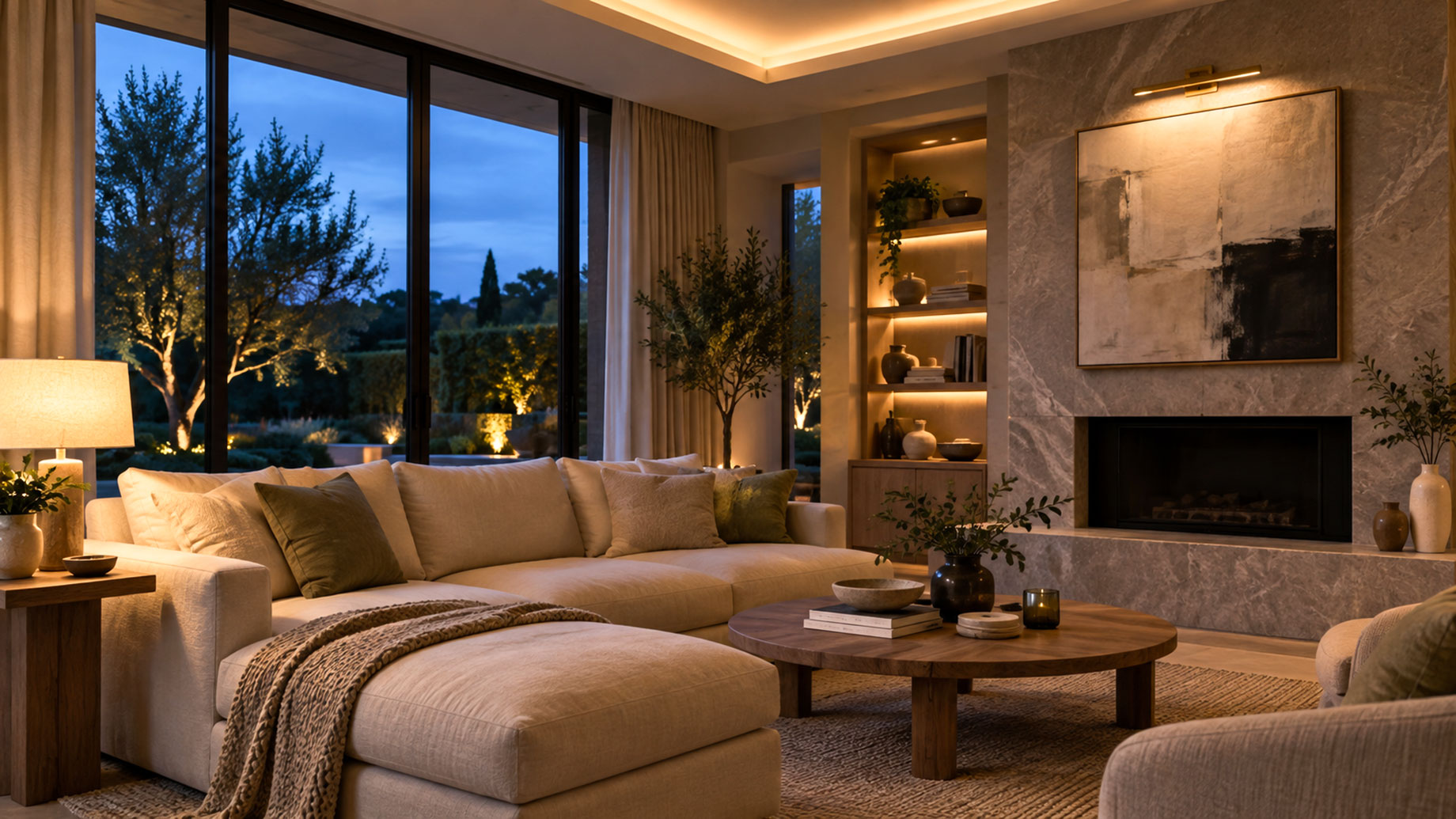
Every interior designer has had this meeting. The client loves the render. The sofa is right, the stone is right, the light pouring through the west windows is gorgeous. Then, about four months after handover, they call to say the room feels flat at night.
Nothing about the room changed. The client simply approved a single moment of it. A rendering is one frame of a space that will be lived in from breakfast to midnight, and the lighting plan we spent weeks on — the cove lighting, the picture lights, the lamps that pull a seating group together after dark — barely registers in a sunlit still.
For the past year, our studio has added one short clip to every major presentation: the same view, moving from late afternoon into evening. It has changed the conversation about lighting more than any number of mood boards.
Why a still undersells a lighting scheme
Lighting design is about change. Daylight fades, the warm sources take over, surfaces that read as pale in the afternoon turn honey-coloured under 2700K, and the room’s focal point moves from the view outside to the fireplace or the art wall. A client looking at a single frame cannot feel that shift, so they tend to judge the lighting budget as an extra rather than as what actually makes the room work at night, which is when most people actually use their living rooms.
Two renders side by side help a little. A few seconds of the light actually changing helps far more, because people respond to the transition itself.
How we build the clip
The approved daytime render is always the starting point, because that is the image the client has already said yes to. We keep it untouched.
Next we need an evening version of exactly the same view. The best source is the 3D model itself: switch to the night lighting scene and render the same camera again. When that isn’t practical, for example with an early concept, we create the dusk version by editing the daytime render in Nano Banana 2, which can edit an image using reference pictures — the original render goes in as the reference, and the prompt describes only the lighting change: windows darkening to deep blue, lamps on, cove lighting glowing along the ceiling line. Everything else is supposed to stay put, and we check that it has.
Then the two images go into Wan 3.0’s first-and-last-frame mode, with the afternoon render as the opening frame and the evening one as the closing frame. The model fills in the transition. We ask for a locked camera and nothing moving except the light, and we keep clips to around eight seconds. Longer than that and clients start waiting for something to happen.
We run all of this inside a browser-based image to video tool that keeps several models in one place, and that turns out to be a real time-saver. If one model handles glass and reflections badly on a particular view, we can try another without opening a new account or redoing the setup.
What we check before a client ever sees it
Generated motion is a guess between two pictures, and a beautiful guess can still be wrong. Before anything goes into a presentation, someone who knows the scheme watches it full screen and checks the details clients will hold us to later.
Materials come first. Marble veining should not drift. Brushed brass should not turn into polished gold halfway through. Timber grain on the joinery should stay where it is. Then fixtures: the number of pendants, the position of the picture lights, the run of the cove. If the clip invents a fitting that is not on the lighting plan, it goes back. Finally, the architecture itself. Ceiling heights, window mullions and door openings must match the drawings frame for frame.
Our hit rate is about two usable clips out of every three attempts. The failures are usually reflective surfaces: a mirror that briefly reflects a corner nobody designed, or glass that flickers as the light changes.
How we present it
The clip plays once, on the big screen, straight after the client has approved the daytime render. We don’t add music or titles, just the room going from afternoon to evening. Then we pause on the last frame and talk about what they are looking at: which fittings are doing the work, what the dimmer scenes will be, and why the lamp budget is not optional.
Every clip is labelled as a concept visual, both in the deck and in the file name. It shows the mood of the lighting scheme, not a specification. Exact colour temperatures and beam angles live in the lighting schedule, and we say so in the meeting. Clients appreciate the distinction, and it protects everyone if a supplier substitution changes a fitting later.
After the meeting, the clip goes to the client with the still renders, in a vertical version cropped for their phone. Several have told us that is the file they show friends and family when describing the project, which is not a bad outcome for something that took an afternoon to make.
Is it worth the extra step?
For a single room refresh, probably not. For a whole-house project with a serious lighting budget, we now treat it as standard. The question we used to hear at handover, “why does it feel so different at night?”, has almost disappeared, because clients have already seen the evening version and signed off on it.
