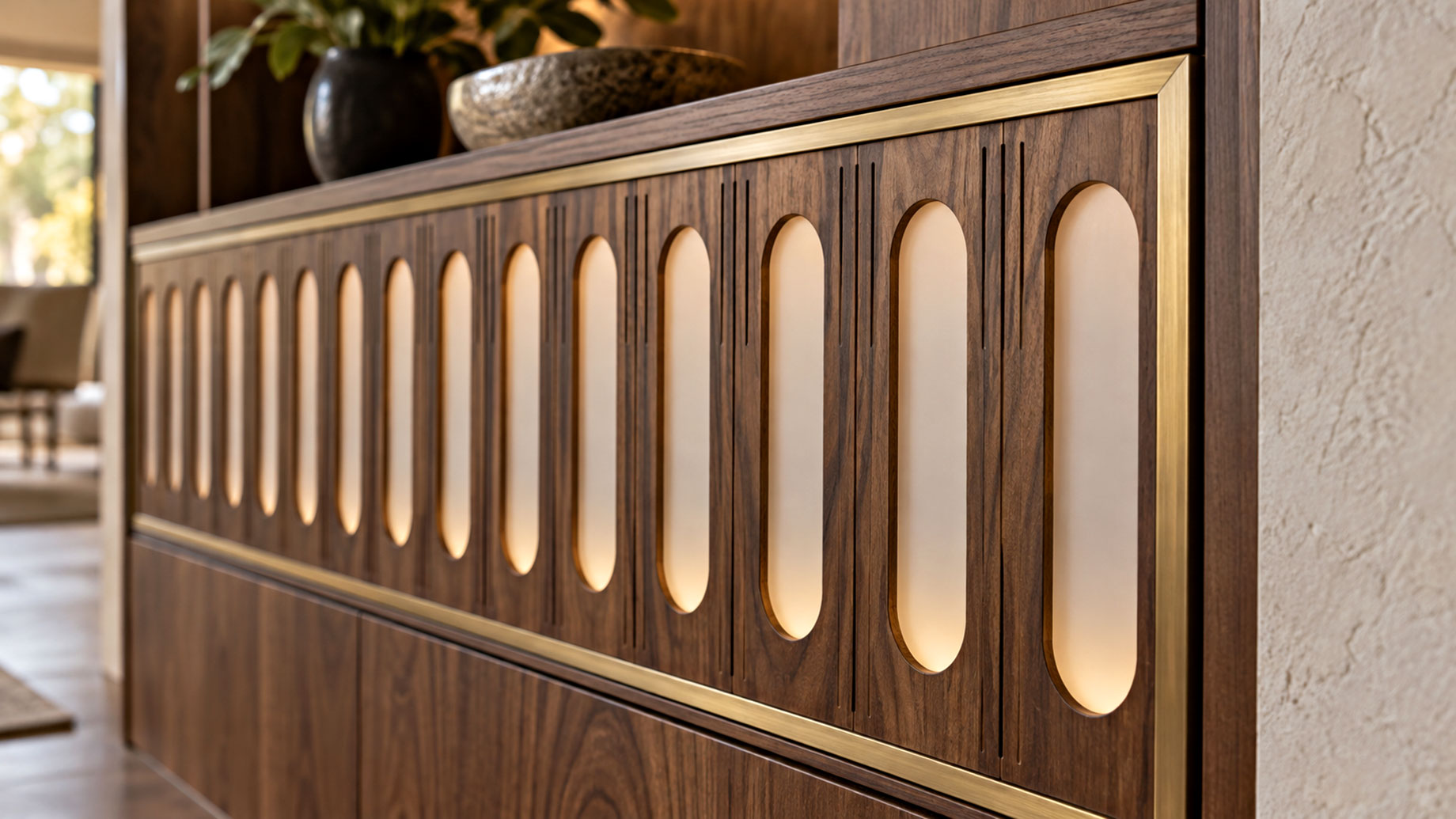
The details that make an interior feel genuinely custom are usually small ones. A room number cut for one specific doorway. A cabinet panel that quietly repeats a motif from the entry. A layered acrylic sign sized to the exact width of a single wall. None of it requires a grand gesture. What it requires is precision, consistency, and a process capable of reproducing an idea exactly as intended, in whatever material the design actually calls for. Digital laser fabrication has become one of the more reliable ways designers and fabricators get there.
Modern Luxury Is Moving Toward More Personal Detail
A recurring idea in contemporary interior design: luxury increasingly reads as intentionality rather than abundance. A room full of expensive but generic finishes doesn’t land the same way as a room with three or four details that clearly exist for no other space but that one. Custom fabrication supports the second option without demanding an entirely bespoke build for every piece in it.
That doesn’t mean piling on ornamentation. Some of the strongest applications are quiet — a minimalist house number, a discreet drawer label, a subtly engraved ventilation screen. Restraint, applied consistently, often reads as more considered than visible complexity ever does.
Material Contrast Can Make Small Details Feel Architectural
Designers working with digital fabrication lean on contrast more than any single material. Warm wood against cool, frosted acrylic. A dark metal plate inset into a pale millwork panel. A transparent acrylic layer floating in front of a solid wood backing. These pairings do more design work than an equivalent piece made from one material alone — the eye reads the boundary between two materials as intentional, not incidental.
The pairing matters more than what any single material costs. A modest plywood insert next to a polished brass detail can read as more considered than an all-metal panel offering no contrast at all.
Digital Fabrication Helps Carry One Design Language Across a Space
The underlying design exists as a digital file rather than a physical template, so the same typography, pattern, or motif can reappear at different scales throughout a project. An entry detail echoed in a cabinet insert. A pattern from a screen, repeated smaller in an accessory elsewhere in the room. That repetition is part of what gives a well-designed interior its sense of continuity, rather than feeling like a pile of unrelated purchases.
Consistency has limits, though. Material variation, calibration, and finishing all still affect the final result. A design meant to repeat identically across a dozen components is better tested early than assumed to hold up by piece five.
That combination of control and consistency already shows up in real interior-production workflows. Formd, a UK design and fabrication company whose work includes retail interiors and event spaces, uses acrylic cutting and wood engraving as part of the same design-and-build process. The company previously depended on outside suppliers for acrylic work, which became difficult whenever projects changed late or deadlines tightened. Bringing that fabrication in-house gave its team more control over production timing and made it easier to keep custom components inside the same workflow as the rest of the design.
Different Materials Require Different Laser Processes
Worth being precise here rather than glossing over it. Cutting separates material along a path. Engraving removes material to create a recessed design or texture. Marking changes a surface’s appearance with comparatively little material removed, and it’s the term most associated with metal identification and branding work. These aren’t interchangeable words for the same outcome. The material in question decides which process — and which category of equipment — actually applies. Studios exploring laser cutting and engraving for interior work should separate the process they actually need from the material and scale of the finished piece first. Equipment built for wood and acrylic is simply a different category from equipment built for metal.
Acrylic Brings Precision and Lightness
Acrylic earns its place in refined interiors through range. Clear, frosted, mirrored, richly colored — the same base material behaves completely differently once installed and lit. A dimensional acrylic sign reads substantial from a few feet away and nearly disappears from across a room. A frosted panel diffuses light in a way solid material never manages.
Results still hinge on the specific sheet and setup. Edge quality on cut acrylic varies with acrylic type, thickness, laser settings, and airflow around the cut. No single result should be assumed regardless of which OMTech laser systems or comparable CO2 equipment produces it — a sample cut on the actual material in use tells a designer more than any spec sheet.
Sign Architects, a London signage company, saw acrylic demand outgrow its production setup in a very concrete way. The company had been processing acrylic on a CNC router, which required extra finishing steps before pieces were ready to install. Adding a laser cutter removed several of those steps entirely. In the company’s published account, jobs that would normally take seven to ten days could be turned around in just a couple when needed — a reminder that the value of laser-cut acrylic in an interior project isn’t only visual. Removing production steps can matter just as much when designers and clients are working against a tight deadline.
Wood Keeps Digital Fabrication From Feeling Sterile
Where acrylic contributes precision, wood contributes warmth and irregularity no synthetic material fully replicates. A laser-engraved panel still carries the grain, density, and character of the specific piece of stock it came from. That’s part of why wood details rarely feel mass-produced even when the process behind them is entirely digital.
That same variability cuts the other way too. Species, resin content, moisture, plywood construction — all of it affects how a piece engraves, and two sheets from different batches may not behave identically under the same settings. For a design meant to repeat across several rooms, that’s reason enough to test each new batch of stock rather than assume it’ll match.
Metal Adds Permanence and Contrast, but It Needs the Right Process
Metal details — engraved nameplates, marked hardware, small inlays, personalized fixtures — bring a weight and permanence wood and acrylic simply don’t. But equipment categories matter most right here. A CO2 system built for cutting and engraving wood and acrylic isn’t the right tool for marking or cutting metal. That work generally calls for fiber laser equipment built specifically for metal surfaces, and sometimes an entirely different fabrication method altogether. A designer specifying a mixed-material piece should expect it to pass through more than one process, not one machine handling all of it.
The Cut Is Only the Beginning
A freshly cut or engraved component rarely looks finished the moment it leaves the machine. Sanding, edge treatment, polishing, painting, sealing, bonding, mounting hardware — all of it still stands between a raw cut piece and something that belongs in a finished interior. This is usually where the actual craftsmanship shows up. Digital fabrication produces a consistent starting shape. Hand finishing and careful installation are what make it feel premium instead of provisional.
Seen that way, digital fabrication doesn’t compete with craftsmanship so much as extend it. The laser handles repeatable geometry. Material judgment, finishing, and installation stay a skilled, largely manual job.
Where Laser-Fabricated Details Fit Best
A corporate reception project for technology company EFI shows how laser-cut details can become part of a much larger interior composition rather than the whole of it. Spectrum Signs & Graphics built a historical timeline extending more than 62 feet across the reception area, combining large-format printed graphics with individually laser-cut acrylic elements mounted on top. The acrylic pieces carried the fine detail; the printed banner beneath carried the scale. It’s a useful reminder that laser fabrication often supplies one carefully controlled layer of an interior rather than producing the entire finished environment by itself.
These techniques show up in very different settings: a boutique hotel’s room numbers and directional signage, a private residence’s wine-room labels and library plaques, a high-end retail interior’s branded display fixtures, a restaurant’s engraved menu presentation. In every case the detail stays decorative and non-structural — signage, display, personalization, prototyping, not load-bearing or life-safety elements. Anything touching structural requirements, fire code, or accessibility compliance still needs proper engineering review and professional fabrication. A laser-cut prototype is a design tool, not a substitute for that process.
What Designers Should Decide Before Sending a File to Fabrication
A short list of decisions tends to separate a smooth fabrication process from a frustrating one: material and finish, final installed size, whether the piece carries any structural expectation at all, material thickness, mounting method, edge treatment, how it interacts with lighting, and how many units actually need producing. Settle these before a file goes to fabrication and most of the common surprises disappear on their own — the panel that didn’t account for mounting clearance, the pattern that reads completely differently at full scale than it did on screen.
Conclusion
Digital tools have made customization more repeatable, but repeatability isn’t what makes an interior feel luxurious. That still comes down to restraint, material judgment, careful finishing, and how precisely each detail fits the architecture around it. The laser is a capable tool for turning a considered design into a physical object. Whether that object actually feels like luxury depends on everything that happens around it.
