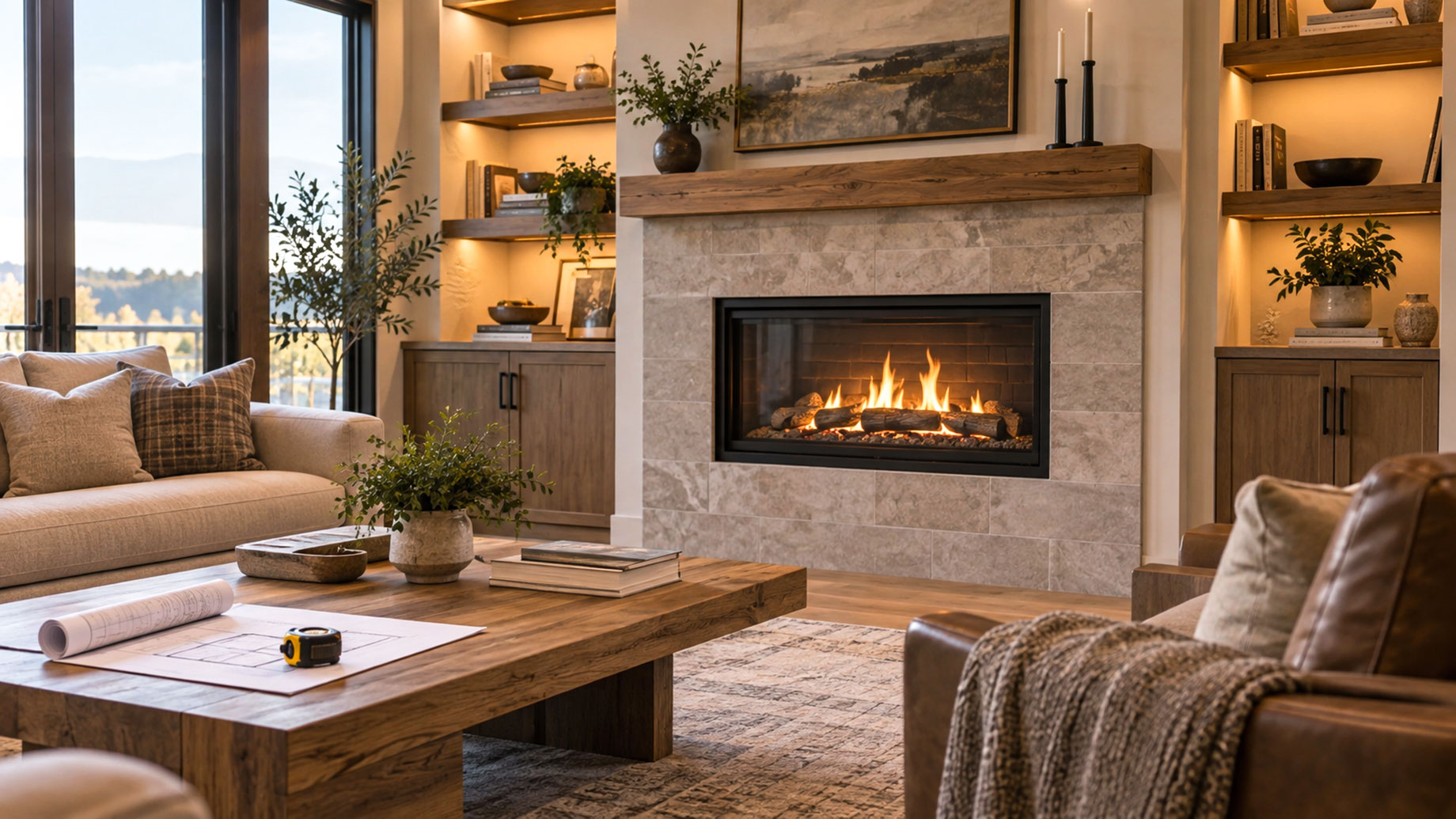
Nine out of ten buyers walk into a showroom with the same question, and it’s the wrong one. They ask which model looks best. The right question is whether that model can physically live in the room they want it in. I’ve watched this play out more times than I can count. Someone falls for a 60 inch linear unit with a bed of crushed glass, orders it, and then finds out their 1974 ranch has no chase to run a vent through.
Now they’re choosing between a remodel they didn’t budget for and a fireplace they don’t love. So here’s the deal. Choosing a gas fireplace comes down to four decisions made in the right order: where it goes, how it vents, how big it is, and who installs it. Get those settled and the styling part becomes fun instead of stressful. Get them wrong and you’re stuck.
Start With the Wall, Not the Catalog
Before you look at a single unit, walk the room and answer three things about it.
- Which wall do you actually sit facing? (Hint: it’s rarely the wall with the TV.)
- What’s behind that wall, and above it? A closet, a bedroom, open sky, or the neighbor’s garage?
- Where does the gas line enter the house, and how far is it from where you want the fire?
That third one surprises people. Running a gas line across a finished basement floor is a real cost, and it’s the kind of thing that flips a “sure, let’s do it” into a “let’s think about it.” A corner placement near the existing line can save you more than a thousand dollars in labor, and honestly, corner fireplaces look great in rooms where a flat wall would fight the seating arrangement anyway.
Here’s my honest take: the venting question is the one that kills projects, so answer it first. Direct vent units pull combustion air from outside and push exhaust back out through a sealed pipe, which means they don’t compete with your indoor air. The U.S. Department of Energy publishes general guidance on home energy systems that’s worth a look if you’re trying to understand how vented and vent-free options differ in practice, because that difference shapes what you can legally and safely install.
Venting Options, Decoded
Three setups cover nearly every home. Knowing which one your house allows narrows your shopping list fast.
| Vent Type | How It Works | Best For |
|---|---|---|
| Direct vent | Sealed pipe through an exterior wall or roof | Most remodels and new builds |
| B-vent (natural) | Uses an existing chimney or vertical flue | Homes with a working chimney |
| Vent-free | No exterior vent, burns room air | Tight spaces, with local code check |
If you’re in an older house with a chimney, B-vent is often the cheapest path because the flue already exists. If you’re finishing a basement or adding a fireplace to an interior wall, direct vent is usually your answer, and you’ll need to think about where that exterior termination lands. Nobody wants a vent cap staring back at them from the patio.
Local code matters here, and it varies more than people expect. The National Fire Protection Association maintains the standards that most jurisdictions build their fireplace rules on, and you can find general reference material through the NFPA. Your installer will know your specific county requirements, but it helps to understand that clearances to combustibles and termination distances aren’t suggestions.
How Big Is Too Big?
There’s a real temptation to go oversized. More fire, more drama. But a fireplace that’s too large for a room reads as overwhelming, and it can make a cozy den feel like a hotel lobby.
A rough rule I’ve found useful: a fireplace should occupy somewhere between a quarter and a third of the wall it sits on, and its viewing height should land near eye level when you’re seated. Small rooms want something in the 30 to 36 inch range. Great rooms and open concept spaces can handle 48 inches and up, especially linear units that spread the flame across a wide span.
Also think about heat output, not just looks. Gas fireplaces are rated in BTUs, and a unit that’s rated for a large space will run you out of a small one. If you mainly want ambiance, a lower output unit with a good flame pattern beats a furnace disguised as a fireplace. Heating and cooling professionals use standards from bodies like ASHRAE to size systems for rooms, and the same logic applies here: match the output to the space, not to your enthusiasm.
Which would I pick for a 14 by 16 foot living room? A 36 inch direct vent with a modest BTU rating and a realistic log set. It’ll heat the room on a cold evening without turning it into a sauna.
Insert, Built-In, or Full Remodel
You’ve got three paths, and they cost wildly different amounts.
- An insert drops into an existing masonry or factory-built firebox. It’s the least invasive option, and it’s the one I’d recommend if you already have a fireplace you don’t use. You keep the surround, gain efficiency, and skip the drywall work.
- A built-in means framing a new opening, running gas, and finishing the wall around it. This is the middle path and the most common for remodels.
- A full redesign adds stone, a mantle, built-ins on either side, the whole treatment. This is where a fireplace stops being an appliance and starts being the room’s centerpiece. It’s also where budgets go sideways, so decide early whether you want a fireplace or a feature wall.
One thing I’d push back on: don’t let a contractor talk you into skipping the finish details to save money. A great unit with a bad surround looks like a mistake. If you’re in Utah and shopping around, there are gas fireplaces utah homeowners can see in person before committing, which beats ordering from a spec sheet every single time.
A Quick Pre-Purchase Checklist
Run through this before you sign anything.
- Confirm the wall location and what’s behind it.
- Get a venting type recommendation from a licensed installer, in writing.
- Measure the wall and check the manufacturer’s framing dimensions.
- Verify your gas line capacity and distance to the meter.
- Check local permit requirements before work starts.
- Ask who handles warranty service and how fast they respond.
That last item matters more than people think. Fireplaces are mechanical systems with valves, igniters, and pilot assemblies, and something will eventually need attention. A dealer who services what they sell is worth a small premium over the cheapest quote you can find online.
The Part Nobody Warns You About
Installation day is messier than the showroom suggests. There’s drywall dust, a hole in your exterior wall, and a crew in your living room for a day or two. Plan for it. Move furniture, cover what you can’t move, and keep pets in another part of the house.
Then comes the part that makes it all worth it. The first cold night when you flip the switch, the flame settles in, and the room gets that specific warmth that a furnace never quite delivers. That’s the payoff. It’s why people in cold climates spend real money on this instead of just turning up the thermostat. So before you buy, get the four decisions right.
Where does it go, how does it vent, how big should it be, and who installs it? Answer those honestly, and you’ll end up with a fireplace that fits your home instead of one you’re working around for the next twenty years.
