Claude Opus 5 API is Anthropic’s flagship reasoning model and it is fully available to any developer right now — no waitlist, no invite, no enterprise sales call. Direct access is a five-minute console setup at Anthropic’s list rate of $5 per million input tokens and $25 per million output; the friction is not getting in, it’s the price and the latency, and both are real. The live rate card and telemetry are on Claude Opus 5; this piece answers the narrower question — how you actually get access, every legit route, ranked by how much it hurts.
The honest starting point is that there is no door. Anthropic shipped Claude Opus 5 on July 24, 2026, and “access” stopped being a question about a month ago. The numbers nobody puts in a launch post are 7.34 seconds to the first token and a $25 output price, and they are exactly where most “how do I get API access” advice quietly stops — because that advice ends the moment you can send a request, not the moment the model fits your product.
The setup: five minutes, one key, no waitlist
Getting in is a console task, not a sales task. You create an Anthropic Console account, fund it, create an API key, and start calling the model ID anthropic/claude-opus-5. That is the entire procedure, and most teams finish it in an afternoon. Existing Anthropic customers get the easiest ride of all: the model simply appears in the console, and the same key that already works keeps working. One correction to a widespread rumor: there is no free API tier. Anthropic has never shipped one — the legit $0 routes are trial credits, the playground, and bundled platform credits, not an API key that stays free.
Two practical notes. The API surface is OpenAI-SDK compatible, so most existing code paths work by swapping the base URL and the model name — no Anthropic-specific tooling required. And the weights are closed, so “access” always means renting the model through Anthropic’s API or through a platform that carries it; self-hosting is not an option. What you’re renting, in other words, is a service — an endpoint and a bill — not a binary you can inspect, tune, or run on your own hardware.
What “access” buys you, in practice
Once you hold a key, you have a flagship. Claude Opus 5 is Anthropic’s top reasoning model — positioned by the independent evaluator Artificial Analysis as near-frontier at half the price of Claude Fable 5 — with a 1,000,000-token context window, the largest in the current Anthropic line. Reasoning runs through an Adaptive Reasoning dial with effort levels from medium to high, xhigh and max; every headline benchmark you’ve seen is the max configuration, so if you run it at a lower effort you will not reproduce those scores. It is multimodal-capable, though text output is primary for the API, and you consume it through the same request/response flow as any other model — the difference is in how long the model thinks and how much it charges per output token.
The real gate is the rate card: $5 in, $25 out
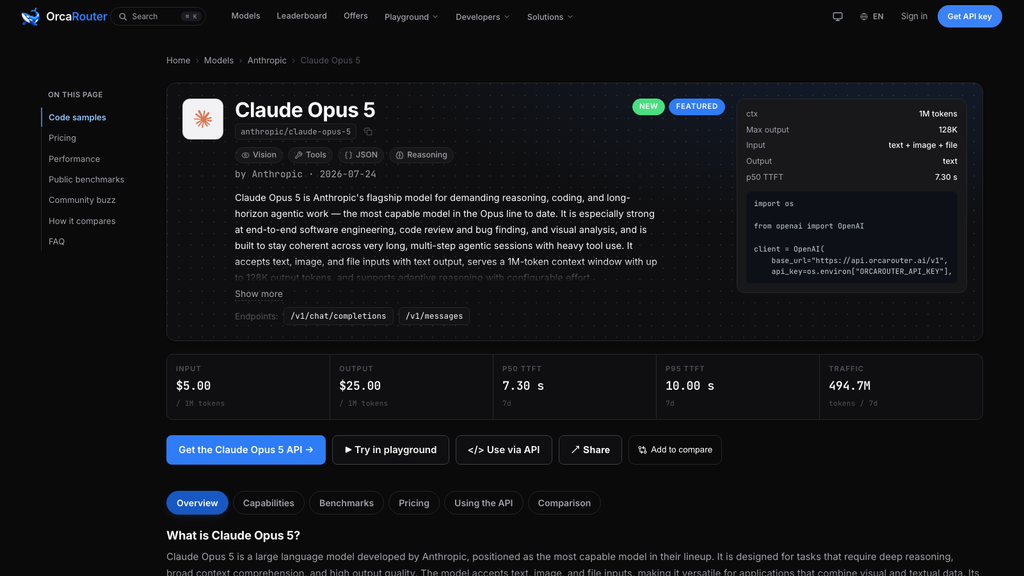
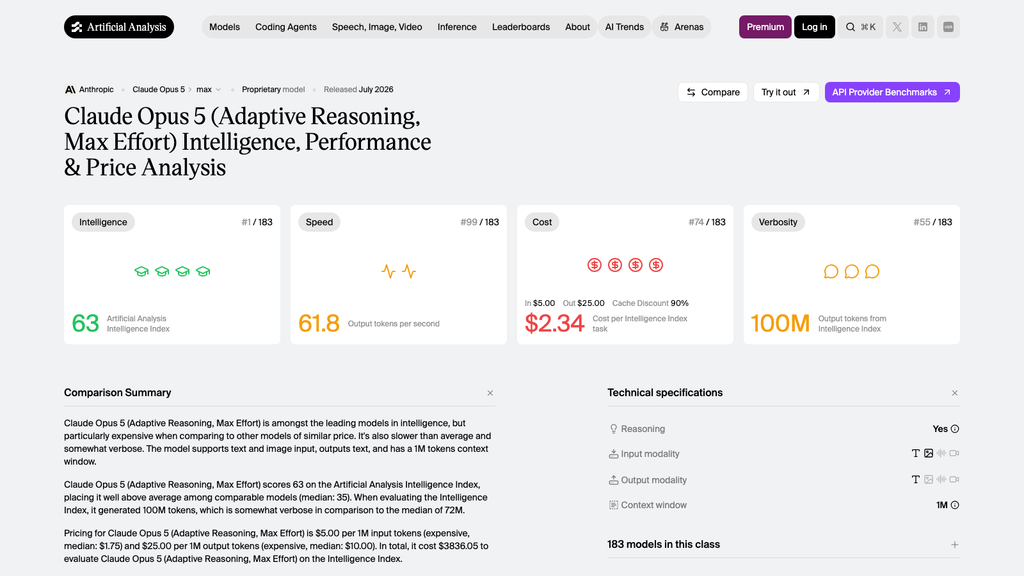
The part that actually decides whether you build on this model is price. Anthropic’s current list rate — verified August 18, 2026 and mirrored on OrcaRouter’s rate card — is $5.00 per million input tokens and $25.00 per million output, with cached input at $0.50, an 80% cut for repeated context. On Artificial Analysis’ live board, Claude Opus 5 ranks 74th of 183 for cost, and one Intelligence Index task costs $2.34 to run — expensive for a chat model, normal for a reasoning flagship.
Read the $25 output price as a signal, not a fee. Artificial Analysis measures Claude Opus 5’s median output speed at 61.8 tokens per second — well below GPT-5.6 Luna’s 156.6 — because the model spends tokens deliberating instead of emitting. If your workload is short answers at high volume, this rate card will hurt you. If your workload is hard, long-horizon problems, $25 per million is the price of not doing the thinking yourself.
| Direct Anthropic API | A router that carries it | |
| Setup | Console account, funded key, one base URL | One key; model already in the catalog |
| Pricing | Anthropic list — $5 / $25 | Same list price, passed through at 0% markup |
| Failover | You own retries | Automatic failover across providers |
| Best for | Teams already on Anthropic infrastructure | Evaluating or A/B-ing models without a second contract |
The latency you’ll actually feel: a flagship that thinks before it answers
Here is the number launch coverage won’t print. On OrcaRouter’s own 7-day telemetry, checked August 22, 2026, Claude Opus 5’s p50 time-to-first-token is 7.34 seconds, with p95 at 10.00 seconds. Even Anthropic’s other flagship, Claude Fable 5 at $10/$50, opens at a p50 TTFT of 4.32 seconds on the same telemetry — Opus 5 gives up three more seconds of responsiveness than its own stablemate. Compare GPT-5.6 Luna, the volume workhorse, at a p50 TTFT of 1.33 seconds and 21,271.6 million tokens moved in the same window — Claude Opus 5 carried 491.5 million. The flagship isn’t broken and it isn’t slow by accident. It is an output-quality model, not a latency model, and the 7-second first token is the price of a model that reads your entire problem before it answers.
The benchmarks agree. Artificial Analysis’ live board scores Claude Opus 5 at 63.05 on the Intelligence Index, first of 185, with the effort ladder running from 63.05 at max down to 58.64 at medium. The same page that crowns it also shows the cost: the model burns roughly 100 million output tokens to evaluate the full index. If you’re building a chat feature where users expect a reply in under a second, this is the wrong model no matter how much you like the score.
Who shouldn’t bother with direct API access (yet)
Given all that, direct access is only the obvious choice if you already run on Anthropic’s infrastructure. If you’re still evaluating the model, or shipping a product that may switch models, the pragmatic route is a platform that already carries Claude Opus 5: one API key, Anthropic’s list price passed through at 0% markup, and automatic failover so a model at $25 per million output isn’t a single point of failure. OrcaRouter carries Claude Opus 5 alongside 200-plus other models, which means you can A/B it against what you run today without a second contract or a code change.
Skip direct access for now if any of these describe you: latency-sensitive, user-facing features, where 7.34 seconds to first token is the deal-breaker; high-volume, low-cost workloads, where a reasoning model is the wrong tool entirely; or teams that just want to test the model without owning its infrastructure and its bills.
The takeaway
Claude Opus 5 API access is solved — there is no waitlist, the setup is a console account and a key, the model ID is anthropic/claude-opus-5 on an OpenAI-SDK-compatible surface, and the only real decisions are the rate card and the latency. You pay $5 in and $25 out, you wait roughly 7 seconds for the first token, and in return you get the top of the independent Intelligence Index. If you need the strongest reasoning Anthropic ships and can live with a model that thinks before it answers, there are two legitimate ways in: Anthropic directly, or a router that passes the list price through at 0% markup. Ranked by pain, both are gentle. Ranked by fit, it comes down to whether your users can wait seven seconds.
Sourcing note: release date and positioning are vendor-reported. Pricing ($5 / $25, cache $0.50) is Anthropic’s current list rate, verified August 18, 2026, and mirrored on OrcaRouter’s rate card. Intelligence Index (63.05, #1 of 185), cost rank (#74/183), cost per task ($2.34), effort-ladder and output-speed figures are from Artificial Analysis’ live model page, checked August 22, 2026. TTFT, traffic and 0% markup figures are OrcaRouter’s own 7-day telemetry, checked August 22, 2026.