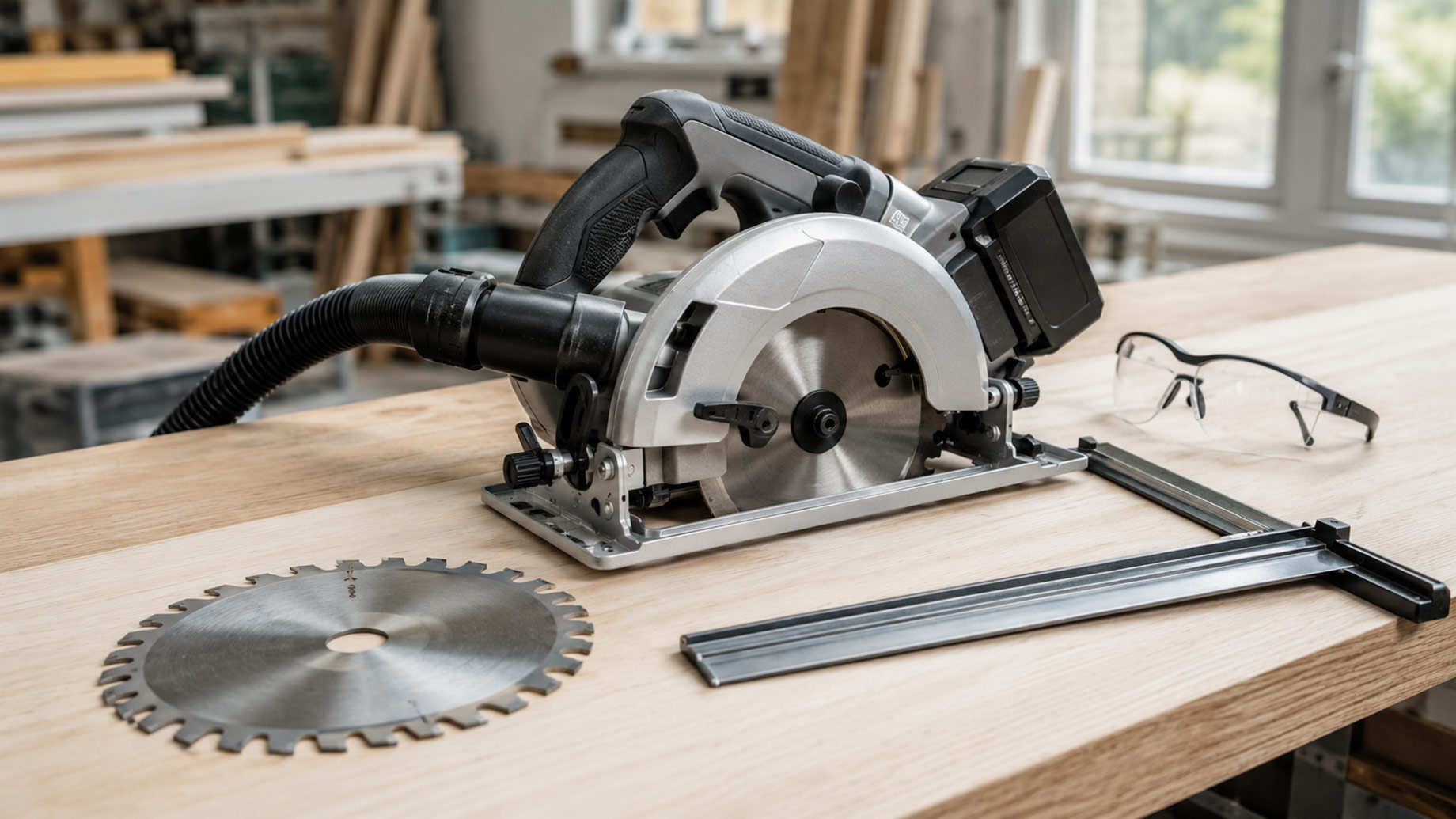
A circular saw is the tool most people buy first and think about least. They pick one on price, discover two years later that it will not cut through what they need, and buy a second one.
The decisions that actually matter are blade size, power source, and saw type, in that order. This guide works through each of them, plus the dust and safety considerations that get skipped far too often.
Key Takeaways
- Blade size determines depth of cut, and 185mm is the all-rounder most trades reach for first.
- A 165mm blade gives roughly 55 to 57mm of depth at 90 degrees, while 185mm gives around 66 to 67mm.
- Battery platform is a longer commitment than the saw itself, so choose the ecosystem before the tool.
- Plunge and track saws deliver straight, tear-out-free cuts that a standard saw cannot match on sheet goods.
- Cutting fibre cement generates respirable crystalline silica, which requires dust extraction and proper respiratory protection.
Corded or Cordless?
Cordless has become the default for most site work, and the performance gap has closed further than many people realise.
Flagship cordless platforms now rival mains-powered tools, with some rated to cut up to 20 percent faster than an equivalent corded model.
Corded still earns its place. If you are planted in one spot doing heavy continuous cutting, mains power removes runtime from the equation entirely, and the tools are usually cheaper.
The honest test is where you work. A saw that lives on a bench or in a workshop has little reason to be cordless, while anything used across a site does.
Battery Platforms Matter More Than the Saw
This is the decision people underestimate. A battery platform is a long-term commitment, because every subsequent tool purchase gets cheaper if it runs on batteries you already own and more expensive if it does not.
Entry-level 18V systems cover most everyday cutting and have the widest tool range. Twin-battery setups running two 18V packs in tandem deliver more power without leaving the platform, which is a sensible middle step.
Premium platforms such as 40V systems sit on separate batteries entirely. They deliver the most power, but they are a second ecosystem to buy into rather than an upgrade within your existing one.
Work out which platform your other tools use before you shortlist saws. Getting this wrong costs far more over five years than any single tool decision.
Blade Size and Depth of Cut
Blade diameter is what determines how thick a material you can cut, and it is the specification to settle first. A 165mm blade is compact and light enough for one-handed work, and it suits sheet goods and tight spaces.
The 185mm size is the workhorse. It handles framing, decking and general construction, which is why most builders reach for it before anything else.
Larger 235mm and 270mm saws exist for depth. Thick timber, engineered beams and deep bevel cuts all need the extra diameter, at the cost of considerable weight.
The numbers are worth knowing. A 165mm blade gives roughly 55 to 57mm of cut at 90 degrees, while a 185mm gives around 66 to 67mm, and bevel cuts reduce both figures.
Standard, Plunge or Track Saw?
A standard circular saw starts its cut from the edge of the material and is the faster option for general site work. It is versatile, and it is what most people need.
A plunge saw drops the blade into the middle of a board and runs along a guide rail. The result is a ruler-straight cut with almost no tear-out, which a standard saw simply cannot match.
The choice comes down to finish. If you are ripping melamine, engineered flooring, cabinetry stock or structural ply where the cut edge will be seen, a track saw pays for itself quickly.
Brushless Motors
Brushless is now standard on anything above entry level and it is worth the difference. The motor has no carbon brushes to wear out, so it runs cooler, lasts longer and needs no maintenance.
The practical gain is runtime. A brushless motor converts more battery energy into cutting rather than heat, which means more cuts per charge on the same battery.
Brushless tools also hold speed better under load. That matters on a long rip through dense timber, where a brushed motor will bog down noticeably.
Skin or Kit?
A skin, also called tool only, is the bare saw with no battery or charger. It is the cheaper option and the right one if you already own compatible batteries.
A kit includes batteries and a charger. Buy the kit if you are starting on a platform from scratch, since buying batteries separately afterwards almost always costs more.
Check the model code before ordering. Many manufacturers signal a skin with a suffix letter, and it is an easy mistake to buy a bare tool expecting a battery in the box.
Dust, Silica and Fibre Cement
This is the section most buying guides skip, and it matters more than any spec. Cutting fibre cement generates respirable crystalline silica, which is a serious occupational health hazard rather than a nuisance dust.
Dedicated dustless saws exist for exactly this reason, designed to pair with an appropriate extraction unit. If you cut fibre cement with any regularity, that combination is not optional equipment.
Check your state’s work health and safety requirements, because silica exposure is tightly regulated in Australia and obligations differ by jurisdiction. Respiratory protection, extraction and exposure monitoring can all apply.
Timber dust deserves attention too. Hardwood dust is a recognised respiratory irritant, and a saw with a dust port connected to a vacuum keeps both your lungs and your sightline clear.
The Blade Matters More Than the Saw
Most people run whatever blade came in the box until it stops cutting. That single habit costs more performance than any specification on the tool.
Tooth count is the main variable. Fewer, larger teeth cut fast and rough through framing timber, while high tooth counts give a clean finish on sheet goods and joinery at the cost of speed.
Material-specific blades exist for good reason. Blades intended for fibre cement, aluminium or laminate are constructed differently, and using a general timber blade on them produces poor cuts and shortens the blade’s life.
Replace blades before they fail rather than after. A blunt blade forces the motor to work harder, increases burn marks and makes kickback considerably more likely.
Safety Features Worth Checking
The lower blade guard should retract smoothly and snap back instantly. Test it before every use, because a sticky guard is the most common serious fault on a used saw.
Electric brakes stop the blade in a fraction of the time it would coast. On a tool spinning at several thousand RPM, that difference is measured in fingers.
Understand kickback before you cut. It happens when the blade binds in the cut and the saw drives back toward you, and correct support of the offcut prevents most of it.
Where to Buy
Specialist tool retailers generally beat generalist stores on advice, stock depth and the ability to tell you when a tool is wrong for your job. That is worth more than a small saving.
Once you have settled the platform, blade size and saw type, you can browse Makita circular saws online and filter by voltage rather than scrolling an undifferentiated catalogue.
Westoz Tools is one example, running physical stores in Perth alongside its online range, which means you can handle a saw before committing.
Check whether the listed price includes GST and whether a battery is included. Those two variables account for most of the confusion when comparing tool prices online.
Conclusion
Decide the blade size against the thickest material you actually cut, then choose the battery platform you want to live with, then pick the saw type based on whether finish quality matters.
Budget for a decent blade and dust extraction while you are at it. A good saw with a blunt blade cuts worse than a cheap saw with a sharp one.
Circular Saw FAQs
What size circular saw blade do I need?
165mm suits sheet goods and tight spaces, 185mm is the general all-rounder for framing and construction, and 235mm or larger is for deep cuts in thick timber.
How deep does a 185mm circular saw cut?
Around 66 to 67mm at 90 degrees. A 165mm gives roughly 55 to 57mm, and bevel cuts reduce both.
Is cordless as good as corded?
On premium platforms, yes for most tasks, with some models rated to cut faster than equivalent corded tools. Corded still suits sustained heavy cutting in a fixed location.
What does skin only mean?
The tool without a battery or charger. It is better value if you already own compatible batteries, while a kit suits anyone starting fresh on a platform.
What is the difference between 18V, 36V and 40V?
They are different battery platforms. 18V is the common entry point, 36V setups run two 18V batteries together for more power, and 40V systems use a separate higher-output battery range.
What is a plunge or track saw?
A saw that starts its cut mid-board and runs along a guide rail, producing straight, tear-out-free cuts. It suits sheet goods, cabinetry and flooring where the cut edge shows.
Is a brushless motor worth it?
Generally yes. Brushless motors run cooler, last longer, need no maintenance and deliver more cuts per battery charge.
Do I need a special saw for fibre cement?
Effectively yes. Cutting fibre cement produces respirable crystalline silica, so use a dustless saw with proper extraction and appropriate respiratory protection.
What causes kickback?
The blade binding in the cut, which drives the saw back toward the operator. Supporting the workpiece and offcut correctly prevents most incidents.
What should I check on a used circular saw?
Test that the lower blade guard retracts and returns smoothly, check the cord or battery contacts, and confirm the base plate is flat and square.
