Every August, the same conversation happens in thousands of households. A student compares their raw mark to a figure they found online, calculates a grade, and either celebrates or panics.
Both reactions are frequently wrong, because the figure they used was from a different examination series.
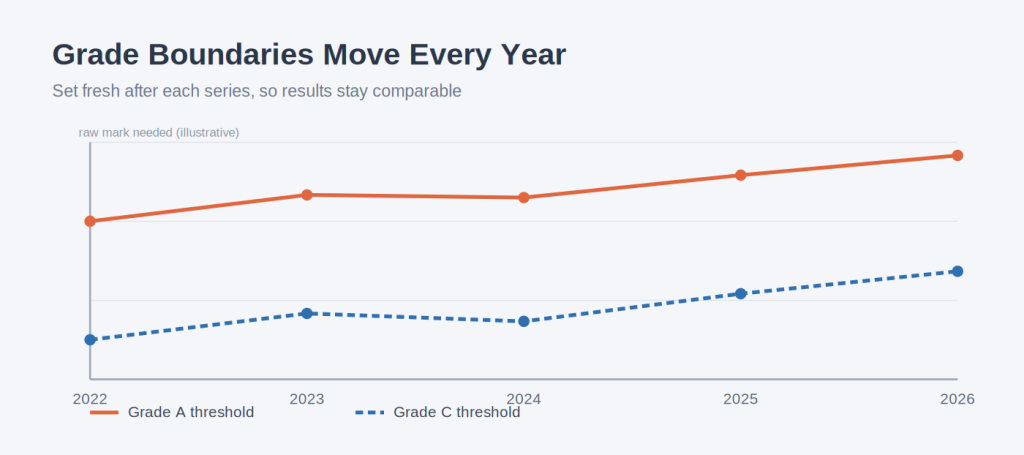
Grade boundaries are not fixed. They are set fresh after every series, and understanding why is the difference between reading your result correctly and misreading it badly.
What a Grade Boundary Actually Is
A grade boundary is the minimum raw mark required to achieve a particular grade on a particular paper in a particular series.
All three qualifiers matter.
The boundary is set after examiners have marked a sample and assessed how the cohort performed on that specific paper. If the paper was harder than intended, boundaries come down. If it was more accessible, they go up.
This is not a flaw in the system. It is the mechanism that makes results comparable across years, and it exists so that students are not penalised for sitting a difficult paper. Historical boundary data across recent series, and you can see the full grade boundary data compiled by series and subject, makes the scale of the variation clearer than any single year does.
Where the Official Figures Come From
Boards publish their thresholds openly after each series.
Cambridge publishes grade threshold tables for its qualifications, showing the marks required for each grade on each component, and these are made available through Cambridge International alongside results.
Other boards publish equivalent data. The important discipline is to use the correct series, June 2026 boundaries for a June 2026 paper, not last year’s, and not an average.
The most common mistake: using last year’s boundaries to convert this year’s mock or raw score. A few marks of movement is normal, and a few marks is often the whole grade.
Why the Variation Has Been Larger Recently
Boundary movement is always present, but the last several years have seen more of it than usual.
During the pandemic, examinations were disrupted and grades were awarded through alternative arrangements. Attainment rose across most systems.
What followed was a deliberate, phased return to pre-pandemic standards. Regulators chose not to correct in a single step, because that would have unfairly penalised one cohort.
The result is that boundaries have been adjusting year on year as the system settles back toward its earlier baseline. Students today are being measured against a stricter reference point than students two or three years ago.
What This Means in Practice
Three practical consequences follow, and all three are actionable.
Mock grades are less reliable than they appear. A school converts a mock percentage into a grade using a boundary table. If that table is from an older series, the predicted grade can be materially off. Ask which series the boundaries came from.
Being close to a boundary is more common than students think. Because boundaries shift by a few marks, a large number of students sit within touching distance of the next grade. This is why reviews of marking are worth considering when a student is one or two marks short, and not worth it when they are well inside a grade.
Technique work has a disproportionate payoff. If the gap between grades is a handful of marks, the marks lost to misread command words, poor answer structure or time management are not minor. They are frequently the entire difference.
How to Use Boundary Data Properly
A few habits make this genuinely useful rather than anxiety-inducing.
Always match the series. Boundaries from the wrong series are worse than no boundaries at all, because they produce false confidence.
Look at several years together rather than one. The range tells you more than any single figure.
Work at component level, not subject level. Boundaries are set per paper, and a student’s position can differ sharply between components.
Treat the boundary as a target with a margin. Aiming to land exactly on it is a poor strategy when the figure moves.
If You Have Landed Just Below a Boundary
This is the situation that produces the most distress and the most poorly informed decisions, so it is worth setting out clearly.
First, establish how far below you actually are. Component marks are available through your school, and the gap is frequently smaller than assumed.
Second, understand the review options. Boards generally offer a clerical re-check, which confirms marks were added correctly, and a full review of marking, which involves a senior examiner reconsidering the marking itself.
These have different costs, different timescales and different likelihoods of success. A review is most worth pursuing when a student is within a couple of marks of a boundary, particularly on a paper with substantial extended writing where marking judgement plays a larger role.
Be aware that a review can lower a mark as well as raise it. Ask your school for an honest assessment before proceeding, and ask specifically whether they think the paper was marked harshly or simply came up short.
Third, check the deadlines immediately. Review windows and resit registration deadlines are shorter than most families expect, and both typically fall within weeks of results release.
Fourth, if a university place depends on the outcome, contact the institution directly rather than waiting. Admissions offices generally have processes for pending reviews, and they cannot apply them if nobody has told them.
What This Means for How You Prepare
Step back from the individual result and there is a broader lesson in how boundaries behave.
If grades are frequently decided by a handful of marks, then the marks that come from technique rather than knowledge are worth more attention than they typically receive.
Misreading a command word costs marks. Writing at length on a low-tariff question costs time that then costs marks elsewhere. Running out of time on the final question costs the most of all, because those marks were fully available.
None of these failures are about knowing less. They are about converting knowledge into marks under timed conditions, which is a separate skill and one that responds quickly to deliberate practice.
For a student sitting close to a boundary, which, given how boundaries are set, is a great many students, that conversion is where the grade actually lives.
The Reassurance Worth Offering
Students often interpret shifting boundaries as evidence that the system is arbitrary or unfair.
It is the opposite. Fixed boundaries would be unfair, because they would reward students who happened to sit an easy paper and punish those who did not.
The adjustment exists specifically to protect against that.
What it does mean is that a result is best understood in context: which paper, which series, and how far from the boundary. A grade on its own answers none of those questions.
And for anyone reading a result this month and feeling that a few marks decided too much, that is a fair observation, and it is exactly why the marks that come from technique rather than knowledge deserve far more attention than they usually get.