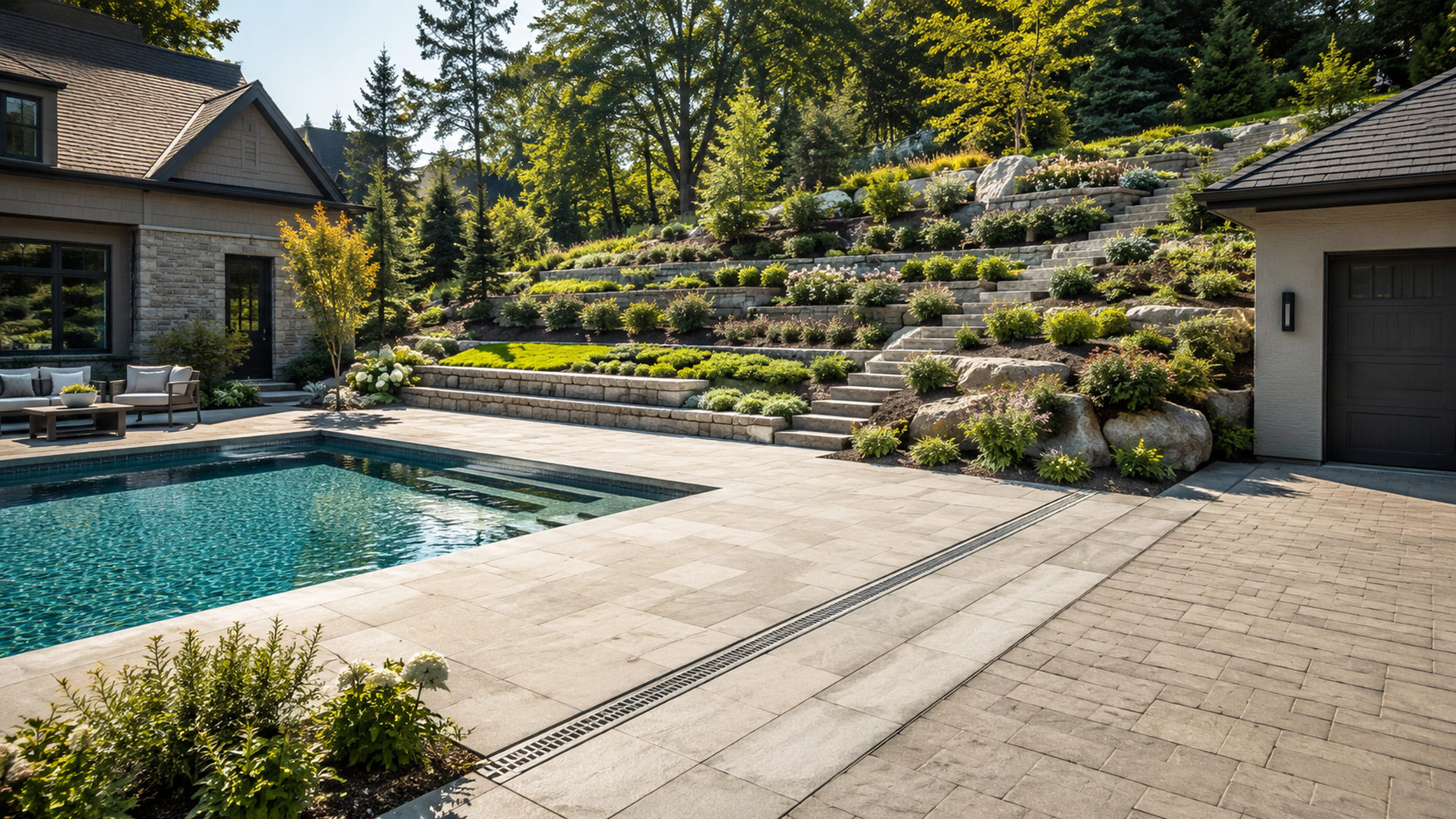
Outdoor spaces last longer when the hidden work is planned as carefully as the visible finish. A stable slope, durable terrace, clean garage floor, and clear pool all depend on choices made before stone, tile, coating, or water goes in. This maintenance-first approach helps finishes keep their look and makes upkeep easier to predict.
Weather adds pressure. Heavy rain tests drainage, soil protection, slab moisture, and pool chemistry. When design decisions include inspection access, testing, and service scope from the start, owners spend less time reacting to problems after storms.
Why Planning Now Saves Money Later
Most outdoor failures happen gradually: a slope washes out, tile lifts because slab moisture was not checked, or a pool finish clouds because chemistry drifted after a storm. For a high-end outdoor area, treat runoff control, surface preparation, and water care as one project. Poor drainage can soak a slab, a failed slab can damage interiors, and storm runoff can upset pool water. Build inspection and testing into the budget, and make vendor quotes describe what is included.
Erosion Control That Fits the Site and Design
Start with the lowest-intervention option that will work. Soft solutions include regrading, discreet drains, and planting that holds soil. Hybrid measures add geotextiles and filter layers. Hard-armour systems belong in high-energy zones, such as outfalls, culverts, and steep channels where vegetation alone is unlikely to hold.
The U.S. Army Corps of Engineers documents articulated concrete mattresses as a bank-stabilization method on the lower Mississippi, and notes that grooved surfaces can support aquatic insect larvae. Technical guidance also describes articulating concrete blocks as flexible alternatives to riprap, soil cement, gabions, and grout-filled mattresses. This matters where the protection needs to tolerate some movement instead of behaving like a rigid slab.
For broader planning, the EPA’s National Menu of Stormwater BMPs is a useful reference when you and your engineer map how runoff should move across a property. It can help frame questions about drains, outfalls, erosion protection, and routine inspection.
Where vegetation and soft engineering are not enough, hard-armour systems enter the conversation. As a regional example, an articulated concrete mattress supplier page from Earthlok outlines applications such as drainage channels, embankment protection, and culvert protection. Earthlok’s FAQ states that its concrete matting weighs about 50 to 55 kg per square metre, can be installed at up to 1,000 square metres per day, and can withstand large flows above 5.79 m/s. Treat those figures as vendor-stated details to review with your engineer, not suitability guidance for every site.
One rule matters most: never specify a hard-armour product without engineer sign-off. Products such as Earthlok’s concrete matting should be selected as part of an engineered drainage design, not as a simple catalogue item.
Floor Preparation Under Premium Outdoor Finishes
Many tile, stone, and epoxy failures in entertaining areas and garages trace back to the substrate, not the finish. If the slab is damp, dusty, weak, or uneven, the surface can show those problems later, even when the finish itself is high quality.
ASTM F710 says concrete floors receiving resilient flooring should be dry, clean, smooth, and structurally sound, and it references ASTM F1869 and F2170 for moisture assessment. ASTM F2170 recognizes in-situ relative humidity probes. In plain terms, measure slab moisture before you commit to a finish, because excess moisture can lead to debonding, finish deterioration, and microbial growth.
Good preparation usually means grinding to the right profile, levelling to tolerance, repairing defects, and using primers or moisture mitigation where readings are high. Clear scoping is what keeps this work from becoming a surprise cost late in the project.
For commercial-grade prep in South East Queensland, a floor preparation contractor page lists grinding, levelling, repairs, and pre-coating work across Brisbane and the Gold Coast. That kind of service list can help shape scoping questions and RFP checklists. Use it as an example of how commercial prep services describe scope, not as proof of performance.
Pool Care That Protects Finishes and Health
Water chemistry protects both swimmers and surfaces. The CDC recommends a pool pH of 7.0 to 7.8 and at least 2 ppm free chlorine when cyanuric acid is in use, with routine testing of chlorine and pH using a DPD kit.
Beyond testing, consistent maintenance routines prevent problems from accumulating. Regular skimming, filter cleaning, and scrubbing protect the pool’s condition and extend the life of finishes. For owners managing multiple seasonal tasks, residential pool maintenance tips can help prioritize the core procedures that protect both water chemistry and surfaces.
For public venues, the CDC advises testing disinfectant and pH at least twice per day, and hourly under heavy use. Those public-venue intervals can be a useful benchmark for a private pool during a busy weekend.
Storms deserve special attention. Runoff, debris, and dilution can push chemistry out of range quickly, so testing and correction after severe weather matter as much as any routine visit. For operators who want a formal reference, the CDC lists the 2024 fifth edition as the current Model Aquatic Health Code.
If you are comparing local options in Brisbane, an Aussie Pool Man service page details standard and commercial service packages and notes that chemical dosing is billed separately. Aussie Pool Man lists a Standard Service at $88 per service and a Minimum Service at $66 per service, with chemicals separate. When comparing providers, confirm whether testing, dosing, equipment checks, and chemicals are included before you compare prices.
Build a 12-Month Outdoor Maintenance Calendar
A calendar turns good intentions into upkeep. Tie tasks to seasonal cues and after-storm triggers rather than vague reminders.
- Pre-storm season: clear drains, inspect erosion protection, and confirm access points.
- Post-storm: inspect slopes and outfalls, and run pool triage.
- Pre-summer: apply sealers and confirm coating condition on outdoor floors.
- Quarterly: check substrates and moisture-sensitive transitions to interiors.
- Twice a year: audit water chemistry practices, especially for secondary or guest pools.
Two judgment calls come up often. Use hard-armour systems only where site energy warrants them and with engineer sign-off. If Earthlok’s matting is being considered near a culvert, ask how the underlay, anchoring, and inspection access will work. Invest in moisture mitigation when slab readings are high.
If you use outside help, record service dates, test results, and exclusions. For Brisbane-specific comparisons, pool cleaners Brisbane Australia can be treated as a regional example; for any pool service, note whether chemicals are included on the invoice so seasonal costs do not surprise you.
Frequently Asked Questions
How flat and dry should a slab be under outdoor finishes?
ASTM F710 calls for slabs that are dry, clean, smooth, and structurally sound, and directs you to ASTM F1869 and F2170 for moisture testing. ASTM F2170 recognizes in-situ RH probes and warns that excess moisture can cause debonding and finish deterioration. Test before you commit to a finish.
How often should a private pool be tested during parties or peak season?
The CDC advises public venues to test disinfectant and pH at least twice daily, and hourly under heavy use. During a busy weekend, a private pool benefits from a similar cadence: keep pH at 7.0 to 7.8 and free chlorine at or above 2 ppm when cyanuric acid is present.
