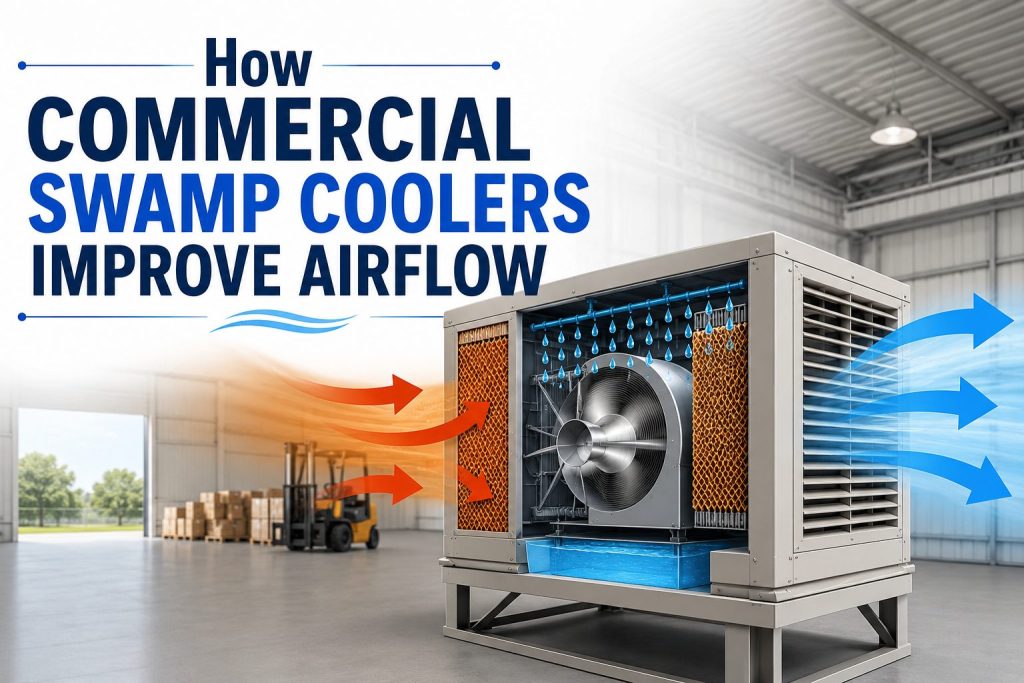
Airflow plays a major role in keeping commercial buildings comfortable, productive, and safe during warm weather. In large facilities, heat can build up quickly due to high ceilings, machinery, foot traffic, open doors, and limited ventilation. Traditional air conditioning is not always practical for these environments, especially when cooled air escapes through loading bays, service doors, or open work areas. A commercial swamp cooler offers an efficient way to improve airflow while reducing indoor temperatures through evaporative cooling. By moving large volumes of fresh air through a space, these systems can help create a cooler and more breathable environment for employees, customers, and equipment.
What Is a Commercial Swamp Cooler?
A commercial swamp cooler is an evaporative cooling system designed for larger spaces such as warehouses, workshops, gyms, event venues, restaurants, auto shops, agricultural buildings, and manufacturing facilities. It cools air by pulling warm outdoor air through water-saturated cooling pads. As the air passes through the pads, water evaporates and absorbs heat, creating cooler air that is pushed into the building by a powerful fan. Unlike refrigerated air conditioning, a swamp cooler does not rely on compressors or chemical refrigerants. Instead, it uses water, airflow, and evaporation to deliver cooler fresh air.
The key difference between a commercial swamp cooler and a residential unit is capacity. Commercial models are built to move higher volumes of air and withstand heavier use. They may be portable, wall-mounted, rooftop-mounted, or connected to ductwork, depending on the size and layout of the facility. Many are designed for continuous operation during hot months. This makes them useful for spaces where steady airflow is just as important as temperature reduction.
Why Airflow Matters in Commercial Spaces
Poor airflow can make a building feel hotter than the actual temperature. When air becomes stagnant, heat, humidity, odors, dust, and fumes can linger in work areas. Employees may feel tired, uncomfortable, or less focused when warm air does not move efficiently through the space. In customer-facing environments, poor airflow can also affect the overall experience and make visitors less likely to stay. A strong airflow strategy helps keep indoor air moving, fresh, and more comfortable.
Commercial buildings often have areas where heat collects, especially near machinery, kitchens, loading docks, storage racks, or upper levels. Without enough air movement, these hot zones can become uncomfortable and difficult to work in. Fans alone may circulate warm air without lowering the temperature. A commercial swamp cooler improves airflow while also cooling the incoming air, which makes the air movement more effective. This combination can help reduce heat stress and create a more balanced indoor environment.
How Evaporative Cooling Supports Better Air Movement
A commercial swamp cooler improves airflow by continuously drawing in outdoor air, cooling it through evaporation, and pushing it into the building. This process creates positive air movement that helps displace hot, stale indoor air. As fresh, cooled air enters, warmer air exits through doors, vents, windows, exhaust fans, or louvers. The result is a steady exchange of air rather than the repeated circulation of the same indoor air. This is especially helpful in buildings that already need regular ventilation.
Evaporative cooling works best when air has a clear path through the space. Incoming air should move across work areas and then exit through planned openings. When this airflow path is properly designed, the system can help reduce stagnant zones and improve comfort throughout the facility. It can also help remove odors, dust, and airborne particles more effectively than simple recirculation. For many commercial spaces, this fresh-air approach is one of the biggest advantages of using a swamp cooler.
Fresh Air Versus Recirculated Air
Traditional air conditioning typically cools and recirculates indoor air. This can be effective in sealed buildings, but it may not be ideal for facilities with open doors, fumes, dust, or heavy equipment traffic. A commercial swamp cooler takes a different approach by bringing in fresh outside air and pushing stale indoor air out. This constant air replacement can be valuable in workplaces where ventilation is necessary for comfort and safety. It also helps prevent air from feeling stale or trapped.
Fresh-air cooling can be especially helpful in spaces such as auto repair shops, warehouses, commercial kitchens, greenhouses, and manufacturing areas. These facilities often need both temperature control and regular air exchange. Because swamp coolers are designed to work with ventilation, they can perform well in spaces that are not fully sealed. Open doors and exhaust points are not always a problem because they help air move through the building. This makes evaporative cooling a practical option for many real-world commercial environments.
Benefits of Improved Airflow
Improved airflow can provide several advantages beyond lowering the temperature. When air moves consistently, employees are less likely to feel trapped in hot, stagnant conditions. Better airflow can also help reduce moisture pockets, odors, and airborne contaminants when the building is properly ventilated. In spaces with equipment or stored goods, air movement can help reduce localized heat buildup. A commercial swamp cooler supports these benefits by combining high-volume airflow with evaporative cooling.
Key benefits may include:
- Better circulation across large or open spaces
- Reduced hot spots in work areas
- More fresh air entering the building
- Less stagnant air around equipment and storage zones
- Improved comfort for employees and visitors
- Potentially lower cooling costs compared with refrigerated air conditioning
- Better support for facilities with open doors or frequent air exchange
These advantages can have a direct impact on daily operations. Comfortable workers are often more productive and less affected by heat-related fatigue. Customers and guests may also spend more time in spaces that feel cooler and better ventilated. For facility managers, improved airflow can reduce complaints and support a more consistent indoor environment. When paired with good building ventilation, a swamp cooler can be a valuable part of a broader cooling strategy.
Where Commercial Swamp Coolers Work Best
A commercial swamp cooler works best in hot, dry climates where outdoor air has low humidity. Dry air can absorb more moisture, which allows evaporation to happen more effectively and creates a stronger cooling effect. Businesses in arid and semi-arid regions often see the best results from evaporative cooling. These systems can be especially effective in large buildings where refrigerated air conditioning would be expensive to operate. In the right climate, the cooling and airflow benefits can be significant.
In humid areas, swamp coolers may still move air well, but the cooling effect is usually limited. When the air already holds a lot of moisture, it cannot absorb much additional water from the cooling pads. This means the temperature drop may be smaller and the indoor environment may feel damp if ventilation is poor. Before choosing a system, business owners should review local humidity levels and seasonal weather patterns. The best results come from matching the cooling method to the climate and the building design.
Choosing the Right Size and Placement
Sizing is critical when selecting a commercial swamp cooler. The unit must move enough air to support the size and layout of the building. Airflow capacity is commonly measured in cubic feet per minute, or CFM. A larger space, higher ceiling, or hotter work environment will usually require more CFM. If the unit is too small, it may not provide enough air movement to make the space comfortable.
Placement is just as important as size. The cooler should be positioned so that fresh, cooled air travels through occupied areas before exiting the building. Obstacles such as storage racks, walls, machinery, or closed doors can block airflow and reduce performance. In some cases, multiple units may be needed to serve different zones. A well-planned layout can help prevent hot spots and make the most of the cooler’s airflow capacity.
Features That Support Stronger Airflow
Not all commercial swamp coolers are designed the same way. Some are built for spot cooling, while others are made for large-scale air movement across entire facilities. The right model should match the demands of the space and the way people use it. Fan strength, cooling pad quality, housing durability, and control options all affect performance. A strong commercial swamp cooler should deliver reliable airflow while being easy to operate and maintain.
Helpful features include:
- High-CFM fan or blower capacity
- Variable-speed controls
- High-efficiency cooling pads
- Durable, corrosion-resistant housing
- Easy-access panels for cleaning and maintenance
- Automatic water level controls
- Portable or mounted installation options
- Oscillating airflow for spot cooling
- Compatibility with thermostats or smart controls
These features can help improve comfort and simplify day-to-day use. Variable-speed controls allow facility teams to adjust airflow based on heat levels, occupancy, and weather. High-quality cooling pads can improve evaporation and support a better temperature drop. Durable construction is important for demanding environments with dust, equipment, and frequent use. Easy maintenance access also helps keep airflow strong over time.
FAQ About Commercial Swamp Coolers
How does a commercial swamp cooler improve airflow?
It pulls in outdoor air, cools it through evaporation, and pushes it through the building. This creates steady air movement and helps move hot, stale air out.
Does a commercial swamp cooler work better than fans?
In many dry climates, yes. Fans only move existing air, while a swamp cooler moves air and lowers its temperature.
Do commercial swamp coolers need ventilation?
Yes. The building needs vents, doors, windows, exhaust fans, or louvers so warm indoor air can exit as cooled air enters.
Can a swamp cooler reduce hot spots?
Yes, if it is properly sized and positioned. Good airflow planning helps direct cooled air toward problem areas.
Will a commercial swamp cooler increase humidity?
Yes, it adds moisture to the air. Proper ventilation helps prevent humidity buildup and keeps the space comfortable.
Where should a commercial swamp cooler be placed?
It should be placed where it can draw in fresh outdoor air and push cooled air across occupied areas. The best location depends on the building layout and airflow path.
Maintaining Airflow Over Time
A commercial swamp cooler can only improve airflow if it is properly maintained. Cooling pads should be inspected and cleaned or replaced as needed because clogged pads can restrict airflow. Water distribution lines should be checked to make sure pads stay evenly saturated. Fans, belts, pumps, filters, and vents should also be inspected during the cooling season. Regular maintenance helps the system deliver consistent airflow and prevents small issues from becoming costly repairs.
Facility managers should also review the building’s ventilation setup throughout the year. Changes in storage layout, equipment placement, or door usage can affect how air moves through the space. If new hot spots appear, the cooler may need to be repositioned or supported with additional exhaust. Keeping pathways clear helps cooled air travel farther and work more effectively. With the right system, proper placement, and routine care, a commercial swamp cooler can provide dependable airflow and comfort for many commercial environments.