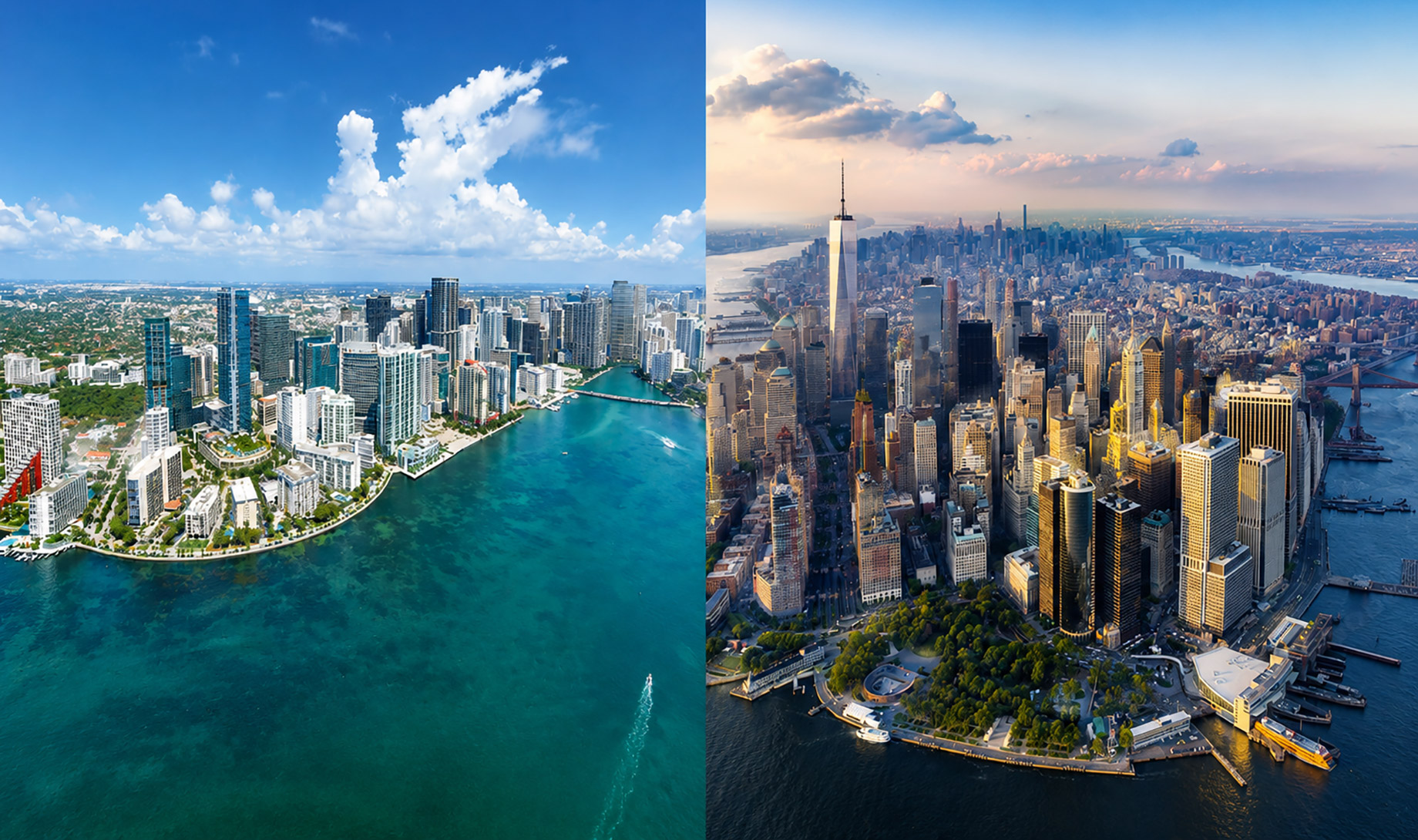
Few cities define high-end real estate in the United States the way Miami and New York do. Both attract international buyers, both carry global name recognition, and both sit at the top of the conversation when serious buyers are looking for a significant property in the US. But the two markets operate on very different terms, and understanding those differences matters whether you are buying, selling, or tracking where the top of the market is heading.
Miami: A Market Built on Mobility and Climate
Miami’s rise as a genuine global luxury destination accelerated sharply in the early 2020s and has not meaningfully reversed. What drove it was a combination of factors that compound rather than simply add: favorable tax environment, year-round climate, proximity to Latin America, and a growing concentration of financial and technology firms relocating from higher-cost states.
The buyer profile in Miami reflects this. A significant portion of transactions at the upper end involve international buyers, particularly from Latin America and Europe, for whom Miami functions as both a primary residence and a strategic asset. The market is genuinely global in a way that few US cities outside New York can claim.
What Shapes Demand in the Luxury Real Estate Market in Miami
Demand at the top of the Miami market is less dependent on local economic conditions than most. When a buyer’s wealth is denominated in another currency and their primary concern is a stable, well-located asset in a politically neutral jurisdiction, local employment numbers matter less than they would in a more domestically driven market.
This creates conditions where certain properties hold value through cycles that affect other segments more severely. It also creates a market where international visibility is not a nice-to-have but a core part of how the finest properties find their buyers. The right purchaser for a significant waterfront estate in Miami may be in São Paulo, London, or Zurich. A local listing strategy simply does not reach them.
Inventory at the true upper end remains constrained. Waterfront positions with genuine privacy are finite, and new supply at that level is limited by geography rather than development appetite. Scarcity at this specific tier continues to support values in a way that broader market softness has not fully offset.
New York: Depth, Density, and Enduring Demand
New York occupies a different position in the global luxury market. The market is deeper, meaning more transactions happen at significant price points, and the buyer pool is more diverse in its composition. Finance, law, media, technology, and international wealth all converge in a city where the finest properties are genuinely scarce relative to the demand that exists for them.
The New York market is also more internally segmented than it appears from the outside. Downtown and uptown behave differently. Co-ops and condominiums carry different buyer profiles and different friction points in the transaction process. A penthouse in a new Billionaires’ Row development competes with a pre-war Fifth Avenue apartment on entirely different terms, despite similar price tags.
Reading the Luxury Real Estate Market in New York
What makes New York useful as a broader market indicator is precisely its transaction depth. Because enough activity happens at the upper tier, patterns are more legible than in thinner markets. When sentiment shifts among high-net-worth buyers globally, New York tends to reflect it relatively quickly and relatively clearly.
For sellers, this depth is both an advantage and a challenge. There are more qualified buyers than in most markets, but there are also more competing properties. Achieving the best outcome in New York requires a level of market positioning and buyer reach that a standard listing rarely delivers on its own. The properties that perform well are the ones that reach every serious buyer, not just those who happen to be searching locally.
What Both Markets Share at the Top
Despite their differences in character and composition, Miami and New York share a few defining characteristics when it comes to how exceptional properties actually trade.
International buyers are active in both. The finest properties in either city are rarely purchased by someone who discovered them through a domestic portal. Cross-border buyer reach is not incidental at this level; it is central to achieving the right outcome.
Pricing is also genuinely opaque in both markets once you move above a certain threshold. Comparables thin out quickly, standard valuation methods lose their precision, and the gap between asking price and achievable price can be significant in either direction. This is where a structured auction process offers its clearest advantage: rather than relying on an estimated value, competitive bidding establishes what the market will actually pay, with qualified buyers competing in real time.
Concierge Auctions has operated across both markets for nearly two decades, bringing a global buyer network and a defined process to properties that sit above what conventional market data can reliably price. For anyone serious about either market, understanding how the top of it actually operates is worth doing well before a decision needs to be made.
