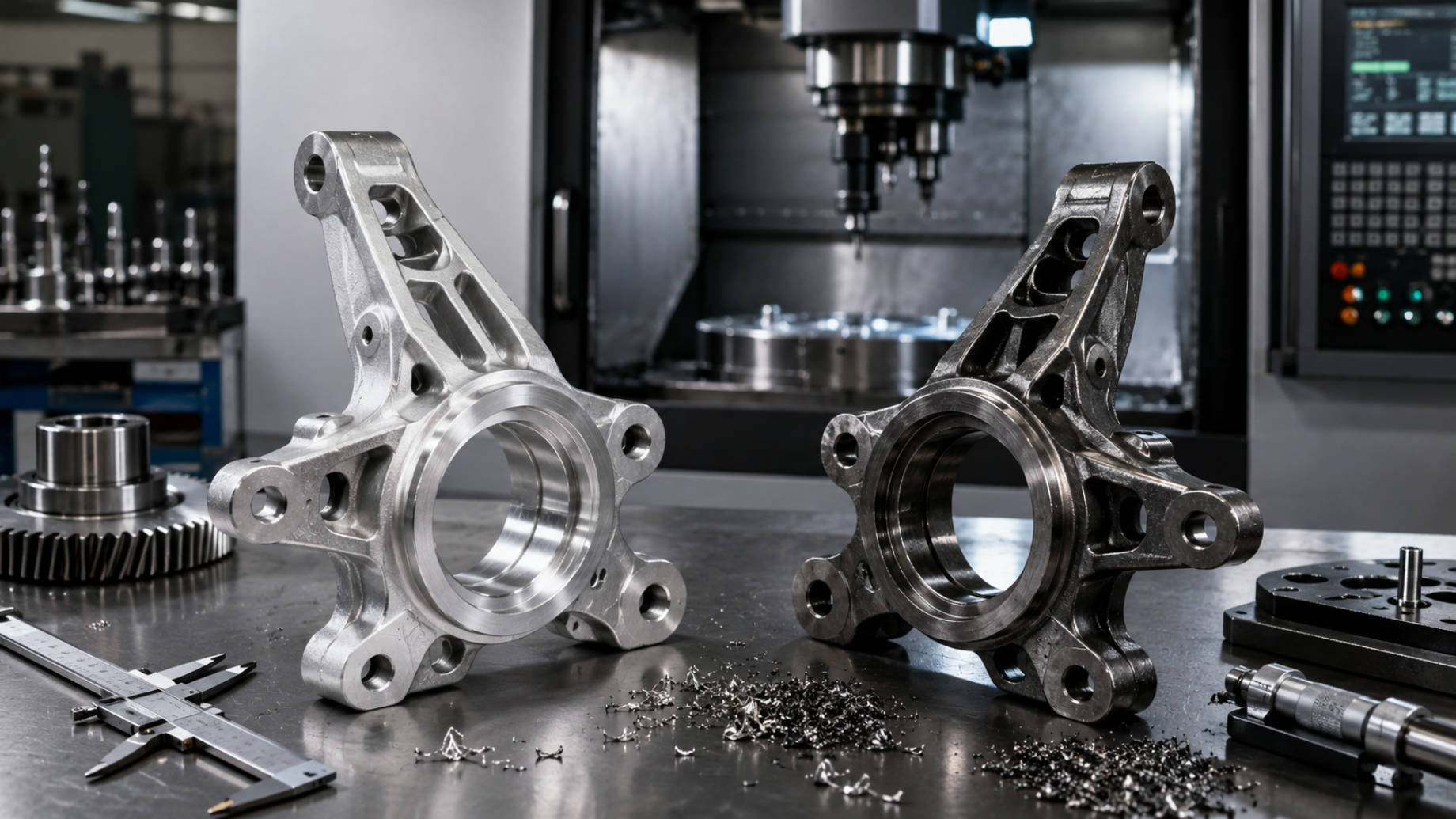
Picking the wrong metal costs you money long after the part leaves the shop. That is the real stakes behind aluminum versus steel car parts machining. Both metals work well in CNC machining, but they fail in different ways under load, heat, and high-volume production. Aluminum runs faster on the machine and saves weight. Steel holds up under stress that would deform softer metal. The right choice depends on the part, the budget, and the performance target.
This guide breaks down how each material behaves in automotive parts manufacturing, so you can match the metal to the job instead of guessing.
What Makes Aluminum and Steel Different for CNC Machining?
On paper, both metals cut cleanly. In practice, they respond to tools, heat, and speed in very different ways.
Aluminum is soft, light, and conducts heat well. It clears chips fast and lets you run higher spindle speeds. Steel is dense and hard. It resists wear but pushes back against the cutter, which slows feed rates and heats up tooling.
The core differences come down to a few measurable traits:
- Density: Aluminum weighs about one-third as much as steel.
- Hardness: Carbon steel and stainless steel resist deformation far better.
- Thermal behavior: Aluminum pulls heat away from the cut zone quickly.
- Tool wear: Steel dulls cutting edges faster than aluminum alloys.
Material science drives every downstream decision here. Once you know how the metal reacts, the rest of the process gets easier to plan.
Weight and Performance Considerations
Weight looks like a simple spec until you connect it to fuel economy, handling, and range. Then it becomes a design priority.
Aluminum supports lightweight vehicle design directly. Less mass means better acceleration, shorter braking distance, and lower emissions. Electric vehicles depend on this. Every kilogram saved extends battery range.
Steel adds mass, but that mass is not always a flaw. In crash structures and load-bearing parts, weight and rigidity work together. A heavier component can absorb impact energy that aluminum would not handle as well.
Here is the trade-off in plain terms:
- Choose aluminum when you want speed, efficiency, and reduced fuel use.
- Choose steel when stiffness and impact resistance matter more than mass.
Vehicle performance is rarely about one metal winning outright. It is about placing each metal where its strengths count.
Strength and Durability Comparison
Aluminum gets dismissed as the “weak” metal. That reputation is only half true.
Pound for pound, some aluminum alloys rival steel in strength-to-weight ratio. But raw strength still favors steel. Carbon steel handles high tensile loads and repeated stress without cracking. Stainless steel adds toughness plus resistance to heat and rust.
For parts that face constant force, steel wins on fatigue life. Think crankshafts, gears, and suspension links. These steel automotive components survive millions of cycles.
Aluminum holds up well in lower-stress roles. It performs reliably as long as the load stays within its limits. Push it past that point, and it deforms faster than steel. That is why automotive engineering teams test fatigue thresholds before committing to a material.
Machining Efficiency and Production Speed
A part that machines slowly drains your shop schedule. This is where aluminum pulls ahead.
Aluminum cuts fast. It allows aggressive feed rates, higher RPMs, and shorter cycle times. Tools last longer because the metal is soft. That combination boosts manufacturing efficiency and lowers cost per unit.
Steel demands more from the process. It needs slower speeds, stronger tooling, and frequent tool changes. Cycle times stretch, and tool wear adds expense.
Modern CNC manufacturing narrows the gap. CAD software designs the geometry, CAM software plans the toolpaths, and industrial automation keeps the spindle running with tight repeatability. Shops offering precision machining services, such as AIXI CNC Machining Manufacturing Services, use these workflows to hold consistent manufacturing tolerances across both metals. Still, when raw throughput drives the decision, aluminum stays the faster option.
Corrosion Resistance and Maintenance
Rust quietly destroys parts that looked fine on day one. Corrosion resistance often decides which metal survives the long haul.
Aluminum forms a natural oxide layer that protects it from rust. It resists corrosion without coatings, which suits exposed parts and humid climates. That makes CNC aluminum parts a strong pick for components facing moisture or road salt.
Carbon steel rusts easily. It needs paint, plating, or galvanizing to stay protected. Skip that step, and the part degrades fast. Stainless steel solves this with chromium content, but it costs more and machines slower.
Maintenance follows the same logic:
- Aluminum: Low upkeep, naturally corrosion-resistant.
- Carbon steel: Needs protective finishes to avoid rust.
- Stainless steel: Durable and clean, but pricier to produce.
For long-term reliability in wet conditions, aluminum reduces maintenance headaches.
Cost Factors in Automotive Manufacturing
Material price tells only part of the story. The full cost shows up across the whole production run.
Steel usually costs less per kilogram than aluminum. For high-volume runs, that gap adds up fast. But steel’s slower machining and higher tool wear push processing costs back up.
Aluminum costs more as raw stock. It pays some of that back through faster cycles, longer tool life, and lighter shipping weight. For custom machined parts in smaller batches, aluminum often lands competitive on total cost.
Weigh these factors together:
- Raw material: Steel is cheaper upfront.
- Machining time: Aluminum runs faster and saves labor.
- Tooling: Steel wears tools harder.
- Volume: High volume favors steel; complex low-volume work often favors aluminum.
OEM suppliers run these numbers per part, not per metal. The cheapest material on the invoice is not always the cheapest part to produce.
Which Material Is Better for Different Car Parts?
There is no universal winner. The smart move is matching each metal to the part it serves best.
Aluminum works best for:
- Engine blocks and cylinder heads
- Wheels and suspension housings
- Transmission cases and brackets
- EV battery enclosures and lightweight panels
Aluminum’s weight savings and corrosion resistance shine in these roles. A specialized CNC Aluminum Machining Parts Manufacturer can hold tight tolerances on these parts while keeping cycle times short.
Steel works best for:
- Crankshafts, gears, and camshafts
- Chassis frames and crash structures
- Fasteners and high-stress mounts
- Drivetrain components under heavy load
Steel automotive components handle force and fatigue that aluminum cannot match. Most vehicles use both metals together, placing each where its strengths pay off.
Conclusion
The aluminum versus steel car parts machining debate has no single answer, and that is the point. Aluminum gives you lighter parts, faster machining, and built-in corrosion resistance. Steel gives you strength, fatigue life, and lower raw material cost. The best choice depends on the part’s job, the production volume, and the performance target.
Start with the function. A suspension housing and a crankshaft have different demands, so they call for different metals. Match the material to the load, the environment, and the budget. Do that, and your CNC machining process delivers parts that perform well and last in real automotive use.
