In contemporary home design, architecture is often the first layer to command attention. Clean lines, open layouts, and carefully considered sightlines tend to define how a home is first perceived. Yet even the most resolved architectural space remains incomplete until it begins to support the rhythms of daily life.
It is within this shift from structure to inhabitation that furniture takes on its most meaningful role. The strongest pieces do more than occupy space. They help determine how a home is experienced, shaping how people gather, rest, work, and move through it over time.
A Shift Toward Intentional Living
This reflects a broader evolution in modern living. Minimalism was once widely understood as reduction. Increasingly, it is being reinterpreted as restraint with purpose. Scandinavian influence has played an important role in this shift, bringing a greater emphasis on warmth, usability, and light into domestic interiors. Mid-century modern design has remained equally relevant for its ability to balance sculptural form with everyday practicality.
Together, these influences have contributed to an interior language that values clarity, simplicity, and continuity over visual excess. Within this context, the idea of a return to the essential has become a useful guiding principle. It suggests a reconsideration of what is truly necessary in a home, not in terms of quantity, but in terms of purpose, proportion, and lived experience.
From this perspective, materials, textures, and scale begin to carry more weight than decoration alone. The result is an interior approach that feels composed, tactile, and quietly intentional.
The Living Room as a Spatial Anchor
The living room is often where this philosophy becomes most visible. Here, furniture begins to establish both the visual and emotional tone of the home.
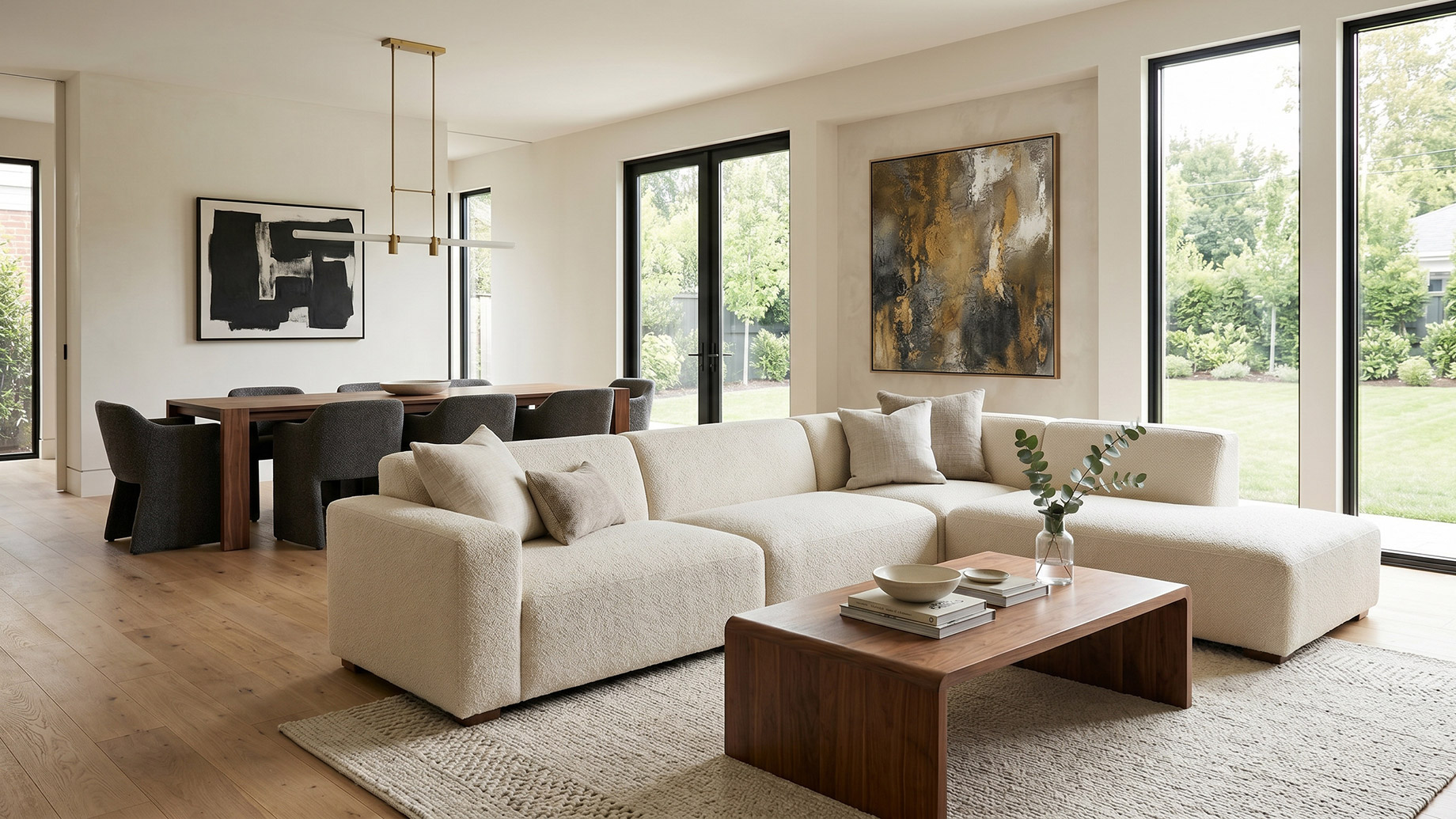
A well-proportioned sectional, for example, does more than provide seating. Its low, balanced silhouette can create a sense of openness while still giving the room structure. In this way, comfort becomes part of the room’s architecture rather than an afterthought layered onto it.
Textural upholstery also plays a more deliberate role in these spaces. Bouclé, refined linen, and other weightier woven fabrics add depth without overpowering the room. They soften geometry, introduce warmth, and help the interior feel more settled.
Comfort, in this setting, is not separate from design integrity. Materials such as powder-free foam cores support form retention while still adapting to the body, allowing seating to feel structured yet accommodating over time. That balance between support and softness reflects a broader understanding of refinement: not only how something looks, but how convincingly it lives.
Subtle Layers of Material and Form
Beyond seating, pieces such as coffee tables and media units help complete the room’s internal balance. Though often placed near the visual centre of the living area, their role is rarely to dominate. More often, they provide quiet architectural weight, helping the room feel resolved.
Material selection is central to that effect. Wood veneer, for instance, introduces natural variation while maintaining tonal consistency. A restrained palette allows timber, fabric, and stone to define atmosphere through texture and surface quality rather than through contrast alone.
This is one reason contemporary interiors often feel calmer, even when they are materially rich. The room is not built through visual competition, but through measured relationships between form, finish, and proportion.
The Dining Space and the Ritual of Living
The dining area extends this logic into a different register of daily life. If the living room is often about pause and gathering, the dining space is more closely tied to ritual, interaction, and continuity.
A dining table acts as a natural anchor. It is where time slows slightly, where routines become visible, and where the social dimension of the home takes shape. Proportion and material harmony matter especially here. A table with clean lines and grounded presence can establish clarity, while dining chairs reinforce continuity through silhouette, texture, and finish.
Upholstered seating in the dining area also plays a subtle but important role. Repetition in material language across living and dining spaces helps the home feel unified rather than segmented. In that sense, cohesion is not only visual. It shapes how one room leads into another.
Calm Luxury as a Design Philosophy
The tactile quality of materials contributes to a quieter interpretation of luxury. Rather than relying on spectacle, this approach places value on how surfaces respond to light, how finishes age, and how textures interact within a room.
Carefully engineered materials, such as 0.4 to 0.6 mm veneer and high-GSM textiles, help maintain both consistency and longevity. Their value lies not simply in specification, but in the way they contribute to an interior that feels grounded, stable, and easy to live with.
This is where the idea of calm luxury becomes useful. It describes a kind of richness that is sensed through restraint, material confidence, and long-term usability rather than overt display.
A System That Supports the Experience
Brands working within this warm modern design language tend to treat furniture less as standalone objects than as part of a broader living system. What matters is not only whether a sofa, chair, or table looks resolved on its own, but whether it contributes to a more coherent domestic environment.
Louxas can be read within this framework. Its collections suggest an interest in design cohesion, material consistency, and the relationship between individual pieces across the home. The emphasis appears to be less on isolated statement-making and more on creating furniture that supports composed, livable interiors.
The same logic increasingly extends beyond aesthetics. In contemporary retail, the experience of furniture is shaped not only by how it looks in a room, but by how easily it enters daily life. That is why ease of use has become more important. Products that arrive ready to use, or require very little assembly, reduce one of the more common friction points in furniture ownership.
Louxas responds to this by rethinking not just design, but delivery. By offering living room and dining room furniture that arrives fully assembled out of the box, the brand removes one of the most persistent points of friction associated with large-scale interiors. There is no need for on-site installation, adjustment, or prolonged setup, allowing spaces to take shape immediately and without interruption.
This approach reflects that when furniture supports both aesthetic cohesion and a seamless transition into daily use, it contributes to a more complete and uninterrupted living experience. Seen in that light, the more relevant development is not service language for its own sake, but the reduction of distance between design intention, delivery, and everyday use.
Revamping Spaces of Focus and Rest
Bedrooms and home offices follow many of the same principles, even if the emphasis shifts toward restoration and concentration. A carefully chosen bed frame or desk helps support the function of the room while preserving visual calm.
Soft textures, subdued tones, and clear sculptural forms all contribute to an atmosphere conducive to rest or focus. These spaces rely less on visual complexity than on subtle control, creating conditions in which the mind and body can settle more easily.
Here again, furniture helps translate architecture into experience. It gives rhythm to the room without over-defining it, allowing the space to remain both purposeful and quiet.
A Quiet Evolution in Modern Living
Modern residential design continues to move toward greater clarity. Within that evolution, design-led furniture plays a defining role. It transforms architecture into experience, structure into lifestyle, and space into something more personal and more usable.
When approached with purpose, furniture does more than complete a room. It shapes how the home is actually lived in. That may be why the most compelling contemporary interiors feel neither heavily styled nor overly reduced. Instead, they feel collected in the truest sense: considered, connected, and capable of supporting everyday life with calm confidence.
Discover how these design principles come together in practice by exploring
Louxas’s modern furniture collections at www.louxas.com or following their spatial inspirations on Instagram @louxas_official.
