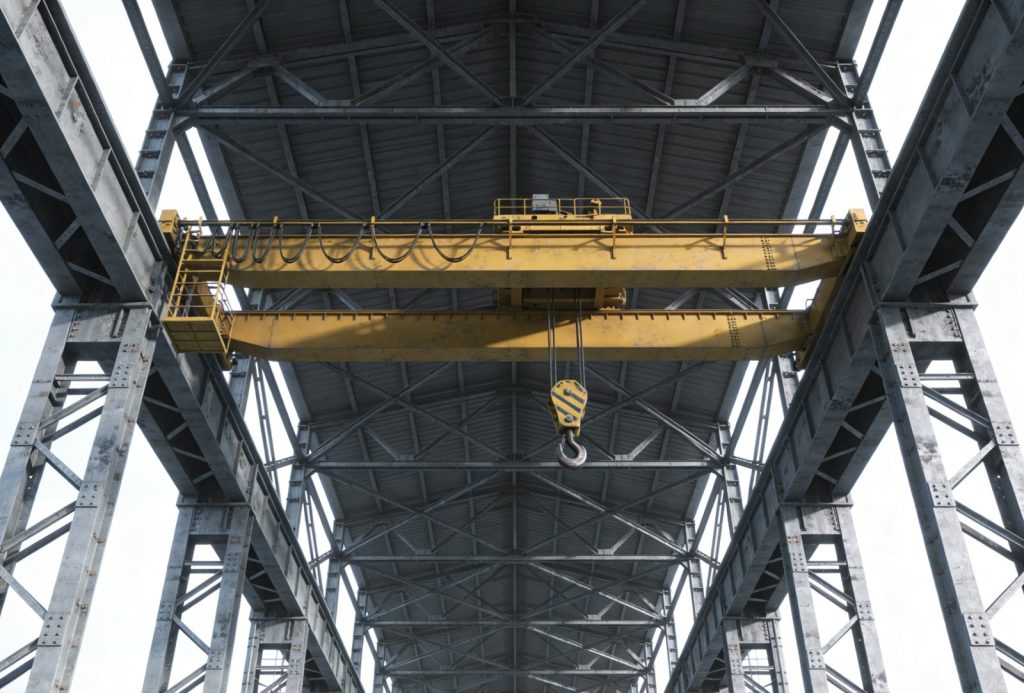
Steel structure warehouses are widely used in modern industrial storage due to their large span, high space utilization, and strong durability. Unlike traditional concrete buildings, steel structures offer greater design flexibility, faster construction cycles, and easier modification—making them ideal for accommodating heavy-duty equipment such as a bridge crane.
As industries like manufacturing, logistics, and construction expand, installing a bridge crane in steel structure warehouses has become a standard solution. This setup streamlines hoisting, moving, and stacking of materials, reduces labor costs, and improves operational efficiency.
When planning such installations, selecting a reliable crane that matches the warehouse specifications is crucial. Engaging a professional manufacturer such as WYCRANE ensures the crane’s capacity, span, and operational features are fully compatible with the steel structure. Early involvement of experts helps prevent miscalculations, ensures compliance with safety standards, and reduces long-term maintenance risks.
Pre-Installation Inspection and Warehouse Evaluation
Before installation, a comprehensive structural inspection is essential to guarantee safety and compliance. Key focus areas include:
- Steel Material and Component Check: Verify the grade (e.g., Q355 or Q235) and inspect beams, columns, and roof trusses for corrosion, bending, cracks, or other damages.
- Connection Integrity: Confirm that all bolts and welds are secure and meet the required industrial standards.
- Foundation Assessment: Ensure foundations can safely support the additional crane loads without excessive settlement.
For warehouses older than 10 years, assess component aging and potential corrosion. Reinforcement may be required using techniques such as:
- Enlarging beam sections
- Adding auxiliary supports or bracing
- Replacing critical components with higher-strength steel
Such measures ensure the warehouse can withstand the increased load from crane operations.
Core Load Calculation for Bridge Crane Installation
Accurate load calculation is vital for crane safety and structural integrity. Loads can be divided into four main categories:
- Dead Load
The dead load is the static weight of the crane, including bridge girders, trolley, hoist, and electrical components. It is constant and forms the foundation for subsequent load calculations. Incorrect estimation of dead load may result in undersized beams or overloaded columns, compromising safety.
2. Live Load
The live load is the maximum weight of goods to be lifted. Accurate estimation is critical:
- Heavy machinery warehouses may require 50–100 tons
- Logistics warehouses for lighter materials may require 5–10 tons
A 10–20% safety margin is typically added to account for uneven load distribution or temporary overload.
3. Dynamic Load
Dynamic load arises from crane movements—starting, stopping, accelerating, decelerating, or sudden braking. Expressed via a dynamic load coefficient (1.1–1.3), this factor accounts for trolley speed, lifting speed, and structural rigidity. Faster trolley speeds or heavier loads increase dynamic forces on beams and columns.
For example, a crane moving at 10 m/min may require a coefficient of 1.1, while one operating at 20 m/min may need 1.2–1.3.
4. External Loads
Other loads include:
- Wind load: Strong horizontal forces can sway beams and columns, especially in large-span warehouses..
- Snow load: Accumulated roof snow can significantly increase vertical load.
- Temperature effects: Expansion/contraction of steel components, mitigated with expansion joints.
These factors are particularly important for long-span warehouses or regions with extreme weather.
Structural Design Considerations
Steel Beam Design
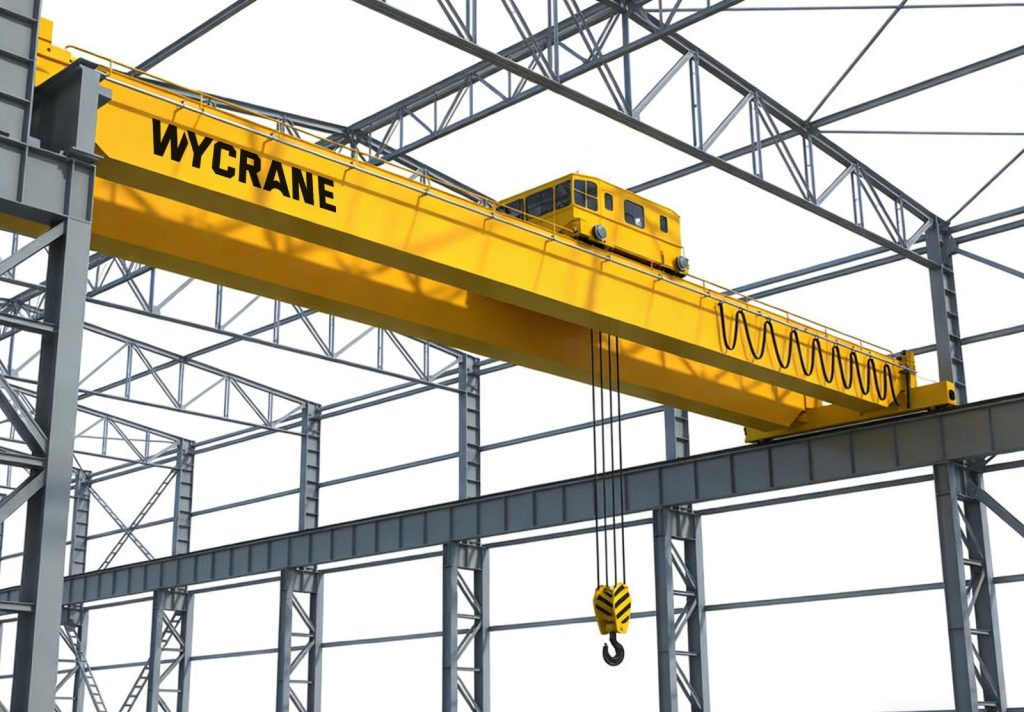
Bridge crane runways are mounted on steel beams, which must resist bending, shear, and torsion.Design considerations include:
- Bending, shear, and torsional strength: Beams must withstand combined loads.
- Beam type selection: I-beams, H-beams, or box-section beams are preferred for spans over 20 meters.
- Firm connections: Welding or high-strength bolts prevent displacement during operation.
- Anti-slip pads: Optional for smooth trolley travel.
Steel Column and Foundation Design
Columns transfer vertical loads and resist lateral forces. Key design aspects:
- Adequate compression strength and height-to-width ratio
- Bracing systems (cross or diagonal) to prevent buckling
- Foundations sized for total load, including dynamic effects
For weak soils, pile foundations may be used to transfer load to deeper, more stable layers. Concrete reinforcement ensures the foundation can handle upward forces from crane braking or sudden stops.
Load Distribution Optimization
Careful attention to load distribution reduces stress concentrations:
- Align crane runway beams with primary warehouse columns
- Avoid long unsupported spans by adding intermediate supports if necessary
- Evaluate vibration patterns to minimize fatigue on structural components
Case Example: 10-Ton Bridge Crane Installation
Consider a 35m x 18m steel warehouse planned to house a 10-ton crane with a 22-meter span. Key steps:
- Beam selection: I-beams sized for combined dead, live, and dynamic loads
- Column reinforcement: Diagonal bracings and concrete encasement for heavy load-bearing
- Dynamic factor application: 1.1–1.2 based on crane speed
- Finite Element Analysis (FEA): Stress verification and deflection limits
This ensures structural stability, safe crane operation, and long-term reliability.
Safety and Compliance
All designs must follow international and national standards:
- AISC Steel Manual (USA)
- GB 50017 Code for Design of Steel Structures (China)
- CMAA Specifications for overhead crane safety
Professional supervision is essential. Structural engineers and crane installation technicians can verify calculations, implement modifications, and monitor installation. Regular maintenance, inspection of bolts, welds, and moving components is critical to extend service life and prevent accidents.
Additional Recommendations for Optimal Crane Performance
- Install limit switches and overload protection systems to prevent accidents.
- Use vibration dampers if crane operations generate oscillations in long-span warehouses.
- Plan for future load increases or warehouse modifications, ensuring flexibility in beam and column design.
- Implement a preventive maintenance schedule including lubrication, wear monitoring, and periodic structural assessments.
Conclusion
Installing a bridge crane in a steel structure warehouse requires careful planning, precise load calculation, and scientific structural design. By conducting thorough inspections, accounting for dead, live, dynamic, and external loads, and adhering to standards, enterprises can ensure safe, efficient, and reliable operations.
Investing in professional design, consulting providers like WY CRANE, and maintaining rigorous inspection routines not only improves material handling efficiency but also reduces the risk of accidents, equipment failure, and costly repairs—providing long-term economic and operational benefits.