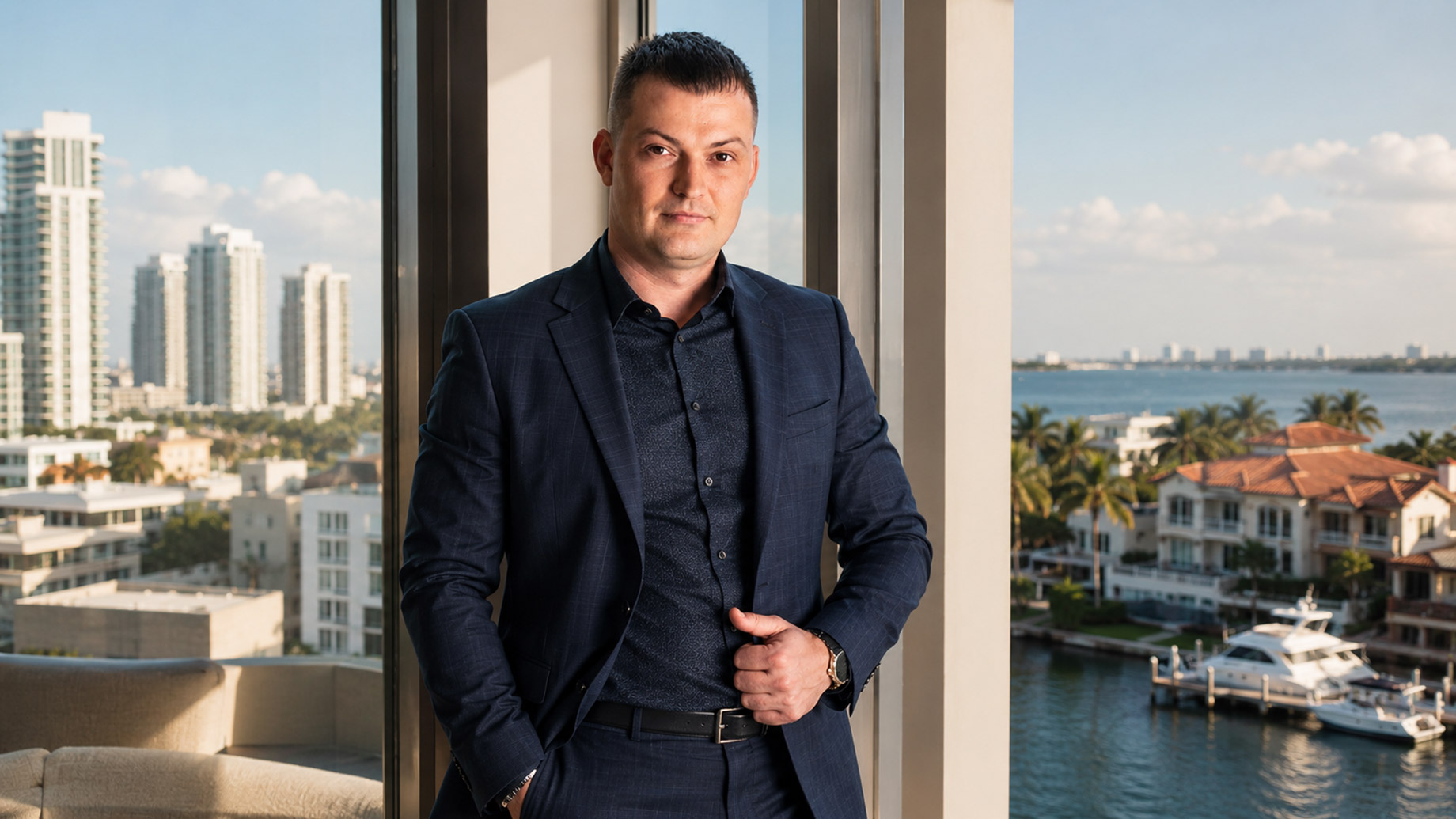
Maksym Herasimov works in the real estate industry in both Ukraine and the United States. His career began in the Ukrainian market, where he had to build a team, attract clients, implement digital tools, and maintain control over the quality of real estate transactions—all at the same time.
In 2020, he founded the WellHome real estate agency in Kyiv. It was a challenging period for the market: clients were making decisions more cautiously, competition for high-quality leads was increasing, and traditional sales methods were becoming less effective. Herasimov focused on improving the company’s internal operations through clear role distribution, a CRM system, agent training, rapid response to client inquiries, and thorough legal due diligence.
“We started from scratch in Kyiv. We needed to build a process that could be repeated and scaled. It wasn’t enough just to attract clients—we had to guide them through the transaction in a clear, structured way, without chaos,” recalls Maksym Herasimov.
How WellHome grew in Ukraine
Maksym Herasimov founded WellHome at the end of 2020 and took on the role of CEO. During its first year, the agency increased its client base by 500–600%, while revenue grew by 200–250%. For a young company, this pace of growth required constant involvement in sales, team management, and client service.
One of the company’s first initiatives was hands-on agent training. New agents accompanied experienced real estate professionals to property viewings, observed real negotiations, received direct feedback, and quickly determined whether the profession was the right fit for them.
“From the very beginning, we trained people through real work. A new agent had to see the property, the client, the negotiations, and the real issues that arise during a transaction,” Herasimov explains.
More than 220 new agents went through the agency’s training program, of whom 22 remained with the company as permanent team members. This selection process helped build a core team capable of working with different types of clients and properties.
Video Property Tours and Remote Work
In 2021, WellHome began actively using video property tours to work remotely with investors. This became especially relevant during COVID-19 restrictions, when clients were not always able to attend property viewings in person.
Each property was presented with a video tour, a description of its condition, details about any renovations, and the relevant documentation. This allowed investors to evaluate a property more quickly and make an initial decision without visiting the site in person.
“A client could receive a consultation and view a property remotely on the same day they made an inquiry. For us, this became a way to respond to demand faster and avoid losing deals due to physical distance,” says Maksym.
One of the most complex transactions during this period involved preparing the sale of an industrial asset—a brick factory valued at $2.5 million. The deal was nearly finalized in spring 2022, but it was halted by the start of the full-scale war. At the same time, the preparation itself gave the team experience in working with large-scale assets, complex contracts, financial risks, and multi-party communication.
Transition to the U.S. market
After a pause caused by the war, Maksym Herasimov moved to the United States and joined Charles Rutenberg Realty in Clearwater, Florida. For him, it was a new market with licensing requirements, access to MLS, high competition, and different standards for working with clients.
The first months were dedicated to adapting to the local system: brokerage rules, deal structures, digital services, mobile applications, and client communication practices. The approaches he had developed in Ukraine remained the foundation of his work: controlling the sales funnel, tracking every stage of a transaction, responding quickly to inquiries, and maintaining careful attention to documentation.
“The American market is very competitive. Here, response speed, access to data, and the quality of document preparation are extremely important. But the principle remains the same: the client must feel that their transaction is under control,” he says.
In his second year in the United States, Herasimov’s personal income increased four- to fivefold. According to him, this result was driven by consistent work with the client base, operational processes, and service quality.
How the WellHome team was structured
At WellHome, each role had a clearly defined area of responsibility. HR and recruiters were responsible for sourcing candidates, the marketer managed lead generation, and a four-person call center handled client inquiries and supported agents, while the final hiring decision remained with the company’s leadership.
Agent commissions ranged from 40–50% per transaction. This model motivated real estate agents to focus on performance and take faster ownership of their results.
“We invested in people, but we also quickly saw who was truly ready to work at this pace,” says Herasimov.
Thanks to this structure, the team was able to handle a larger number of inquiries without losing quality. An agent did not work alone in a chaotic environment, but within a system that provided support, a knowledge base, control points, and a clear logic for how each transaction should progress.
CRM, fast response, and data-driven work
In the Ukrainian market, many small agencies relied on spreadsheets, manual databases, or agents’ personal notes. At WellHome, the company immediately prioritized a CRM system where clients, properties, transaction stages, communication history, and next actions were all recorded.
This made it possible to see which inquiries required immediate response, where a deal was being delayed, which agent was overloaded, and which clients were ready to move to the next stage.
In addition to this, standards for response speed, video property presentations, and online consultations were introduced. A client could receive initial information, a consultation, and the next step without long waiting times.
Analytics also became part of management. Decisions were made based on data: which channels generated high-quality leads, which properties moved through negotiations faster, at which stages clients most often dropped off, and where the team was losing time.
Ukrainian and American markets: What’s the difference?
According to Herasimov, the Ukrainian real estate market is less institutionalized. It is often operated by small teams or individual brokers, and service standards can vary significantly from company to company. Therefore, WellHome was established as an agency with uniform operating rules, rather than as a group of individual agents.
In the U.S., the situation is different. There are stricter licensing requirements, more technological tools, broader access to market data, and fierce competition among agents. At the same time, a lot depends on the realtor’s personal discipline: how they manage their client base, how quickly they respond, how they prepare documents, and how they stay in touch after the first meeting.
“In Ukraine, I learned how to build a system. In the U.S., that experience helped me adapt more quickly and avoid starting with chaotic experiments,” explains Maksym.
Benefits of this experience
The experience of Maksym Herasimov in Ukraine and the United States shows that in real estate, results depend on process organization: who is responsible for the client, how quickly the team responds to inquiries, how documents are verified, how agents are trained, and how the company works with data.
WellHome became a platform where Herasimov refined these approaches in Ukraine. After moving to the United States, he applied them in the Florida market—with different regulations, different competition, and different client expectations.
“Technology is important, but it doesn’t work on its own. The key is to build a process in which the team understands its actions, and the client feels control and confidence,” concludes Maksym Herasimov.
