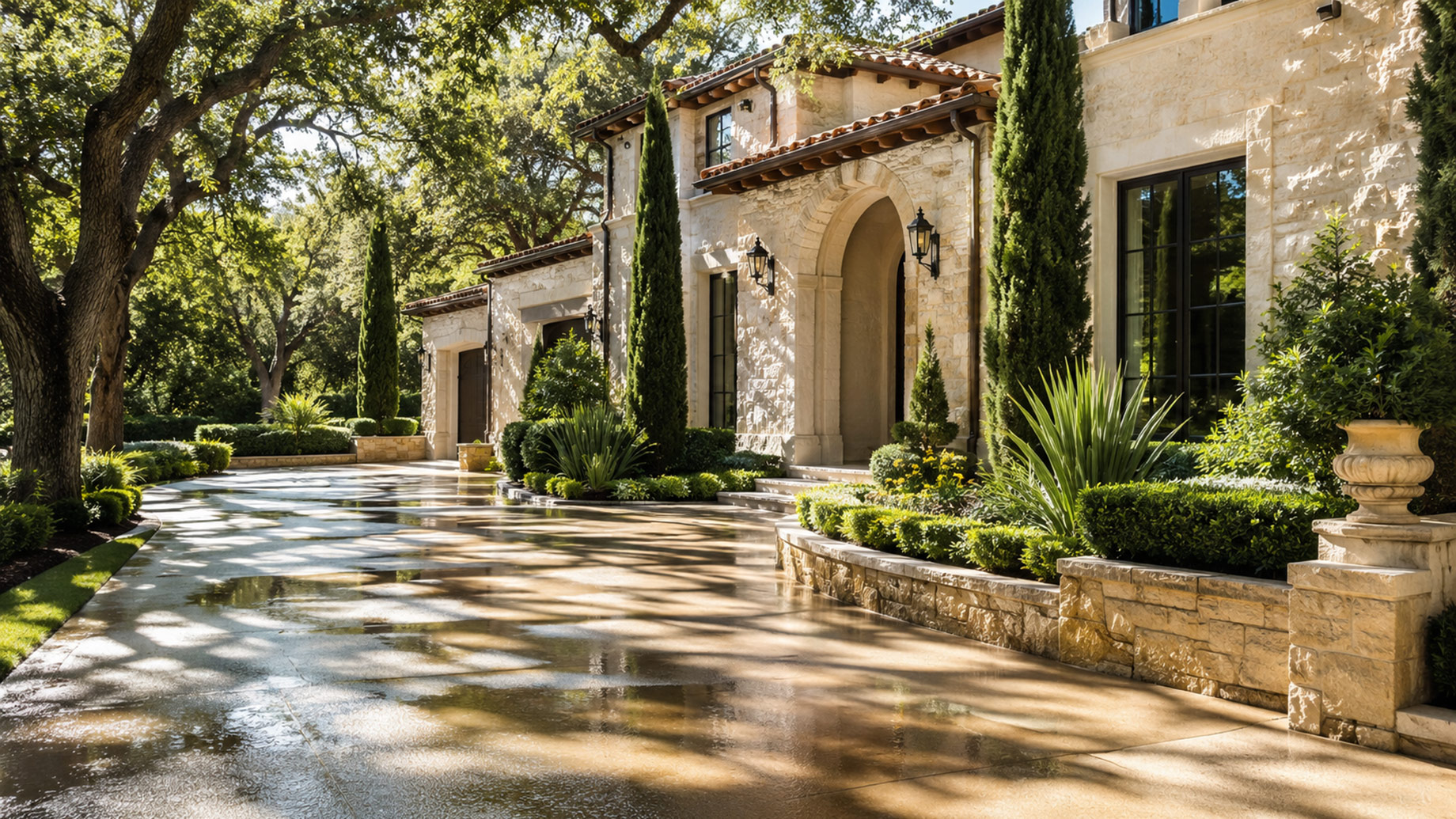
Exterior cleaning is often treated as a simple item on a home-maintenance checklist: notice that the driveway, stonework, siding, or patio looks dirty, then clean it. In Austin, TX, a more considered approach can produce better results.
The city’s combination of intense summer heat, periodic heavy rain, dry stretches, airborne debris, mature landscaping, and varied residential architecture means that timing matters almost as much as the cleaning method itself. This becomes particularly important for luxury homes, where a single property may combine limestone, painted stucco, architectural concrete, timber, pavers, metalwork, and extensive outdoor living areas.
Rather than choosing an arbitrary annual date, homeowners can treat exterior cleaning as part of a seasonal property-care strategy.
What Is the Best Time to Pressure Wash a Home in Austin?
There is no single month that is universally best for every Austin property. In practical terms, the right time depends on three factors: surface condition, recent weather, and what the property needs to be ready for next.
Spring and autumn often provide convenient opportunities for broader exterior cleaning, while summer and post-storm cleaning may be better approached selectively. A home surrounded by mature trees may also require a different schedule from a newer property with open landscaping and extensive concrete.
The objective is not simply to wash everything at fixed intervals. It is to clean each surface when doing so makes sense.
Spring: Reset the Exterior Before Outdoor Living Season
Spring is a natural time to inspect the entire property.
Winter weather, moisture, dirt, pollen, fallen leaves, and general organic debris can leave subtle deposits across façades, driveways, garden walls, terraces, and walkways. These changes may be difficult to notice day to day because they accumulate gradually.
A spring inspection should begin at the entrance sequence of the property and move outward:
- Driveways and motor courts
- Front steps and walkways
- Exterior walls and architectural features
- Courtyards and terraces
- Pool surrounds
- Outdoor kitchens
- Fences, gates, and retaining walls
This is also a useful time to distinguish between surfaces that merely need rinsing and those requiring more specialised cleaning.
Natural stone, painted finishes, wood, and decorative masonry should not automatically receive the same pressure as durable concrete. The material—not simply the stain—should determine the technique.
Summer: Work With Austin’s Heat, Not Against It
Austin summers change the practical conditions for exterior maintenance. Prolonged sunshine and high temperatures mean surfaces can become extremely hot, particularly exposed concrete, dark pavers, metal details, and south- or west-facing walls.
For that reason, large exterior-cleaning projects are often better scheduled during cooler portions of the day rather than under intense midday sun.
Rapid drying can also make cleaning less forgiving. Cleaning solutions may dry before they have been properly rinsed, while water can evaporate unevenly across large surfaces. On substantial luxury properties, breaking a project into controlled sections may produce a more consistent finish than attempting to clean the entire exterior at once.
Summer can nevertheless be an excellent time for targeted work, particularly around outdoor entertaining spaces that receive heavy use.
After Major Storms: Inspect Before You Clean
A strong storm can make a property look like it immediately needs pressure washing, but inspection should come first.
Look for loose materials, damaged caulking, displaced pavers, cracked masonry, weakened timber, blocked drainage points, or damaged exterior fixtures. High-pressure cleaning should never become a substitute for determining whether the underlying surface is still sound.
Once the property has been assessed, cleaning can help remove soil splash, leaf residue, dirt trails, and debris deposited by runoff.
Drainage deserves particular attention. If staining repeatedly returns to the same location after storms, the problem may not be cleanliness at all. It may indicate overflowing gutters, poor grading, irrigation overspray, or water travelling across a surface in an unintended way.
Cleaning the symptom without correcting the water source simply starts the cycle again.
Autumn: Prepare the Property for the Cooler Season
Autumn provides another useful opportunity to look at the residence as a complete exterior environment.
Rather than automatically repeating every spring task, concentrate on high-traffic areas and locations affected by landscaping. Driveways, shaded paths, garden walls, terraces, and outdoor stairs often show environmental deposits sooner than protected vertical surfaces.
For homeowners who entertain during the cooler months, this is also an appropriate time to coordinate exterior cleaning with landscape maintenance, window cleaning, outdoor-furniture care, lighting inspections, and other finishing work.
The result is a more coherent maintenance programme rather than a series of unrelated service visits.
Match the Cleaning Method to the Material
One of the most important distinctions in exterior care is the difference between pressure washing as a tool and high pressure as a default setting.
Austin homes can incorporate materials with dramatically different tolerances.
- Concrete and certain hardscapes can generally tolerate more mechanical cleaning, although joints, coatings, sealers, and decorative finishes still require consideration.
- Natural stone and masonry should be assessed individually. Porosity, age, mortar condition, and previous sealants can all influence the appropriate method.
- Painted stucco and siding may require considerably lower pressure, particularly around joints, openings, vents, windows, and ageing finishes.
- Wood decks, pergolas, and fences require controlled cleaning because excessive pressure can mark or raise the grain of the timber.
The correct question is therefore not, “How much pressure will remove this stain?” It is, “What is the least aggressive method that will clean this particular surface effectively?”
Remember Austin’s Water and Runoff Requirements
Exterior cleaning also involves where the water goes after it leaves the surface.
Austin has water-conservation rules affecting commercial pressure-washing equipment, and local regulations address the handling of wash water that contains pollutants or cleaning compounds. Homeowners arranging professional service should therefore consider wastewater management alongside the visible cleaning process.
That is particularly relevant when working around driveways, garages, vehicle areas, heavily soiled hardscapes, or surfaces requiring cleaning agents.
Current rules can change with local water conditions, so checking Austin Water guidance before significant exterior work is a sensible part of project planning.
When Professional Exterior Cleaning Makes Sense
A homeowner may be comfortable cleaning a small patio or limited section of concrete, but the risk equation changes on a large residence with multiple materials, elevations, rooflines, landscaped areas, and drainage systems.
Working with experienced pressure washing experts can be particularly useful when the project requires different techniques across the same property, specialised equipment, controlled application of cleaning solutions, or careful management of surrounding landscaping and runoff.
A professional assessment should identify the material being cleaned first and determine pressure, temperature, cleaning agent, dwell time, and rinsing method from there.
Treat Exterior Cleaning as Property Management
The most effective exterior-cleaning schedule for an Austin home is not necessarily annual, semi-annual, or tied to any single season.
It is condition-based.
Inspect surfaces regularly. Watch how sunlight, landscaping, irrigation, storms, vehicle traffic, and outdoor living affect different areas of the property. Clean durable surfaces when accumulation warrants it, and use gentler methods where architectural materials require greater care.
For a well-designed residence, that approach is more consistent with thoughtful property management than simply pressure washing everything whenever the calendar says another year has passed.
A luxury home is a collection of materials, systems, and environments. Maintaining its exterior well begins with recognising that each of them has its own rhythm.
