Quick Answer
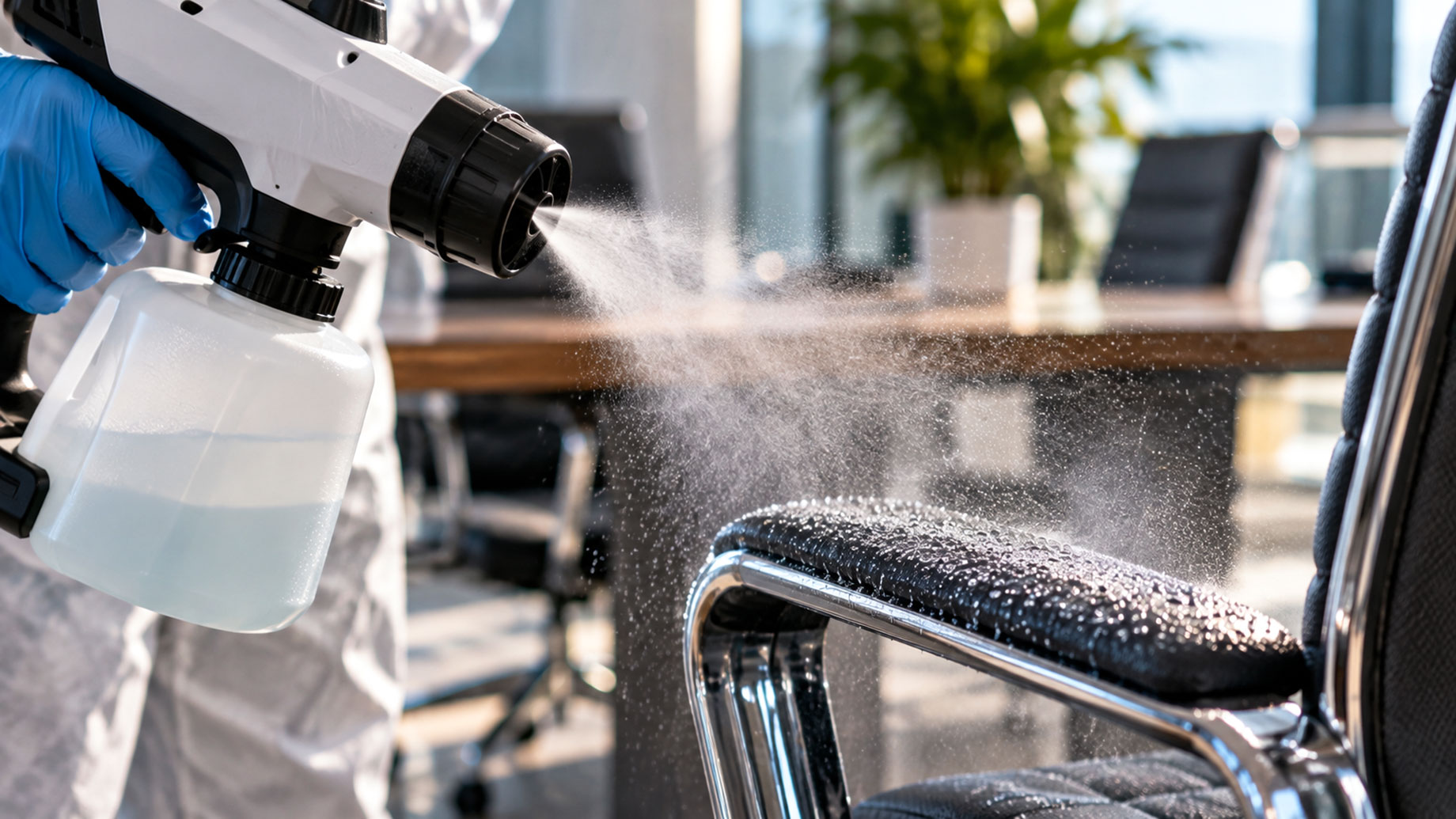
Is electrostatic disinfection safe? Applied correctly, yes. The method charges liquid droplets so they carry a positive electrical charge, then wrap around surfaces and cling to them evenly. Trained operators pair approved chemistry with proper ventilation and correct contact times, which protects both occupants and assets. Safety rests on the product chosen and the operator following the label, not on the spraying technology itself.
Introduction
Commercial facilities lose measurable productivity to preventable illness, and manual wiping leaves the gaps that spread it. A cloth reaches the front of a desk, then misses the sides, the underside, and the tangle of cables behind a monitor. High-touch points in offices, clinics, and gyms hold pathogens for hours, and patchy coverage is the reason routine cleaning so often falls short of its own goal.
The fix draws on building science rather than marketing claims. Charged droplets seek out the surfaces that manual methods skip, which is why facility managers across Calgary now weigh this approach against their conventional routines. Teams offering advanced commercial disinfection in Calgary pair the equipment with approved chemistry and verified protocols, the combination that separates a real safety upgrade from a fine mist with no measurable benefit.
What Electrostatic Disinfection Is and How It Works in Practice
The technology moved from hospital corridors into everyday commercial cleaning because it solves a coverage problem that cloths cannot. Understanding the mechanism explains why.
The Science of Charged Droplets and Wrap-Around Coverage
So what is electrostatic disinfection, and why does the charge matter so much. The sprayer passes liquid through a nozzle that gives every droplet a positive electrical charge on its way out. Surfaces sit at a slight negative or neutral charge, so the droplets are pulled toward them and pushed apart from each other.
That single principle spreads an even film instead of a running puddle, and it curves the mist onto the back and underside of an object rather than only the face pointed at the operator.
How Electrostatic Spraying Reaches Complex Surfaces
Cluttered rooms are where the method earns its place, because how does electrostatic spraying work is really a question about awkward geometry. The charged mist follows the electrical field lines around a shape, coating edges, recesses, and cable runs in a single pass.
Droplet size decides the outcome here. Most commercial units produce particles between 40 and 80 microns, fine enough to travel and cling, yet heavy enough to resist drifting into the breathing air of an occupied room.
Equipment Types, From Cordless to Backpack Sprayers
Operators match the tool to the space, and the common formats span a wider range than most buyers expect:
- Handheld cordless units for desks, counters, and small rooms
- Rolling cart systems for corridors and open floors
- Backpack sprayers for gyms, warehouses, and large event venues
- Fixed clamp-on heads for repetitive production-line work
Each format trades reach for portability, so a job is scoped to the room before a unit is chosen.
Cleaning Versus Disinfecting: Where the Method Fits the Workflow
Spraying onto a dirty surface wastes both the chemical and the visit. Soil, grease, and biofilm shield microbes from contact, so the application has to sit inside a fixed sequence rather than replace one.
Cleaning vs Disinfecting, and Why the Sequence Matters
The gap between them comes down to what each step targets. Cleaning lifts visible dirt and organic matter using detergent and friction, while the second step applies a registered product that destroys pathogens on an already clean surface. Skip the first and the second underperforms, because the chemical binds to grime instead of germs. The charged application handles that second stage, once manual cleaning has cleared the way.
Sanitizing vs Disinfecting on High-Touch Surfaces
The line is set by regulation, not casual habit. Sanitizing lowers bacteria to a level judged safe under public health standards, whereas disinfection meets a higher bar and destroys a broader range of viruses and bacteria named on the label. Commercial settings pick by risk. A restaurant prep counter may only need sanitizing, while a clinic waiting room warrants full disinfection.
Dwell Time, the Detail Most Guides Skip
Coverage counts for nothing if the surface dries before the chemistry acts. Every registered product carries a dwell time, the minutes it must stay visibly wet to reach its kill claim.
- Read the label dwell time before starting, since products vary widely
- Confirm the charged layer keeps the surface wet for that full window
- Re-apply on porous or fast-drying materials that flash off early
- Log the contact time on audited sites so results can be verified
Pro Tip: On glass and stainless steel, a surface can look dry while the dwell window is still running. Time the window from a watch, not from appearance.
Is Electrostatic Disinfection Safe for Staff, Occupants, and Assets
It comes down to three things the operator controls: the chemical, the ventilation, and the surfaces in the room. The machine atomises whatever product is loaded, so a low-toxicity registered formula in trained hands suits occupied space, while a harsh product misused does not.
Chemical Choice and Ventilation for Occupied Buildings
Product selection governs occupant exposure more than any other factor. Skilled operators choose formulas cleared for indoor commercial use, often hydrogen peroxide or quaternary ammonium at label strength. Air handling then carries off any residual mist, so a window opens or the HVAC runs during the pass, and people clear the zone until the surface reaches its contact window.
Electronics, Soft Furnishings, and Material Compatibility
A charged fine mist behaves gently on delicate assets. The droplets coat without soaking, so keyboards, monitors, and phones tolerate a treatment that a wet wipe would threaten, and fabric chairs or acoustic panels take it without saturation. Careful operators still spot-test unfamiliar finishes, since some screens and coatings carry manufacturer limits worth respecting.
Verifying Results and Choosing a Qualified Provider
A safe outcome is a measured one, so the credible marker of quality is verification rather than a promise of a clean-looking room. The table below sets the three service tiers side by side, so a facility manager can match the method to the risk in a given space.
| Attribute | Sanitizing | Disinfection | Electrostatic Application |
|---|---|---|---|
| Primary target | Bacteria to safe levels | Broad viruses and bacteria | Broad pathogens, full coverage |
| Surface reach | Sprayed or wiped faces | Wiped faces | Wrap-around, hidden sides |
| Best commercial fit | Food prep counters | Clinic touch points | Large or cluttered rooms |
| Contact control | Short dwell | Label dwell time | Label dwell, even layer |
Read together, the tiers show a clear progression, from surface-level reduction to full pathogen control with verified coverage. Before hiring, a manager can hold a provider to a short set of checks:
- Ask for the product label and its registration number
- Request the dwell time the operator followed
- Confirm staff training and material-safety records
- Review the contact-time logs on audited sites
Choosing Electrostatic Disinfection With Confidence
The measurable outcome of a proper pass is a room certified against a recognised standard, ready for occupants to return the same day. Match the chemistry to the setting, respect the dwell time, and verify the result, and the method delivers coverage that hand-wiping cannot.
Read the label, confirm the training, and check the logs. Handled that way by trained operators, is electrostatic disinfection safe and effective in commercial spaces, and the evidence sits in the verification record rather than in any sales pitch.
