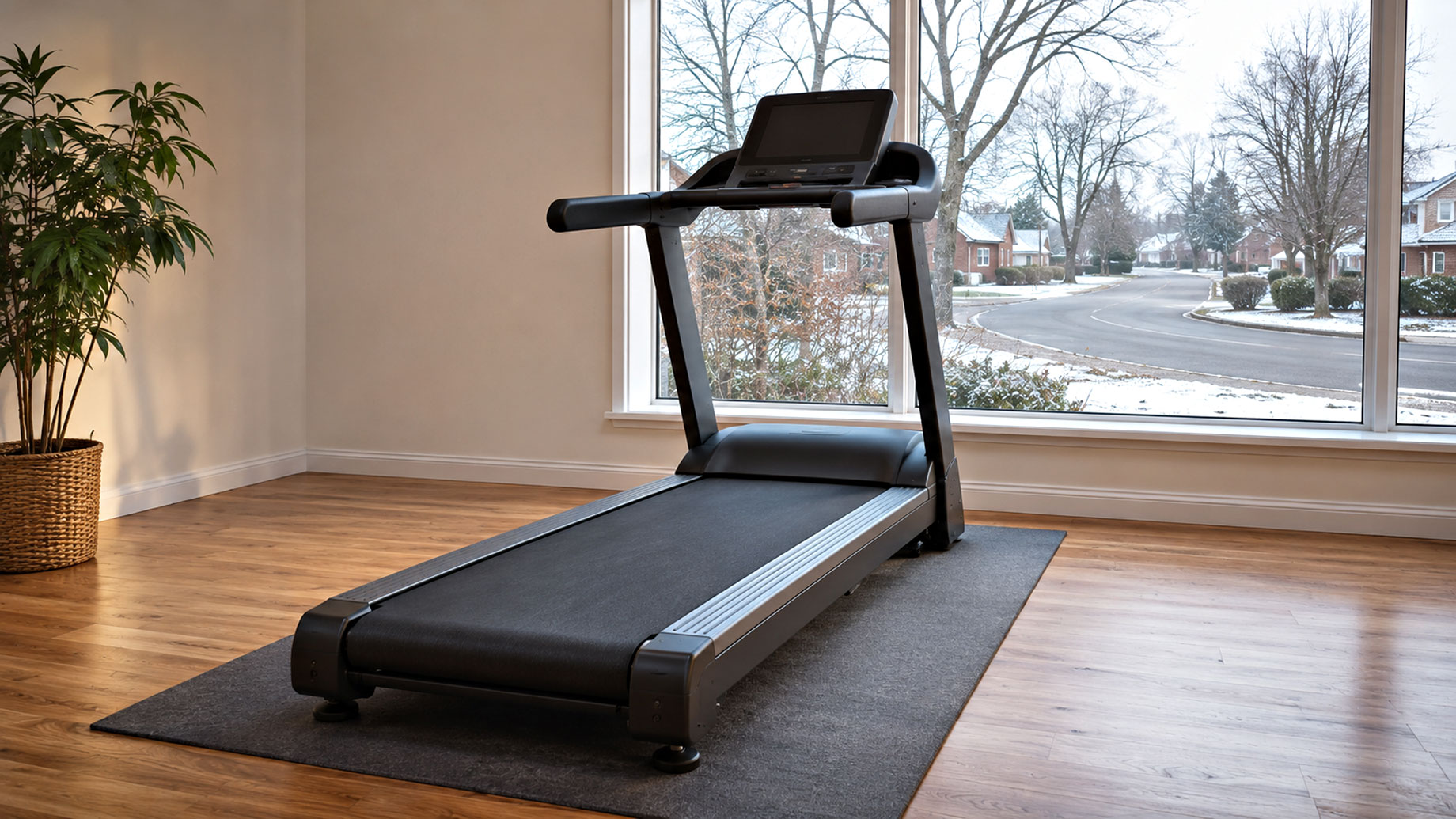
A winter training block is when many runners move more of their weekly miles indoors. The road still matters, but a running treadmill can keep pace work consistent when darkness, cold, rain or icy surfaces make outdoor training less practical.
The question isn’t treadmill or road. It’s which sessions belong where. Each surface trains something the other can’t, and a block that uses both on purpose tends to feel smoother than one that drops the treadmill overnight.
This guide sorts your sessions by surface. It gives you three short, hard workouts that suit a running treadmill, then a 6-week plan that keeps your winter training mostly indoors while preserving enough road time for race-specific durability.
Treadmill vs. Road: What Each Surface Does Best
A treadmill controls everything except your effort. The road controls nothing, and that’s the point. The treadmill wins on precision. The road wins on specificity, meaning how closely training matches race day.
| What you’re training | Treadmill | Road |
|---|---|---|
| Exact pace for reps | Strong: the belt holds the speed you set | Harder: you pace by feel or watch |
| Hills | Controlled grade if your machine has incline | Real climbs and, just as important, real descents |
| Footing | Even, predictable surface | Camber, turns, curbs and changing surfaces |
| Wind and air resistance | None | Always there, and it adds effort at faster paces |
| Fitting runs into your day | Any hour, any weather, no traffic stops | Depends on daylight, weather and route |
| Race-day feel | Low | High |
Two practical points come out of that table.
First, the treadmill is a little easier at speed because there’s no air to push through. Many runners set a 1% grade to make up for it during faster work. At easy paces the difference is small, so a flat belt is fine.
Second, the road asks more of your calves, ankles and hips. Turns, camber and downhills load your legs in ways a belt doesn’t. That’s why the move outdoors should be gradual, even if your fitness is solid.
Which Sessions Belong on the Treadmill
Put your most precise sessions on the treadmill. Intervals, tempo runs and hill repeats all depend on holding an exact effort, and that’s what a belt does best.
The treadmill also takes the guesswork out of short, hard training. You can’t drift slow on the third rep, and you don’t need a flat quiet stretch of road to run your workout.
Treadmills show speed in miles per hour, while most runners think in pace per mile. Use this table to set the belt for your target pace.
| Treadmill speed | Pace per mile | 5K at that pace |
|---|---|---|
| 6.0 mph | 10:00 | 31:04 |
| 7.0 mph | 8:34 | 26:38 |
| 7.5 mph | 8:00 | 24:51 |
| 8.0 mph | 7:30 | 23:18 |
| 8.5 mph | 7:04 | 21:56 |
| 9.0 mph | 6:40 | 20:43 |
| 10.0 mph | 6:00 | 18:38 |
| 11.5 mph | 5:13 | 16:13 |
Three Compact High-Intensity Sessions
Each session fits in about 30 to 40 minutes, including warm-up and cool-down. Start every one with 10 minutes of easy running and finish with 5 to 10 minutes easy.
- Short intervals: 6 × 2 minutes at about your 5K pace, with 1 minute of easy jogging between. Add a rep every week or two, up to 8.
- Incline power repeats: 8 × 60 seconds at a 6–8% grade, at an effort you could hold for about 10 minutes. Recover with 90 seconds of easy jogging at 1%. Keep your speed modest and let the grade do the work.
- Progression tempo: 20 minutes that start at your easy pace and rise by 0.2 mph every 4 minutes. The last block should feel comfortably hard, not all-out.
If your treadmill doesn’t incline, run the hill repeats on a road hill instead. That gives you the climb plus the descent, which you need anyway before a road race.
These sessions also tell you what your machine needs. If you’re choosing a running treadmill for this kind of work, check that the top speed sits comfortably above your fastest rep. A 6:00 mile needs 10 mph, and compact folding models now reach 10 to 11.5 mph. Look at deck length for your stride, quick speed controls for switching between reps, and a folded size that fits the room you have.
Which Runs Belong on the Road
Take your long run, most easy runs and anything race-specific outside. These runs build the durability and pacing sense a belt can’t give you.
- Long run: Running for 75 minutes or more on a belt is tough mentally. More importantly, your feet, ankles and hips need time on real surfaces before race day.
- Easy runs: Easy pace is where you get used to wind, turns and uneven footing at low risk.
- Downhills: Most treadmills don’t decline, so descents are a road-only skill. Running downhill controlled takes practice, and your quads need the work.
- Race-pace rehearsals: Pacing by feel on open road is a skill of its own. Practice it on a route like your race course.
- Strides: Four to six 20-second pickups after an easy run teach you to run fast with real turns and footing.
A 6-Week Winter Block That Keeps You Road-Ready
Move one session at a time toward the treadmill as winter conditions become less reliable. Over six weeks, the belt carries most of your quality work while short, controlled road runs preserve outdoor skills.
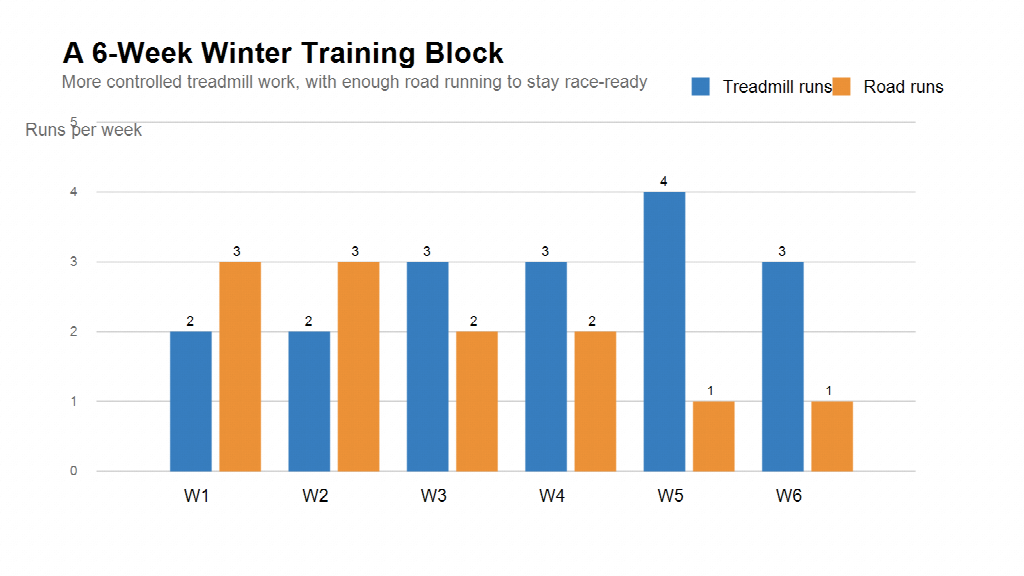
This plan assumes four to five runs a week. If you run three, keep the same order and drop one easy run.
| Week | Treadmill runs | Road runs | Key change |
|---|---|---|---|
| 1 | 2 | 3 | Keep the long run outside; move one quality session indoors |
| 2 | 2 | 3 | Add short strides after one road run |
| 3 | 3 | 2 | Move tempo indoors; keep the long run outside |
| 4 | 3 | 2 | Use incline repeats indoors when roads are slick or dark |
| 5 | 4 | 1 | Keep only one easy road run for footing and pacing |
| 6 | 3 | 1 | Lighter week; finish with a controlled outdoor effort if conditions allow |
A few rules keep the switch smooth:
- Change one thing at a time. When a session moves indoors, don’t also make it longer or faster. When it returns outdoors, keep the first run controlled.
- Expect the road to feel different. Wind, turns, cold air and rolling ground change pace. Run by effort when conditions are poor and let pace return when the route is clear.
- Watch your calves and shins. These often feel road running first. Mild soreness that fades in a day or two is normal. Pain that lingers or gets worse is a reason to back off.
- Hold your total time steady. Swap surfaces, not volume. Add mileage only once a week feels routine.
Keeping the Treadmill in Your Week Through Winter
Don’t treat the treadmill as a temporary substitute during winter. Keep it for the sessions that gain most from control, and use it whenever the road doesn’t offer a safe or useful training surface.
The weekly interval session is usually the best one to keep indoors. It’s short and pace-driven, and it’s easy to run well on a belt. Keep at least one outdoor run for footing, turns and pacing, then choose the safer surface for the remaining easy miles.
The treadmill also covers the days that would otherwise mean a missed run. Heavy rain, a hot afternoon, high pollen, a late finish at work or an early start before daylight are all easier with a belt at home.
That’s where a compact, folding machine earns its place. It stays in the corner or against the wall until a workout needs it, then unfolds in a minute. Your training block stays consistent through winter, while your outdoor runs maintain the skills you’ll need when race season arrives.
Mix both surfaces with a clear job for each, and you’ll reach race day with treadmill sharpness and road-ready legs.
Frequently Asked Questions
Does treadmill fitness carry over to road racing?
Yes, for the most part. Your heart, lungs and pace sense move straight over to the road. What takes a few weeks is the road-specific part: your calves, ankles and hips getting used to turns, camber and downhills.
Should I always run at a 1% incline?
No. A 1% grade helps most during faster sessions, where air resistance outside would add effort. For easy and recovery runs, a flat belt is fine. If your treadmill doesn’t incline, aim slightly higher on effort for tempo and interval work.
Can I train for a road race mostly on a treadmill?
You can, and plenty of runners do when weather, daylight or work hours leave little choice. Still, keep at least one outdoor run most weeks when conditions are safe. Add more road time four to six weeks before race day so your legs can adapt gradually.
Disclaimer: This article is provided for general informational purposes and is not a substitute for professional medical advice, diagnosis, or treatment. Individual health needs and responses to exercise can vary. If you have a medical condition, concerns about your health, or are considering changes to your exercise, diet, sleep, or daily activity, consult a qualified healthcare professional first.
