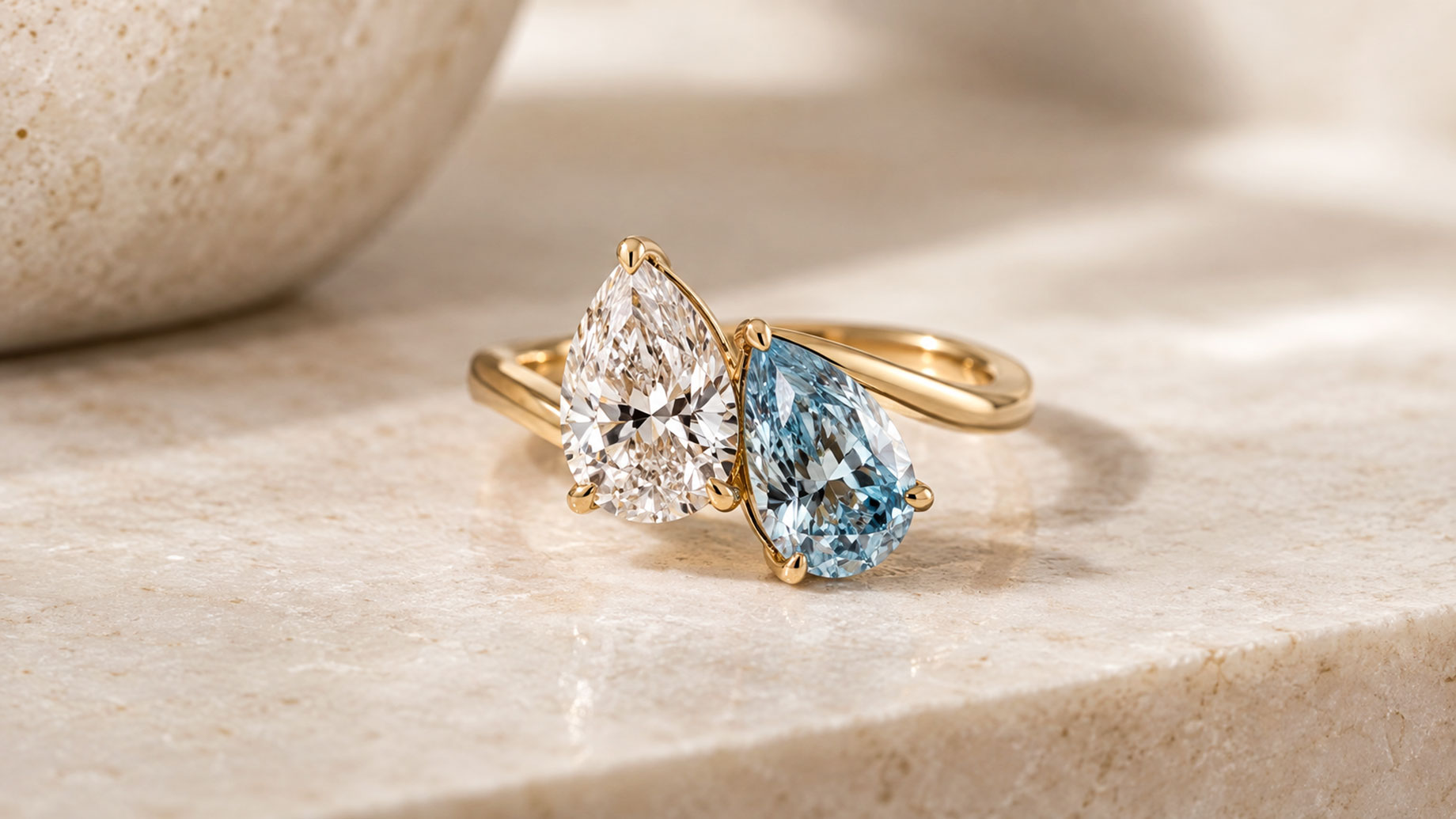
A solitaire gives the eye one place to land. A two stone ring gives it two, and that single difference changes how the entire piece has to be designed. The name toi et moi is French for “you and me,” and the layout is exactly what it sounds like: two stones set side by side on one band, usually leaning away from each other along a soft diagonal. It is one of the few classic forms that genuinely improves when it is made to order, because every interesting decision inside it – which two stones, how they relate, which one leads – has to be made deliberately by somebody. That is why a custom toi et moi ring reads so differently from a design pulled off a shelf.
Where the toi et moi ring came from
The origin story usually cited is Napoleon Bonaparte’s 1796 betrothal ring for Josephine de Beauharnais: a pear cut sapphire and a pear cut diamond of similar size, angled toward one another on a plain band. Whether that ring invented the form or simply made it famous, it fixed the symbolism that still carries the style. Two distinct stones, two people, one shared mount. The twin stone design stayed in circulation through the Victorian and Edwardian periods, then largely vanished while the single stone solitaire dominated the twentieth century, and returned to wide use over the past decade as people looked for a ring with more narrative in it. Antique examples are worth studying before you design one, because they tend to be smaller, flatter and far more restrained than modern interpretations, and that restraint is often exactly what makes them work.
Why the layout invites a commission
Ready-made two stone rings carry a structural problem. The manufacturer has to choose both stones, and to keep production simple they almost always choose two that match. Matched stones are safe, and they are also the least interesting version of the idea. The whole point of a form built on the word “and” is that the two halves are allowed to differ. Jewelers who run a bespoke service, aquamarise.com among them, see this play out constantly in the briefs they receive: a morganite beside a white stone, a sapphire beside a moonstone, one person’s birthstone beside a stone that came out of a family piece. None of those pairings exist as stock inventory. They exist only if somebody builds them on purpose.
Choosing two stones that belong together
Pairing is where a two stone ring is won or lost. A useful test is to ask what the two stones share and what they deliberately do not. Some pairs share a hue family and differ in saturation, which reads as one idea stated in two registers. Others share a cut and differ completely in color, so the matched outline holds them together while the color does the talking. The pairings that fail are usually the ones with nothing in common at all – unrelated cuts, unrelated colors, unrelated brightness – because the eye reads them as two separate rings that happened to collide on one finger.
- Same cut, different color: the most reliable starting point, since the matched outline does the unifying work for you.
- Different cut, related color: livelier, and it asks the two outlines to carry similar visual weight.
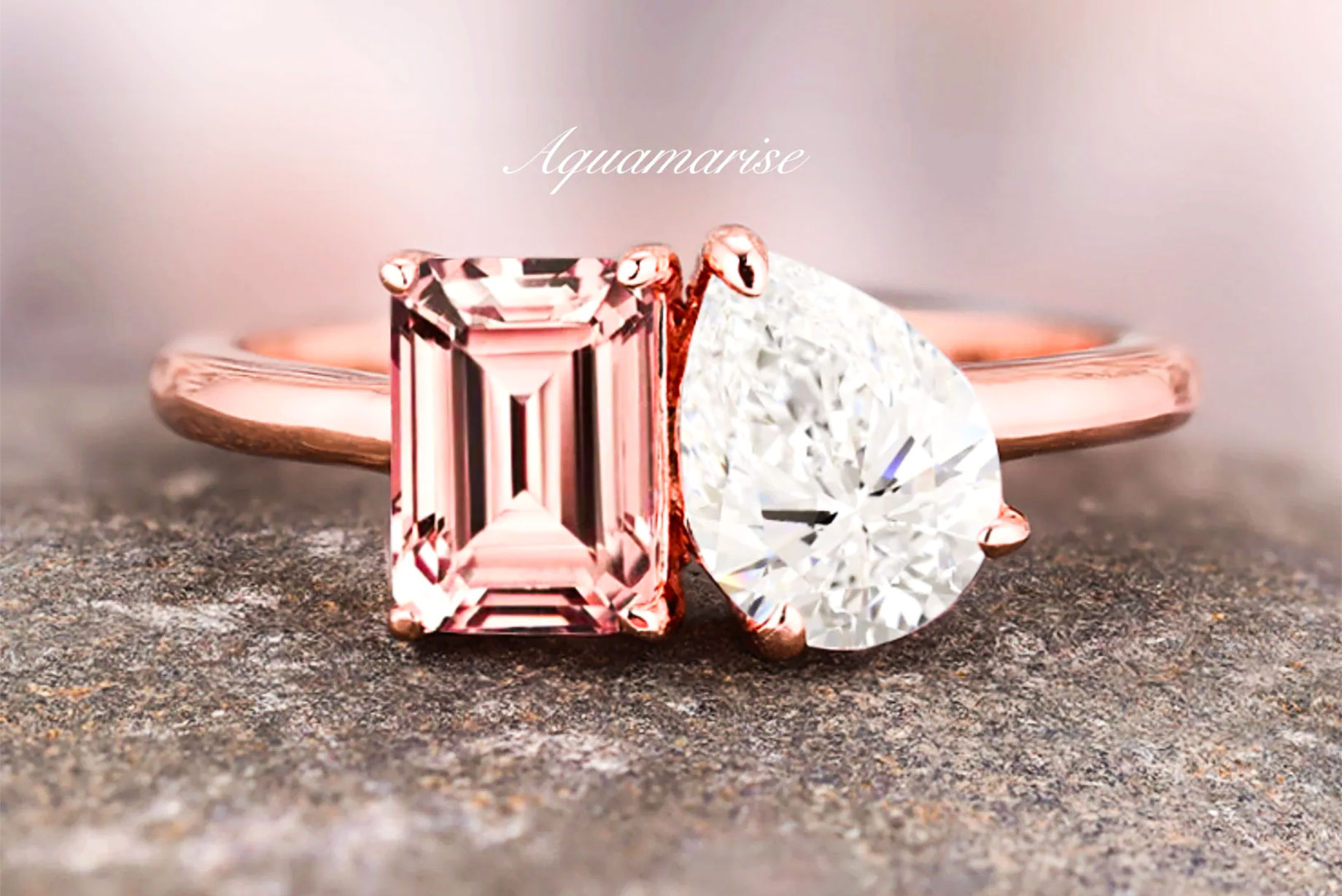
- Different cut and different color: possible, but the setting then has to impose the order that the stones do not supply.
Balancing stones that are not the same size
Two stones of identical carat weight are not automatically the same size on a hand. Cut governs apparent size far more than weight does. An elongated pear or a marquise spreads across more finger than a round of the same weight, and a deeply cut stone hides part of itself below the setting where nobody sees it. The comparison worth making is face-up dimension in millimeters, not weight.
A deliberate size difference is a legitimate choice, and often a better one than a forced match. A larger stone with a smaller companion creates a clear lead and a clear echo, and it usually sits more comfortably because the mass is not split evenly across the finger. If you do want the two to read as equals, aim for face-up dimensions within roughly ten percent of each other, and expect the maker to adjust seat depths so both crowns finish at the same height. Two stones sitting at different levels will look mismatched even when their outlines agree perfectly.
Color, transparency and how light behaves
Transparency is the variable most people forget. A brilliant cut white stone throws light back in hard flashes. A translucent stone with a soft body color – a moonstone, an opal, a milky quartz – glows instead of sparkling. Set side by side, the sparkler can make its neighbor look flat, not because it is, but because the eye adjusts to the brighter of the two. There are two workable answers. Narrow the gap by choosing a companion with some life of its own, or widen it on purpose and let the contrast between glow and flash become the actual subject of the ring. What does not work is treating the two stones as interchangeable and hoping the difference will disappear once the piece is finished.
Color deserves the same scrutiny. Warm metals push warm stones further toward orange and can make a cool stone look grayer by comparison. Half an hour spent looking at both stones loose, together, resting on the metal you actually intend to use, is worth more than any amount of discussion in the abstract.
Settings that hold a two stone layout
The mount has to manage the space between the stones, which is the hardest part of the geometry. A bypass shank, where the band splits and the two ends sweep past each other, is the traditional answer and still the most flexible one, because each stone sits on its own arm and the two arms can be set at different heights and angles without looking forced. A shared prong sitting between the stones pulls them tightly together and suits pairs of similar size; it saves metal in the middle and makes the two read as one unit. Bezels, full or partial, are the practical choice when the stones differ in hardness or when one is softer and needs its girdle protected, and a bezel also gives a clean outline that can reconcile two cuts that would otherwise argue. Split shanks and half bezels sit between those extremes. Whatever the structure, ask to see the profile view during design, because a two stone ring can look perfect from above and sit far too tall from the side.
Working through a custom toi et moi ring design
The sequence that tends to work is stones first, setting second. Choose the pair, look at them together in daylight, then let the mount be designed around what those two specific stones need rather than picking a style first and forcing stones into it. For gold and platinum work, expect a 3D render before anything is made. A render is genuinely reliable for proportion, profile, stone placement and the gap between the two stones, so it is the right moment to argue about balance. It is not reliable for sparkle, for how light travels through a translucent stone, or for true metal color, so those judgments stay with the physical materials. If you want to start a custom design, arriving with a rough idea of your two stones – even just two colors and two shapes – makes the first conversation far more productive than arriving with a picture of somebody else’s finished ring.
The reason this form rewards commissioning is simple. A solitaire can be beautiful without anyone knowing why that stone was chosen. A custom toi et moi ring cannot hide its reasoning, because the pairing is the design. Get the two stones right and the setting largely resolves itself; get them wrong and no amount of metalwork will rescue the piece. That is a demanding way to design a ring, and it is also why the good ones feel so specific to the people wearing them.
