Nashville has become very good at being a destination, and slightly worse at being a place. Broadway is louder than it was a decade ago, the hotel inventory has roughly doubled, and the city now absorbs something on the order of fifteen million visitors a year. For anyone whose travel is built around scarcity rather than volume, that presents a problem.
The solution most well-advised visitors arrive at is the same one locals reached years ago. You do not fix a crowded city by finding a quieter corner of it. You leave for the day.
What is actually out there
Within a two-hour radius of downtown Nashville sits one of the densest concentrations of waterfalls in the eastern United States. This is not a regional tourism board’s phrasing. It is a function of geology: the Cumberland Plateau rises sharply east of the city, and every river running off it has spent several million years cutting a gorge through sandstone and limestone.
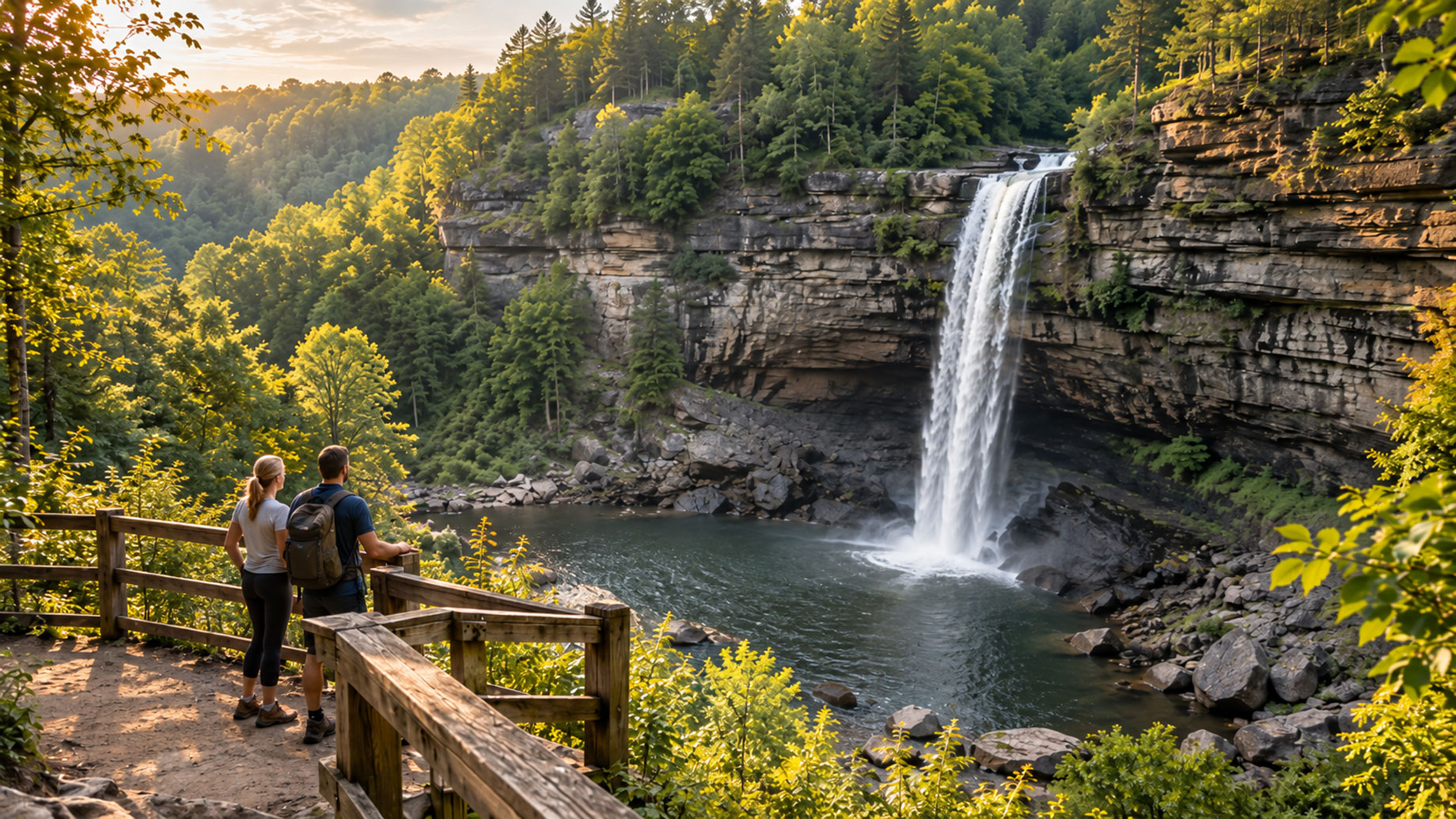
Fall Creek Falls, at 256 feet, is the tallest free-falling waterfall east of the Mississippi. Burgess Falls descends a staircase of three cascades before a 136-foot drop into a gorge. Cummins Falls has what is widely considered the finest swimming hole in the state. Twin Falls at Rock Island is not fed by a stream at all, but by water seeping through rock from a reservoir and emerging eighty feet up a cliff face, which produces something closer to a natural engineering curiosity than a conventional waterfall.
Closer in, Radnor Lake sits twenty minutes from downtown and functions as a genuine wildlife refuge. The Narrows of the Harpeth has a river that doubles back on itself beneath an overlook, and a tunnel cut through solid rock in 1819 to drive an ironworks that you can still walk through.
None of this is secret. It is simply inconvenient, and inconvenience is an effective filter.
The case for handing over the keys
The self-drive version of this day is entirely possible and, for a certain kind of traveller, entirely the point.
For everyone else, the friction is real and worth naming. You are navigating unfamiliar rural two-lanes with unreliable cell coverage. Several of these parks have conditions that change weekly: Cummins Falls issues a capped number of gorge permits daily and closes the gorge outright when upstream rain creates flash flood risk, and the stairway to the base of Burgess Falls has been closed for years following storm damage. Discovering either of those at the gate, after a ninety-minute drive, is a poor way to spend a morning.
Then there is the return. The drive back into Nashville comes at the end of a day on your feet, in the dark half the year, on roads with no shoulders and a serious deer population.
This is the specific gap that private hiking and waterfall tours from Nashville exist to close. Pickup at the hotel, a vehicle you are not driving, an itinerary built around what you actually want rather than a fixed route, a guide who knows this week’s trail conditions rather than last season’s, and somebody else behind the wheel on the way home. For a group travelling together, the arithmetic per person tends to surprise people, because the cost is shared across the vehicle rather than sold by the seat.
Building the day properly
A few things distinguish a well-constructed day out here from a merely adequate one.
- Decide between the overlook and the base. Almost every Tennessee waterfall offers two entirely different experiences. The overlook is typically a short walk on maintained ground. The base is usually a steep descent on wet rock, sometimes with river crossings, occasionally permit-controlled. These require different footwear, different fitness, and different amounts of the day. Choosing in advance is the single decision that most determines how the day feels.
- Understand the season you are in. Waterfall flow in Tennessee peaks between February and May. If volume is what you came for, that is the window, and almost nobody tells visitors this. Autumn is colour season rather than water season, with Middle Tennessee peaking in early to mid November. Summer belongs to the swimming holes. Winter, with the canopy down, gives the clearest view of the geology and very nearly private trails.
- Combine intelligently. Burgess and Cummins sit close enough to pair in a single day. Fall Creek Falls deserves a day on its own. Attempting all three is how a good day becomes a long one.
- Build in the unremarkable parts. The drive out is ninety minutes to two hours. Lunch is not going to appear near a trailhead. A day that budgets honestly for both is a day that does not feel rushed at four in the afternoon.
Who this actually suits
The obvious fit is the traveller who has done Nashville before and is looking for the second visit to be different from the first.
Less obviously, it works well for the group that has assembled in Nashville for something else. Corporate offsites, family reunions, wedding parties with a spare Friday. A private vehicle and a fixed itinerary solve a coordination problem that eight people with three rental cars cannot solve on their own, and a shared day outdoors tends to be the part of the trip people remember afterwards.
It also suits the traveller for whom the marginal hour matters. If you have one clear day in Nashville, spending three of its hours on logistics is a poor allocation.
The wider point
The instinct to buy privacy and time in a crowded destination is a familiar one. What is slightly unusual about Nashville is how short the distance is between the crowd and the alternative. Two hours from a street where the bars stack three deep on a Tuesday, there is a 256-foot waterfall at the head of a gorge, and on a weekday in November you may well have the overlook to yourself.
That gap, between how loud the city has become and how quiet the country behind it remains, is the most underpriced thing about visiting Nashville right now.
