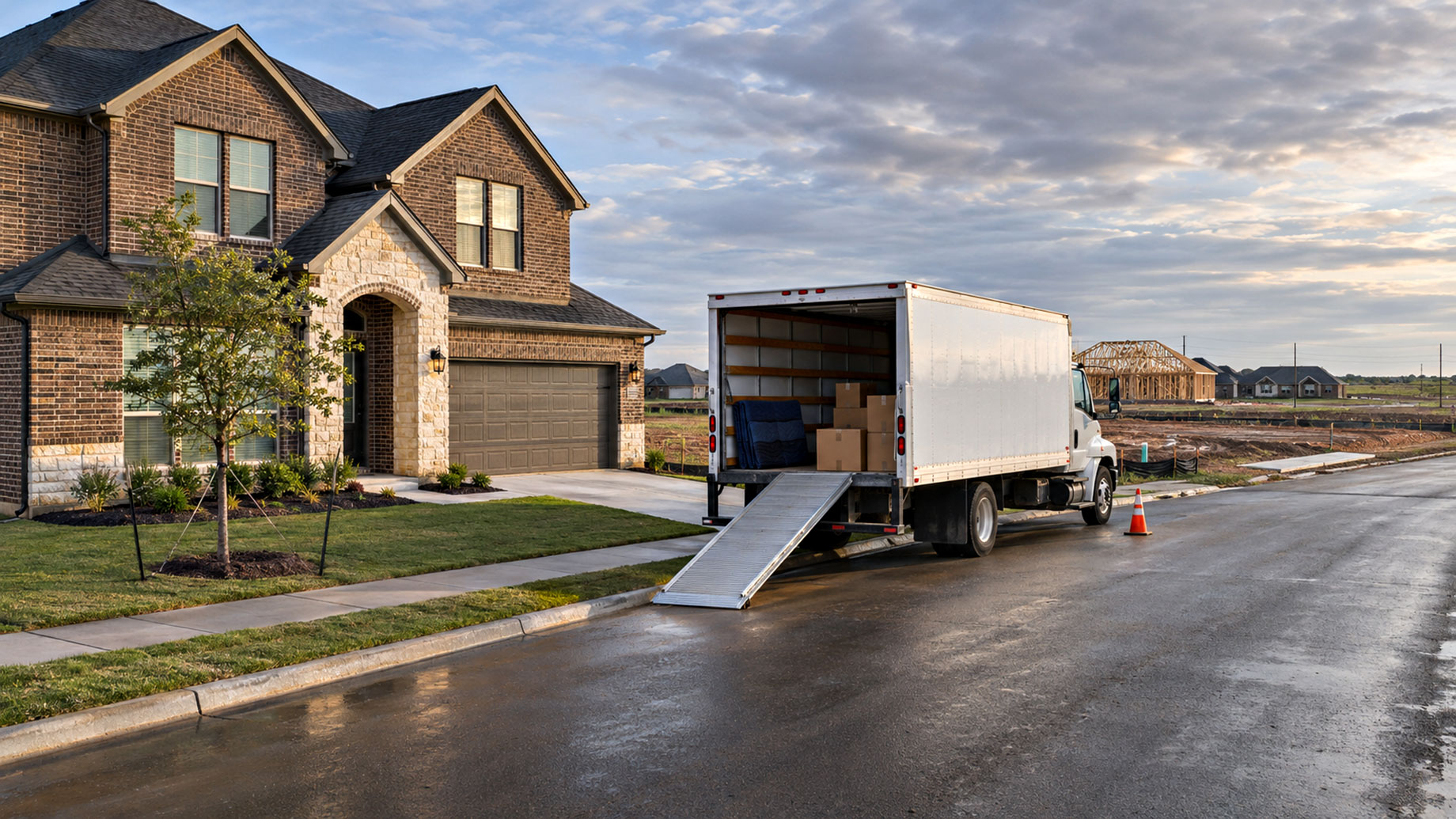
North of Dallas, whole neighborhoods are going up faster than anyone can map them. Census Bureau estimates released in May ranked Celina the fastest growing U.S. city with 20,000 or more residents, up 24.6% between July 2024 and July 2025. Five more Dallas-Fort Worth suburbs made that national top 15: Princeton, Melissa, Anna, Forney and Greenville. WalletHub’s 2026 comparison of 300 cities as real estate markets gave its two highest scores to Frisco and McKinney.
For buyers, those numbers mean new construction. For moving day, they mean an address with no history: the truck may not find the house, the trades already have the curb, the mailbox has no key and the city has not delivered a trash cart.
These problems are simple to handle and easy to miss, because they rarely come up at the closing table.
An Address the Map Hasn’t Learned Yet
Map apps can lag behind new subdivisions. A street paved last spring can show up as an empty field, and a route that works for a car can send a long box truck to an entrance it cannot use.
Send the crew a dropped pin for the driveway itself, along with the name of the nearest finished cross street. If the community has more than one entrance, say which one is open to large vehicles, since some entrances in an active build may be kept for construction traffic or closed for paving. If there is a gate, get the code or the guard’s instructions in writing a week ahead, and check the day before that it still works.
Moving Day on a Street Still Being Built
In a community where the builder is still selling homes, a move shares the street with framers, roofers, concrete trucks and landscapers. Their trucks can line the curb on weekdays. The lot next door may be bare dirt that turns to mud after a rain, and the sidewalk may stop halfway down the block.
Walk the street at the hour the truck will arrive, on the same day of the week as the move. Find a stretch of curb where the truck can stay parked through a long morning without blocking a concrete pour or the next driveway, and check whether the path from the curb to the front door crosses bare ground. Ask the builder’s sales office or site superintendent which days are busiest on your street. If the trades crowd it on weekdays, a Saturday date may give the truck more room.
Read the Rules Before You Book the Truck
Many new communities come with a homeowners association, and its rules apply once you own the home. They can cover where a moving truck may park, whether a portable storage container may sit in the driveway and for how long, and what hours a move may run.
Texas gives buyers a way to read those rules early. The Texas Property Code requires a property owners’ association to file its dedicatory instruments, which include its declaration, bylaws and adopted rules, in the real property records of the county where the property sits, and an instrument has no effect until it is filed. Ask the builder or the association’s management company for the current rules before closing. If what they send leaves a question open, the county clerk’s records are the version that counts.
The Mailbox Comes Without a Key
New subdivisions are usually set up for cluster box delivery. According to the National Association of Home Builders, cluster boxes have been the Postal Service’s default method of delivery since 2012, and in October 2025 the association reported that USPS had reaffirmed that all new developments should use them.
That means there is no box at the curb waiting for you. Before closing, ask who issues the key to your compartment (the builder, the HOA or the local post office) and when delivery to your box will start. Until it does, ask the post office that serves the address how to collect your mail, and time the change of address for a date when you can actually get to it.
A Garage Full of Boxes and No Recycling Cart Yet
Every move ends with a pile of cardboard, and a new build may not have a cart to put it in. Frisco, for example, tells owners of new builds that it will deliver trash and recycling carts within 8 business days of the day they move in. It also offers new residents a single free collection of moving boxes and packing paper, with the boxes emptied, flattened and tied with rope or twine in bundles of up to 50 pounds.
Other cities run their own schedules, so read the new resident page for your city before moving day and book any box pickup early. Break boxes down as you unpack, keep the ones worth reusing, and hold the rest in the garage until collection has started on your street.
Give the Crew the Details a New Address Changes
A crew that has not seen the street will likely plan for an ordinary one. If you are hiring a moving company based in Dallas for a move into one of the new communities up north, send the crew lead these details before moving day:
- A dropped pin for the driveway, the entrance open to large trucks and any gate instructions.
- What the street looks like on that day of the week: trade trucks, open lots, unfinished sidewalks.
- The association’s rules on truck parking, containers and move hours, in writing.
- The time you expect to have keys, so the truck does not arrive at a locked house.
Each of these takes a phone call or a short walk. Found on moving day instead, each one costs the crew time on the clock.
Plan for the Street as Well as the House
A new house comes with a new street, and the street is the part a home inspection leaves out. The map, the curb, the HOA rules, the mailbox and the trash schedule can all be checked weeks ahead with a few calls and one walk around the block. Check them before the truck is booked, and the first day in a new neighborhood starts with the furniture going in.
