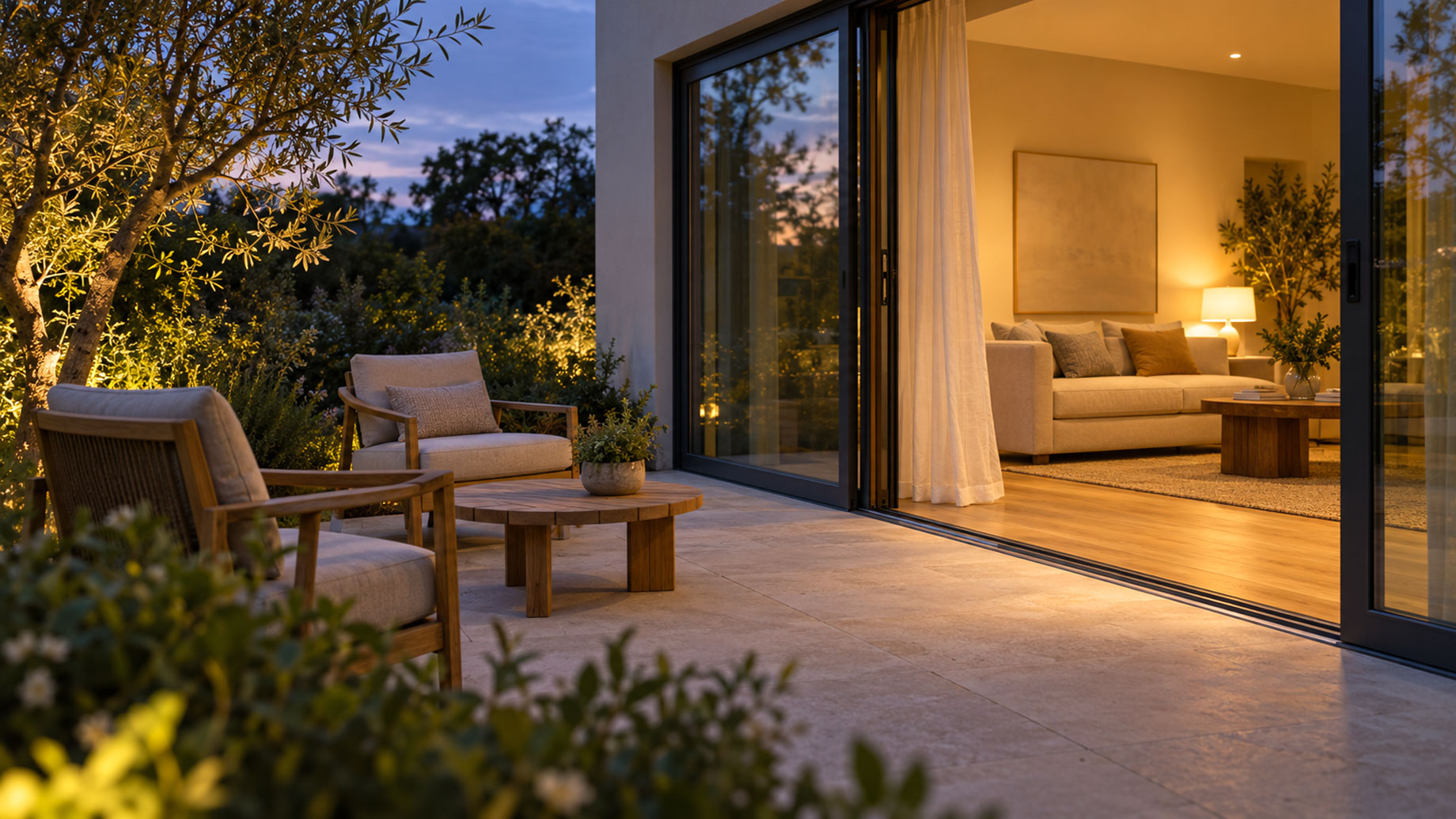
The last light catches a pale stone terrace while the interior beyond the glass begins to glow. A curtain moves slightly, and the camera approaches the threshold without crossing it. For a proposed residential design film, you could build the entire opening around that change of atmosphere. The subject would be the relationship between an outdoor sitting area and the room behind it.
You could explore this concept with Seedance 3.0 AI Video Generator, using a terrace image as the visual starting point and a written brief to describe motion and light. The website presents text-to-video, image-to-video and multi-reference video creation. In this example, those capabilities would help turn a still design concept into a short moving study, rather than establish facts about a property for sale.
The imagined deliverable would be a mood film for a fictional residence, clearly labelled as a visualisation when presented. It would not stand in for a survey, an architectural drawing or verified listing photography. That gives you a precise creative task: express how a proposed terrace could feel at dusk, while keeping the geometry and materials intelligible throughout the sequence.
Start with one convincing viewpoint
Your first reference could show the terrace from the garden side, with the glass doors occupying roughly half the frame. Favour a view with a readable threshold, a simple seating arrangement and a clear relationship between the floor and the facade. An image packed with furniture, reflections and decorative lighting would leave too many competing details for a short opening.
The material palette would stay narrow: pale stone, warm timber and a muted fabric on the chairs. Specify which materials should remain stable as the camera moves. In Seedance 3.0 AI Video Generator, the reference would guide appearance while the prompt would describe what changes over time. The stone should not become marble halfway through the clip simply because the light becomes more dramatic.
Keep the terrace unoccupied. For this particular concept, a person walking through the doors would distract from the spatial connection you want to show. A slight curtain movement and a restrained shift of reflected light would provide enough life. The film would invite the viewer to imagine inhabiting the space without adding an invented resident to it.
Move towards the threshold, not through the walls
A slow forward camera move would be a strong starting point. It would begin with a little planting in the foreground and end where the terrace meets the interior. The distance would be modest, so the viewer could understand the spatial relationship without expecting an exact walkthrough of an unseen floor plan. Avoid a continuous flight through several rooms.
Your shot direction could read: “Twilight residential terrace concept. Move slowly forward from the garden edge towards the open glass doorway. Preserve the reference facade, chair positions and pale stone floor. Warm interior lighting contrasts gently with the cool evening sky. A light curtain moves slightly. Keep architectural lines stable and do not introduce additional rooms, doors or furniture.”
Seedance 3.0 AI Video Generator can accept video references within its multi-reference workflow, so you could consider adding an original camera-movement example. Its purpose would be the pace and steadiness of the approach, not the architecture shown in that clip. State this distinction explicitly and keep the terrace image as the main reference for the design itself.
Let twilight reveal the materials
The second shot would move closer to the transition between stone and timber. A low but natural viewpoint could show the edge of the terrace floor and the warmer surface inside. Instead of transforming day into night within one generation, ask for a consistent moment of dusk. A stable lighting condition makes the material contrast easier to read.
Maintain the direction of the remaining daylight across both shots. If the sky is brighter on the left in the opening, the next angle should not imply a new light source on the right. The prompt would mention the warm interior glow and the cooler outdoor fill together. Neither should flatten the space or obscure the door frame.
A plausible problem in a Seedance 3.0 AI Video Generator version would be a reflection that behaves like another doorway. A revision could reduce reflective complexity, narrow the camera angle and describe a simpler glass surface. Regenerate the affected shot rather than keep a beautiful but confusing reflection. In an architectural film, a viewer should understand where the space continues.
Keep the ending within the same evening
For the closing image, return to a slightly wider view of the terrace. The interior light would now be the visual anchor, but the sky would retain enough colour to hold the scene together. Keep the same chairs and plants in their established positions. The ending should feel like a quiet continuation, not a different house assembled from similar materials.
If the selected workflow offers a suitable video extension option, describe that next moment using the same references and lighting language. Otherwise, separate generated shots could be joined in an external editor. Seedance 3.0 AI Video Generator would provide the moving scenes; the edit would determine their final order and duration. Check available settings rather than promise a fixed format across every model option.
Sound would be equally restrained. A soft outdoor atmosphere, a little fabric movement and a low interior room tone would suit the scene. The site describes generation of sound with video and the use of audio references. Supply only permitted recordings and avoid inventing a conspicuous ocean, fountain or wildlife sound that changes the implied location of the residence.
Spend revisions on spatial clarity
Your generation budget should prioritise the threshold shot because it carries the design idea. Before producing variants, check the current plan and the credit estimate for the selected settings. Reserve room for correcting a shifting chair, an unstable frame or an exaggerated reflection. Those changes matter more to this film than collecting many different sunset colours.
Two variations could be enough to explore the central creative choice: should the camera stop outside the doorway, or move just close enough to emphasise the flooring transition? Compare them for spatial clarity and atmosphere. A longer camera journey would not automatically make the residence feel more generous; it might simply introduce geometry that the source material never established.
The final film would contain a clear opening approach, a material detail and a calm wider ending. Any project name or visualisation label would be added as readable typography in editing. With Seedance 3.0 AI Video Generator, aim to create a coherent moving impression of one terrace at one time of day. The strongest result would let light, materials and a measured camera move tell the story of the space.
