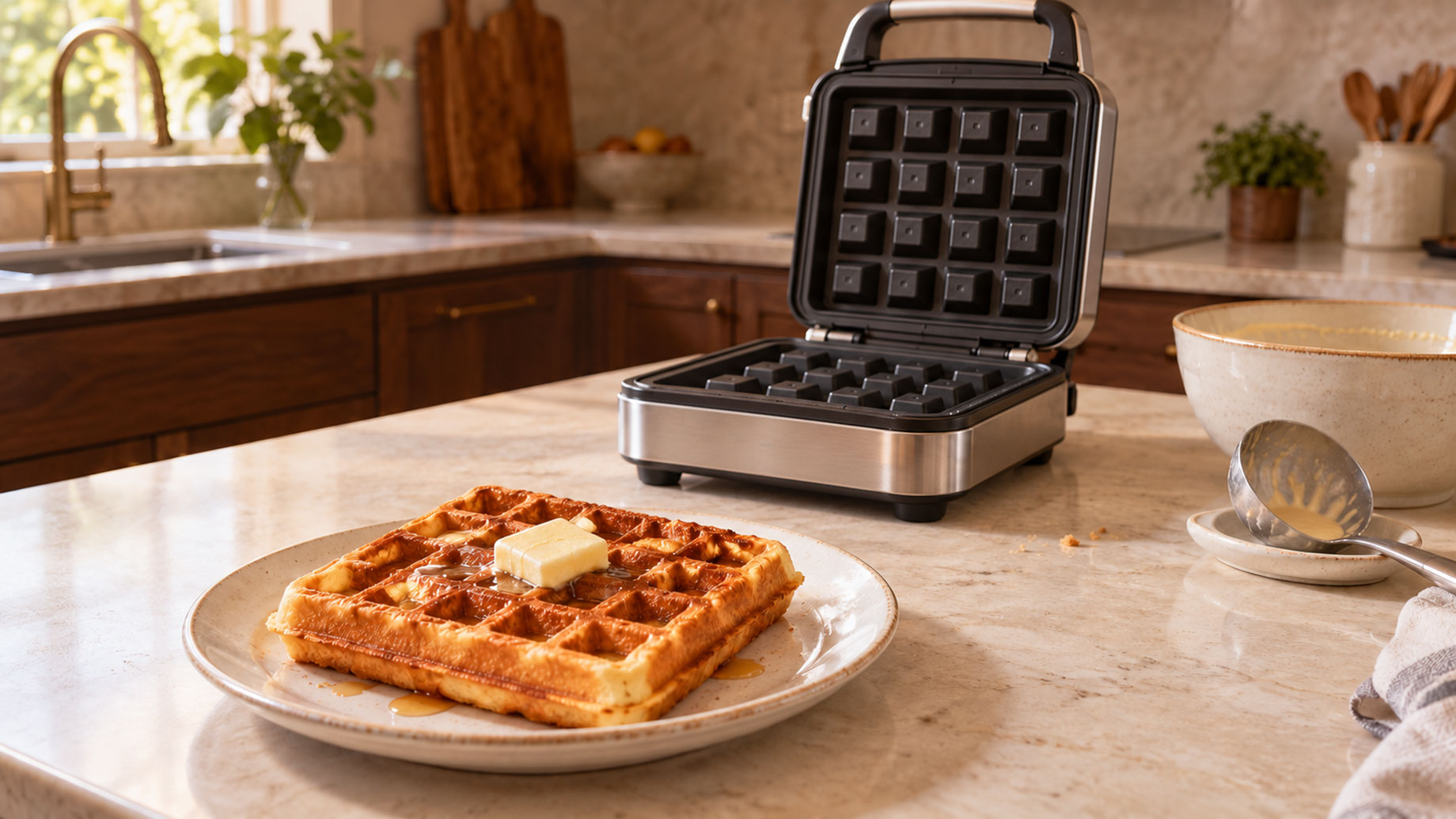
A home baking station earns its space when it makes the food you enjoy easier to prepare. For a household that regularly makes waffles, the useful design questions begin with batter, hot plates and the route to the breakfast table. A handsome cabinet cannot compensate for a work surface that becomes crowded as soon as the appliance opens.
Start with the breakfast, not the cabinetry. Before specifying a dedicated nook, watch how ingredients, bowls, finished waffles and used utensils move during an ordinary morning; the awkward moments in that familiar routine will tell a designer far more about your needs than a photograph of a perfectly styled kitchen with nothing cooking.
Draw the path from ingredients to the table
Begin with an empty counter and the items you actually use. Put out the recipe, scales or measuring tools, mixing bowl, portioning utensil and serving plates. Add the waffle maker with its lid fully open, following the working clearances in its manual. Then notice which objects need to stay within reach and which could be put away after preparation.
The sequence matters. Mixing batter may require a broad clear surface at the beginning, while the cooking stage needs a smaller group of tools beside the appliance. A layout that treats every object as a permanent resident of the counter can feel cramped even when the room has ample space.
Draw separate routes for the cook and the people eating. Someone collecting a cup or opening the refrigerator should not have to squeeze past the hot cooking position. In a shared kitchen, ordinary movement deserves as much attention as the position of the featured appliance. Ask another person to walk through the room during a rehearsal.
Keep the drawing simple. Label the mixing position, cooking position and serving destination, then add the places where used equipment accumulates. This is a household planning tool rather than a construction specification; installation, ventilation and electrical decisions still belong with the appropriate qualified professional and the appliance manufacturer.
Give waffle preparation a clear working surface
Batter preparation creates a short-lived but real demand for space. Ingredients need to be measured, a recipe needs to remain readable and the bowl needs a stable position. Choose a surface that can support those jobs without placing the recipe under a bag of flour or asking the cook to balance a measuring jug beside the edge.
UDTECH’s food knowledge guides connect waffle and pancake preparation with the behaviour of ingredients and the intended texture. That perspective helps explain why a baking station is more than appliance storage. The cook needs room to follow the method consistently, including the measuring and mixing steps that happen before the iron is ready.
Consider where ingredients return after use. A drawer or shelf close to the mixing area may be convenient, but storage conditions must suit the actual products. Follow packaging instructions for perishable ingredients and keep the food-handling arrangements clear. An attractive open shelf is not automatically the right place for everything in a breakfast recipe.
Leave a place for the portioning utensil. If the person cooking has to carry it across the kitchen after every deposit, a small practical omission can become the main irritation in the room. Test a suitable rest or tray with the utensils you own before asking a joiner to build a permanent solution.
Separate cooking access from the serving display
Open the appliance during planning. When a proposed breakfast cabinet looks spacious with its doors closed but forces the user to bend around a shelf, reach over a hot lid or move the maker whenever a serving plate arrives, the design has solved storage while leaving the actual cooking problem untouched. Revise it before installation.
Check the manufacturer’s instructions for operating location, clearances and electrical connection. Do not assume that an appliance may be used inside a cabinet simply because it fits there. Storage dimensions and operating requirements answer different questions. If the directions are unclear, obtain a model-specific answer before committing to the cabinetry.
The guest-facing display can sit elsewhere. Fruit, cups and tableware do not all need to occupy the same surface as the hot iron. Moving a decorative tray away from the cooking position may give the operator more freedom while keeping the breakfast arrangement attractive from the dining side.
Make the handoff visible. A clear place for finished portions reduces the need for guests to ask the cook where to stand or whether something is ready. Keep children and other visitors out of the hot working area, with a responsible adult controlling the appliance throughout use.
Protect the texture you designed breakfast around
Space planning also affects the finished food. If the household values a crisp waffle, rehearse what happens after it leaves the iron: where it rests, when it receives a topping and how far it travels before someone eats it. Judge the actual plate at that point, rather than assuming the first impression beside the appliance will last.
The UDTECH food and baking knowledge site brings together guides to waffles, pancakes and texture problems. It is a useful background resource when deciding which part of a breakfast routine needs attention. Use those explanations to frame a trial, while keeping recipe-specific preparation and food-handling instructions with the recipe itself.
Define the preferred result. A softly topped waffle served immediately may suit one household perfectly, while another wants a more pronounced surface contrast; the layout should support that chosen meal instead of borrowing an image of breakfast whose portions, timing and toppings are quite different from your own. There is no single ideal arrangement.
A surface for finished food should be part of the plan, but it is not a substitute for a suitable handling method. Longer holding, storage or reheating needs appropriate instructions for the food concerned. Texture observations cannot establish safety, and a kitchen design should never depend on an improvised shortcut.
A practical brief for a household waffle station
| Part of the routine | Space to identify | Evidence before choosing a layout |
|---|---|---|
| Measuring and mixing | A stable clear preparation area | The actual bowl and measuring tools laid out together |
| Cooking each portion | An operating position with proper access | Model-specific clearances and a lid-open rehearsal |
| Serving breakfast | A handoff point clear of the hot work | A complete plate carried through the planned route |
| Putting the kitchen away | Cleaning and storage positions | Instructions for cooling, cleaning and storing the appliance |
Plan for the kitchen after breakfast
Walk through cleanup before choosing finishes. Where will the mixing bowl go? Can the counter be wiped without moving decorative objects one at a time? Does the appliance need to cool in its operating position before it can be stored? The answers reveal whether the station is easy to live with after the meal is over.
Cleaning instructions differ between appliances. Removable plates do not necessarily belong in a dishwasher, and a fixed cooking surface may require a particular method. Read the manual rather than treating a product photograph as evidence of easy maintenance. A finish chosen for appearance should also suit the cleaning products and methods its maker permits.
Think about the next user. When one person puts the waffle maker away and another prepares breakfast the following weekend, clearly assigned storage for its permitted utensils, removable parts and instructions can prevent a series of small searches that gradually make a dedicated station feel less convenient than an ordinary cupboard. Make the arrangement easy to understand.
Allow the station to rest. A breakfast nook may also support drinks or food preparation at other times, provided those uses fit the available space and operating requirements. Avoid filling every shelf with objects that belong to one occasional meal. A little unused room can make the kitchen more adaptable.
Turn the rehearsal into a concise design brief
Bring observations to the design conversation. Note the actual appliance model, the dimensions with the lid open, the tools used for batter and the route to the table. Ask the designer to explain how the proposed arrangement handles each of those details. This gives both sides a concrete problem to solve.
- Measure the complete operating arrangement rather than only the closed appliance.
- Keep the mixing area large enough for the recipe and tools you really use.
- Separate guest movement from the hot cooking position.
- Test waffle texture with the intended topping and serving route.
- Include cleanup, cooling and storage in the design discussion.
A successful baking station should feel calm during ordinary use. Materials and styling give it character, but the routine determines whether it remains enjoyable. When a household can prepare its favourite waffles, serve them as intended and put the kitchen away without awkward workarounds, the design has earned its place.
