Renovating an outdated interior does not always require stripping the space back to its structural shell. In many projects, the existing walls, floors, and finishes are still structurally sound even though their appearance is dated. This creates an important choice: should the project become a full gut renovation, or can the existing surfaces be transformed with a no-demo approach?
Microcement has become one of the materials associated with the second strategy. Its thin application allows it to be installed over many existing surfaces, making it possible to change the appearance of a room without automatically removing everything that is already there.
For homeowners and commercial property owners, the difference can be significant in terms of disruption, waste, project complexity, and the amount of existing construction that needs to be disturbed.
What is a no-demo remodel?
A no-demo remodel focuses on transforming an existing space while retaining as much of the existing construction as possible. Instead of removing every wall finish, floor, or countertop, the renovation team evaluates what can remain and builds the new design around structurally sound surfaces.
Microcement is well suited to this philosophy because it is a thin coating that can be applied over suitable existing substrates. Craftex describes applications over tile, concrete, plaster, wood, and other solid surfaces, provided that the substrate is properly prepared.
The result can be a substantial visual transformation without the amount of demolition associated with a conventional gut renovation.
What happens during a full gut renovation?
A full gut renovation takes a fundamentally different approach. Existing finishes, fixtures, cabinetry, flooring, walls, or other elements may be removed so that the space can be rebuilt according to a new plan.
This approach is appropriate when the underlying structure or systems need major work. Outdated plumbing, electrical infrastructure, damaged substrates, poor layouts, structural problems, or major changes to room configuration may all justify extensive demolition.
A gut renovation therefore provides greater freedom at the construction level. It allows the project team to change the space more fundamentally rather than working within the constraints of the existing layout.
The disadvantage is that more demolition usually means more debris, more labor, more coordination, and a longer period during which the property cannot be used normally.
When does a no-demo approach make more sense?
A no-demo remodel can be particularly effective when the existing substrate is stable but visually outdated. A bathroom with unattractive tile, for example, may not require complete demolition if the tile is firmly bonded and the underlying construction is suitable.
Microcement can then be applied after appropriate preparation. Craftex recommends cleaning and repairing the substrate, applying primer, building the base and finishing layers, sanding as necessary, and protecting the finished surface with an appropriate sealer.
This approach can preserve the underlying construction while creating a completely different visual result.
Does microcement really eliminate demolition?
It can reduce demolition, but “no-demo” should not be interpreted as “no preparation.” Surface preparation remains one of the most important parts of the process.
Existing tile must be stable. Grout joints need to be leveled so that the original tile pattern does not telegraph through the new finish. Damaged or moving surfaces must be repaired before microcement is applied.
A professional assessment is therefore essential. If the substrate is failing, removing the old finish may still be the correct solution.
What are the benefits of avoiding demolition?
The first advantage is reduced disruption. Removing tile, flooring, and other finishes can create substantial dust and debris. A no-demo strategy can avoid much of this work.
The second advantage is thickness. Craftex microcement systems are typically around 1 to 3 mm thick, meaning the new finish adds very little height. This can be important around door thresholds, transitions, fixtures, and built-in elements.
The third advantage is visual continuity. Instead of replacing one tiled surface with another tiled surface, microcement can create a continuous finish across floors, walls, counters, and other elements.
When is a full gut renovation the better option?
A full renovation remains the right approach when the problems are structural or functional rather than purely aesthetic.
If the plumbing needs to be relocated, electrical systems require major replacement, walls need to move, water damage has compromised the substrate, or the room layout needs to change substantially, simply applying a new finish is unlikely to solve the underlying issues.
The same principle applies to severely damaged tile or unstable floors. A decorative coating should never be used as a substitute for repairing a failing substrate.
The decision should therefore start with the condition of the building rather than with the preferred finish.
Which approach produces less construction waste?
A no-demo remodel generally has the potential to reduce waste because fewer existing materials are removed. Craftex specifically presents microcement as a renovation-friendly material because it can often be installed directly over existing finishes.
The material itself is also promoted by Craftex as an eco-conscious system incorporating recycled aggregates and water-based resins, with EC-1 Plus certification for very low emissions.
A full gut renovation can still be the more responsible choice when existing construction is damaged or unsuitable. Keeping defective materials in place simply to avoid demolition does not create a better renovation.
How does the design potential compare?
A full gut renovation provides maximum freedom because almost everything can be redesigned. Walls can move, plumbing can be relocated, cabinetry can be replaced, and completely new materials can be introduced.
Microcement provides a different type of design freedom. Craftex offers more than 120 colors and multiple textures, including Eco Cement and Metallic finishes. The system can be used across floors, walls, ceilings, countertops, furniture, stairs, fireplaces, and other surfaces.
This makes it particularly attractive for projects where the desired transformation is primarily visual and material rather than structural.
Which approach is more appropriate for a high-end remodel?
Luxury does not automatically require demolition. A sophisticated renovation can be based on carefully preserving the elements that are still valuable and replacing only what needs to change.
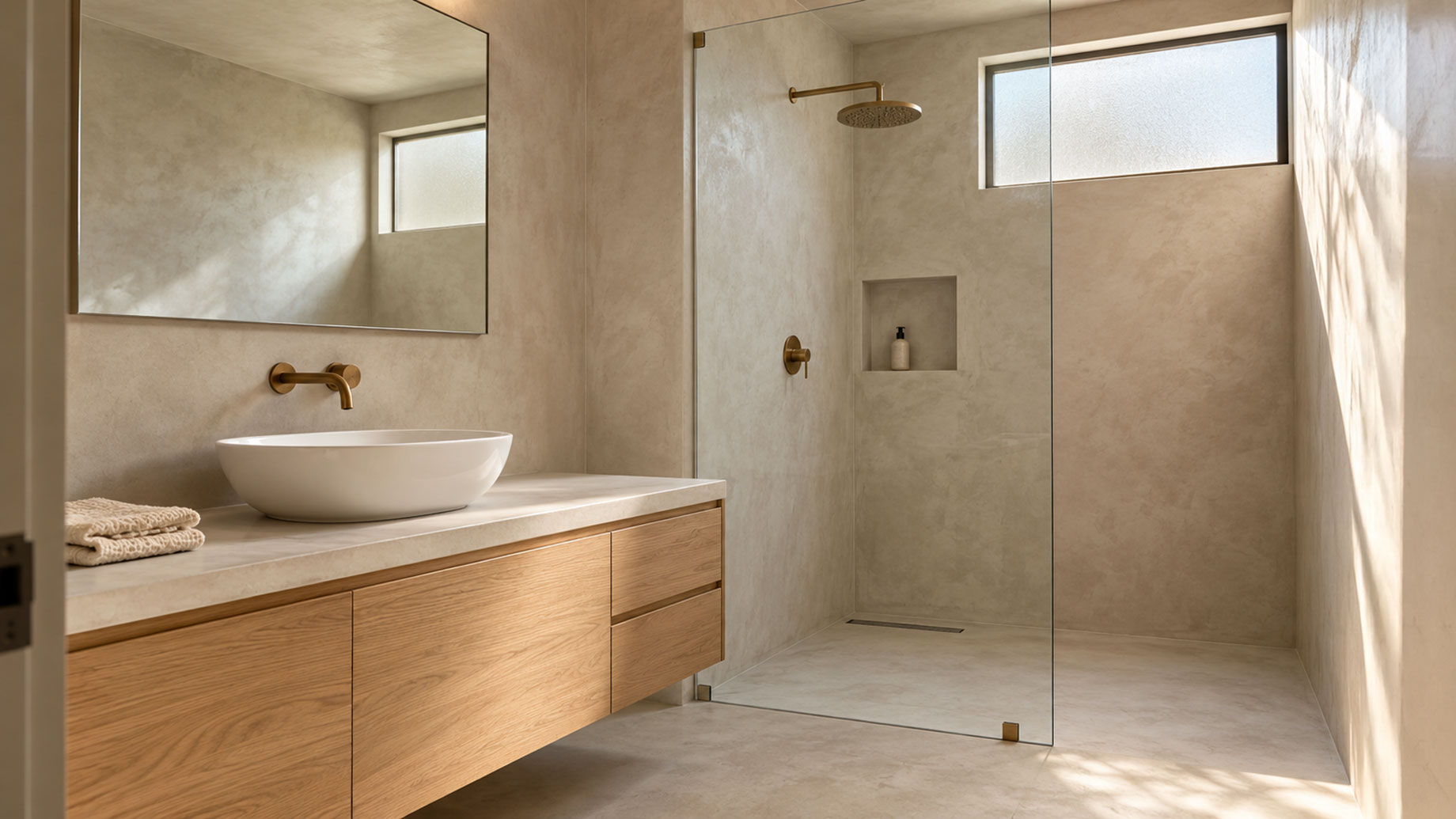
Microcement can support this approach by creating a continuous architectural language across multiple surfaces. A bathroom, for example, can use the same family of finishes across the floor, walls, shower, vanity, and other elements.
Craftex has developed its system for residential as well as commercial applications, with finishes designed to range from subtle concrete-inspired surfaces to more expressive metallic effects.
The final result depends heavily on substrate preparation and application quality, which is why an experienced installer is essential.
No-demo or gut renovation?
The answer depends on what the property actually needs. If the underlying construction is sound and the primary objective is to modernize the appearance, a no-demo remodel with microcement can be an efficient alternative to full demolition.
If the property has structural, plumbing, electrical, moisture, or layout problems, a full renovation is usually more appropriate.
For homeowners considering the no-demo route, Craftex provides a strong example of what modern microcement systems can offer. Its products are designed for application over suitable existing surfaces, are available in a broad range of colors and textures, and can create seamless finishes throughout residential and commercial spaces.
The most effective renovation is not necessarily the one that removes the most material. It is the one that addresses the actual condition of the property while achieving the desired architectural result.
