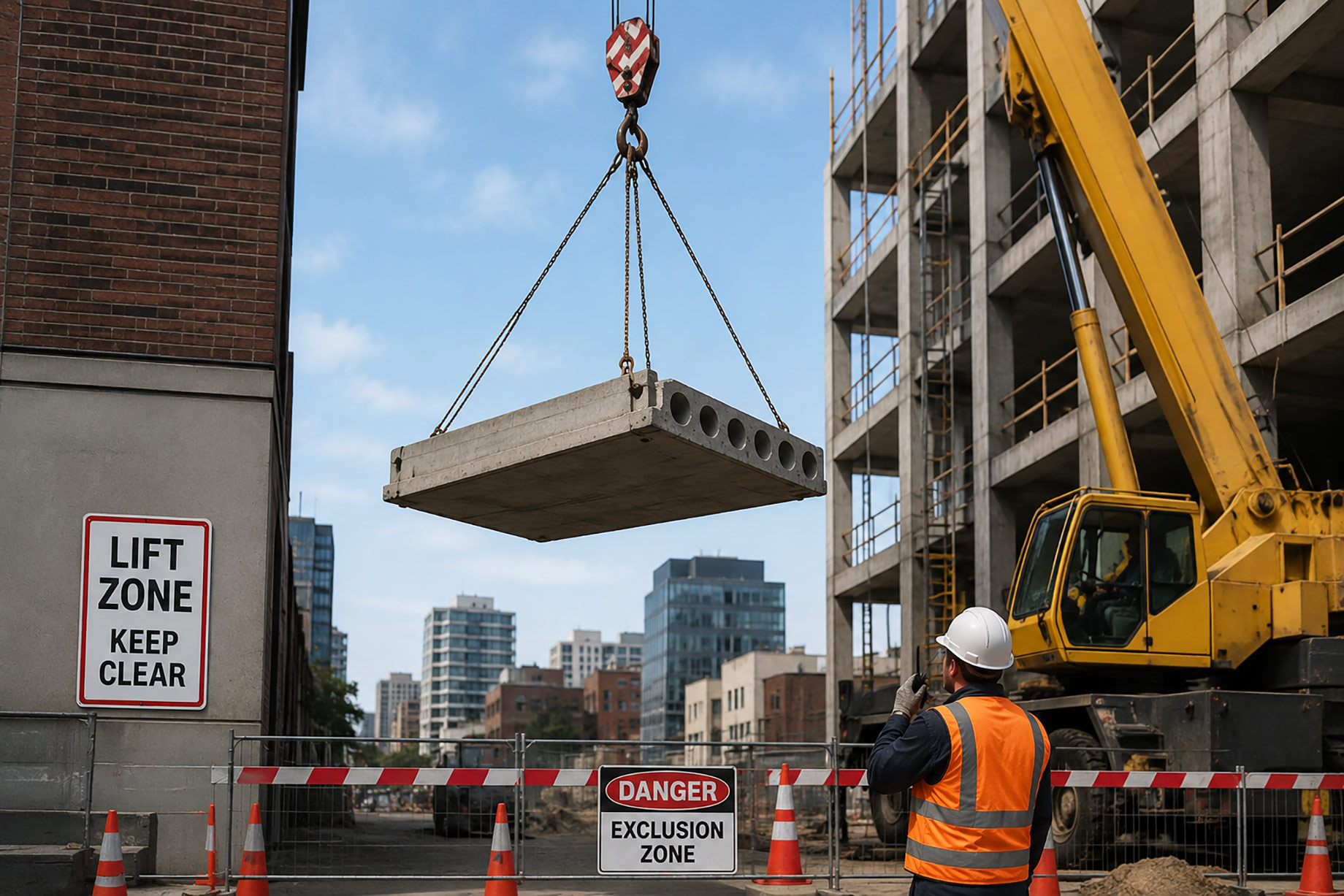
Urban construction sites may have limited storage, narrow access, public traffic, nearby buildings, and restricted crane positions. A lifting plan must coordinate equipment, deliveries, exclusion zones, and neighbors.
The goal is to move loads without improvising in a space that has little room for error.
Survey the Site
Record:
- Access width and height
- Ground and slab capacity
- Overhead lines
- Nearby structures
- Public roads and sidewalks
- Underground services
- Crane setup area
- Landing zones
- Wind exposure
Verify dimensions rather than relying only on early drawings.
Build a Delivery Schedule
Confined sites cannot store large quantities. Link lifting slots to delivery times.
Confirm vehicle size, arrival route, unloading position, and waiting restrictions.
Provide a contingency for delayed trucks or unavailable landing areas.
Define Every Load
Record weight, dimensions, center of gravity, lifting points, packaging, and destination.
Include lifting beams, pallets, and attachments in the total.
Long panels may be difficult because of wind and rotation even when they are not heavy.
Select Rigging
Use compatible slings, shackles, hooks, clamps, and edge protection.
A range of lifting and rigging equipment can support different hitches and load types, but every component must match the configuration.
Calculate sling-angle effects and identify the lowest-rated part.
Choose Site Equipment
Tower cranes, construction hoists, suspended platforms, mast climbers, and smaller hoists each serve different movements.
Construction lifting equipment should be selected by height, reach, route, load, access, and project phase.
Equipment carrying people needs the correct design and rescue planning.
Verify Support
Check crane bases, outriggers, mast ties, beams, anchors, and floor loading.
Temporary works engineering should include sequence and nearby excavation.
Monitor ground or structure changes during the project.
Control the Public Interface
Use barriers, permits, marshals, and scheduled closures where loads could affect public areas.
Never rely only on a person shouting warnings. Define a controlled exclusion zone.
Coordinate with local authorities and neighbors when regulations require it.
Plan the Load Path
Draw the path from truck to landing area. Check clearances at every point.
Avoid passing over occupied areas. Confirm what happens if the load cannot land.
Prepare the receiving crew and onward movement before lifting.
Account for Wind
Urban buildings can create turbulence. Follow equipment and lift-plan wind limits.
Use tag lines only where workers can remain safe. Stop when control or visibility is lost.
Light sheets and façade panels may need stricter limits.
Coordinate Communications
Assign one signaler and a standard signal system. Use radios where visual contact is interrupted.
Test radio coverage among buildings and inside the structure.
Everyone should understand the emergency stop signal.
Schedule High-Risk Lifts
Choose periods with lower public traffic and suitable weather.
Complete permits, briefings, equipment checks, and trial movements before the delivery arrives.
Avoid schedule pressure that encourages shortcuts.
Prepare for Failure
Plan for power loss, weather change, blocked roads, equipment faults, and a load that cannot be placed.
Define safe holding or return options. Keep emergency contacts and rescue procedures available.
Do not invent a new rigging method during the lift.
Review as the Site Changes
Access and crane reach change as the building rises. Review the plan by project stage.
Remove outdated routes from drawings and brief new crews.
Use incident and delay data to improve delivery slots.
Coordinate Permits and Neighbors
Urban lifts may affect roads, sidewalks, nearby businesses, residents, and public transport. Confirm permit lead times early and identify restrictions on working hours, noise, vehicle size, and temporary closures. A technically sound lift can still fail if the required public-space approval is missing.
Give affected neighbors practical notice: the date, duration, access changes, and a contact for urgent concerns. Coordinate waste collection, deliveries, and emergency access. Good communication reduces last-minute conflict and helps the crew maintain the approved exclusion zone.
Rehearse Critical Movements
For complex lifts, walk through the sequence with the crane operator, rigger, signaler, supervisor, and delivery driver. Use drawings or a simple digital model to check tail swing, boom clearance, landing orientation, and worker positions. Confirm where each person moves as the load changes direction.
A rehearsal should include stop signals and loss-of-communication actions. It can also reveal that a load needs different lifting points or must arrive in another orientation. Resolving these details before the crane is committed saves valuable site time.
Measure and Improve
Record actual delivery time, setup time, lift duration, delays, near misses, and changes to the original plan. Compare the record with the estimate after each major lift. Even a short review can identify recurring problems such as late trucks, blocked access, or unsuitable packaging.
Feed these lessons into later lift plans as the building rises and access becomes tighter. Continual improvement is especially valuable on urban projects, where small planning gains can prevent costly disruption.
Confirm the Landing Area
The receiving area deserves the same attention as the crane position. Verify its capacity, dimensions, edge protection, lighting, access, and ability to hold the load after the lifting gear is removed. Confirm how workers will guide, release, and move the item without standing beneath it or between trapping points.
Prepare dunnage, temporary supports, tools, and fixings before the lift begins. Mark the final orientation and centerline clearly. If the load cannot be secured immediately, define a stable temporary condition and protect it from wind or accidental movement. A well-prepared landing area prevents the last few meters from becoming the most dangerous part of the operation.
Conclusion
Confined urban lifting depends on accurate site information, scheduled deliveries, verified supports, compatible rigging, and control of the public interface.
Plan the complete load path and credible failure scenarios. When lifting and logistics are managed together, the project can use limited space more safely and efficiently.
