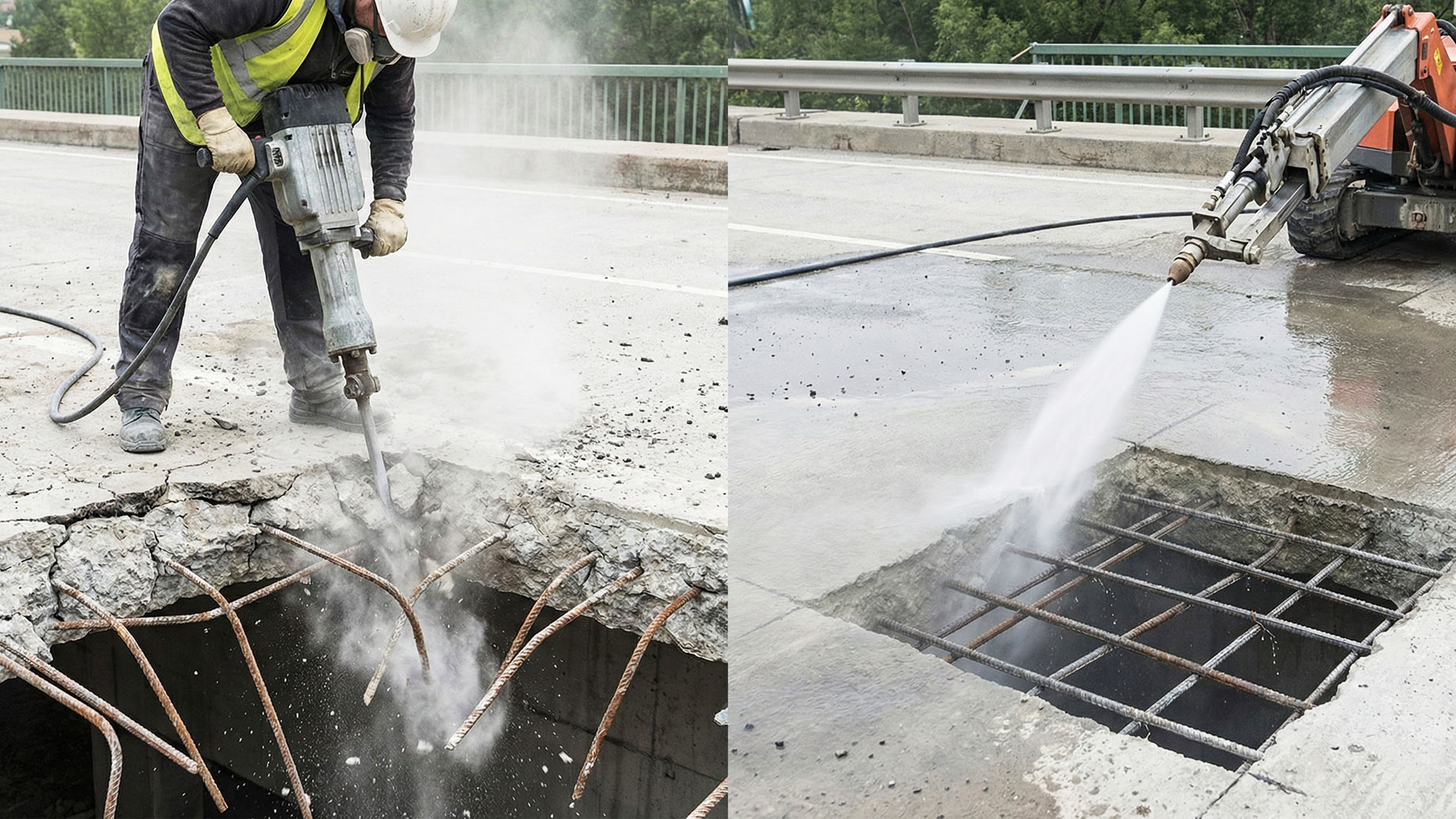
Looking for the most effective and least destructive way to remove damaged concrete?
If you’ve been in the construction industry for a while, you’ve undoubtedly had to deal with the challenging task of concrete removal. Traditional methods like jackhammers, pneumatic tools and mechanical breakers have been around for years and continue to be widely used. However, the cost in terms of time, money and impact on the structure is significant.
But what if there was a better way?
Hydrodemolition is the process that uses high-pressure water to precisely remove damaged concrete. In this post, we compare traditional demolition techniques with hydrodemolition and show when each method makes the most sense for your project.
What You Will Learn:
- What is Hydrodemolition?
- Traditional Demolition Methods
- The Major Differences
- Choosing The Right Method
What is Hydrodemolition?
Hydrodemolition is a process where high-pressure water jets are used to selectively remove concrete. The water is usually at a pressure between 15,000 and 42,000 PSI and is projected using a specialised robotic device. The force is enough to effectively blast away the concrete.
Hydrodemolition can be used for both selective demolition of deteriorated sections and the complete removal of concrete to certain depths. The high-pressure water is able to achieve this by penetrating the surface and creating internal pressure within the pores of the concrete. This eventually causes the concrete to break away.
Professional hydrodemolition services make use of purpose-built robotic equipment to spray the water across concrete surfaces. The amount of pressure used can be adjusted as required for the job.
The technology has been developed over the past several decades and is currently used in a variety of applications across the construction industry.
Traditional Demolition Methods
Traditional demolition is simply breaking apart a structure with physical force. The most commonly used tools for this purpose include:
- Jackhammers – Hand-held pneumatic devices that chip away at concrete using repeated blows.
- Hydraulic Breakers – Mechanical devices that are mounted and used for larger and more industrial demolition.
- Mechanical Scarifiers – Machines that grind and scrape the surface of concrete.
These methods have been used for many years and as a result are widely available and very familiar to most contractors. However, being more common does not necessarily mean that they are better.
One of the biggest downsides of mechanical demolition methods is the vibrations that are created with each blow. As the hammer hits the concrete, shockwaves are sent throughout the rest of the structure which causes micro-cracks to form in the concrete. These micro-cracks are very tiny and almost unnoticeable at first.
However, the problem is that these fractures weaken the concrete and the bond between old and new concrete when it comes to repairs.
The Major Differences
Comparing hydrodemolition and traditional concrete removal, it becomes obvious that the methods have their pros and cons. This is why it is important to consider the major differences between the two.
Speed and Efficiency
Hydrodemolition is much more efficient than traditional mechanical methods. Industry statistics have shown that hydrodemolition is up to 25 times faster than traditional jackhammering techniques.
A single hydrodemolition robot can match the productivity of 20 or more mechanical jackhammers. The implications of this for time frames are massive. Projects that could have taken weeks or even months can now be completed in a matter of days.
Structural Integrity
A big issue with traditional mechanical demolition is the micro-cracks it causes. This happens because of the vibrations sent through the concrete when it is hit.
Hydrodemolition, on the other hand, creates zero micro-cracks. This is because water jetting removes only the intended material while leaving the rest of the concrete structure intact.
The result is a much stronger and longer-lasting repair.
Rebar Preservation
Something that is often overlooked…
Jackhammers hitting the reinforcing steel (rebar) within concrete damages the rebar and compromises structural strength. Bent and nicked rebar is weaker and usually needs to be replaced completely.
This can add more time and money to every project that requires rebar replacement.
The water used for hydrodemolition actually cleans the rebar by removing rust and corrosion at the same time while causing no mechanical damage. This means that the steel will come out almost brand new, ready to bond instantly with new concrete.
Worker Safety
Mechanical demolition produces high levels of silica dust which is a respiratory hazard for workers. This is because the dust is breathed in and over time can cause silicosis and other forms of lung damage.
Hydrodemolition limits worker exposure to silica dust significantly. This is because the water used during the process captures and suppresses the dust at its source.
The process also does away with the vibration injuries that are common with prolonged jackhammer use.
Noise Levels
If you have ever used a jackhammer, you will understand the high level of noise it produces. This is an issue in construction projects in cities where strict noise regulations are in place.
Hydrodemolition is significantly quieter. It also produces a different kind of noise. It is a constant water stream as opposed to the repeated and jarring mechanical blows of a jackhammer.
As such, it can be used in noise-sensitive areas, for example, hospitals and schools.
Environmental Impact
Environment-friendly construction is the buzzword today. Traditional demolition spreads dust and debris all over the place which end up in the surrounding areas.
Hydrodemolition works differently as the water contains all of the waste. This water runoff can be collected, filtered and then disposed of properly. Some hydrodemolition systems even recycle water for the same project.
When To Choose Each Method
In many cases, hydrodemolition is not always necessary. Understanding when to use traditional methods and when to choose hydrodemolition can help make the best decision for your project and budget.
Opt for hydrodemolition when:
- The integrity of the rebar is essential.
- The structure will still be in use after repairs have been made.
- Working in a noise-sensitive or dust-restricted area.
- Speed is of the essence.
- Durability of the repair is a concern.
Choose traditional methods when:
- Complete demolition of the structure is required.
- Budget is extremely tight for small projects.
- Access limitations make it impossible to set up robotic equipment.
- The concrete is free of reinforcing steel.
As a matter of fact, concrete structures typically need maintenance every 15 to 25 years. The method of removal used for repairs will determine how long before the next maintenance is due.
Cost Considerations
Equipment costs for hydrodemolition tend to be higher when compared to traditional tools. This can make it appear like a significant initial investment, especially for small contractors and one-off projects.
The total cost of the project though usually weighs in favour of hydrodemolition when the following aspects are taken into consideration:
- Shorter labour hours as a result of the faster completion times.
- No expenses on rebar replacement.
- Long-lasting repairs which will minimise maintenance.
- Lower risk of worker compensation claims.
- Minimal clean-up and disposal costs.
The more extensive the project, the greater the efficiency gains which make hydrodemolition very attractive. Bridge decks, parking structures and even highway repairs can benefit immensely from the process.
Smaller residential and commercial projects can still make use of traditional methods for financial reasons. However, this equation changes very quickly once the quality and longevity of the repair is considered.
Wrapping It All Up
Hydrodemolition is a significant improvement on traditional concrete removal methods. It offers faster project completion, better results and a safer work environment.
Traditional methods still have their use. But if concrete integrity, rebar preservation or the durability of the repair is a priority for your project, hydrodemolition is the better choice.
Selecting the appropriate removal method ultimately comes down to the requirements of the job. All of the factors that are important for a particular job should be taken into consideration. Speed, accuracy, safety, environmental impact and long-term durability are some of the most important considerations.
Choosing the right one will help you save money and a lot of hassle in the future.
