Going solar is one of the best financial decisions a homeowner can make. But the installation is just the beginning of a 25 to 30-year relationship with an energy system that needs to perform consistently every single day to deliver the return you planned for.
Most homeowners assume solar is a set-and-forget investment. The panels go up, the savings start, and everything runs automatically. That assumption is understandable. It is also one of the most expensive things a solar owner can believe, because without visibility into how a system is actually performing, problems go undetected. Production quietly drops. Savings slowly shrink. Months pass before anyone notices.
Solar Energy World’s live monitoring is built specifically to prevent that scenario. It is included with every installation at no additional cost, and it gives every SEW customer real-time visibility into their system from the moment they sign a contract through every year of operation.
What solar monitoring actually does
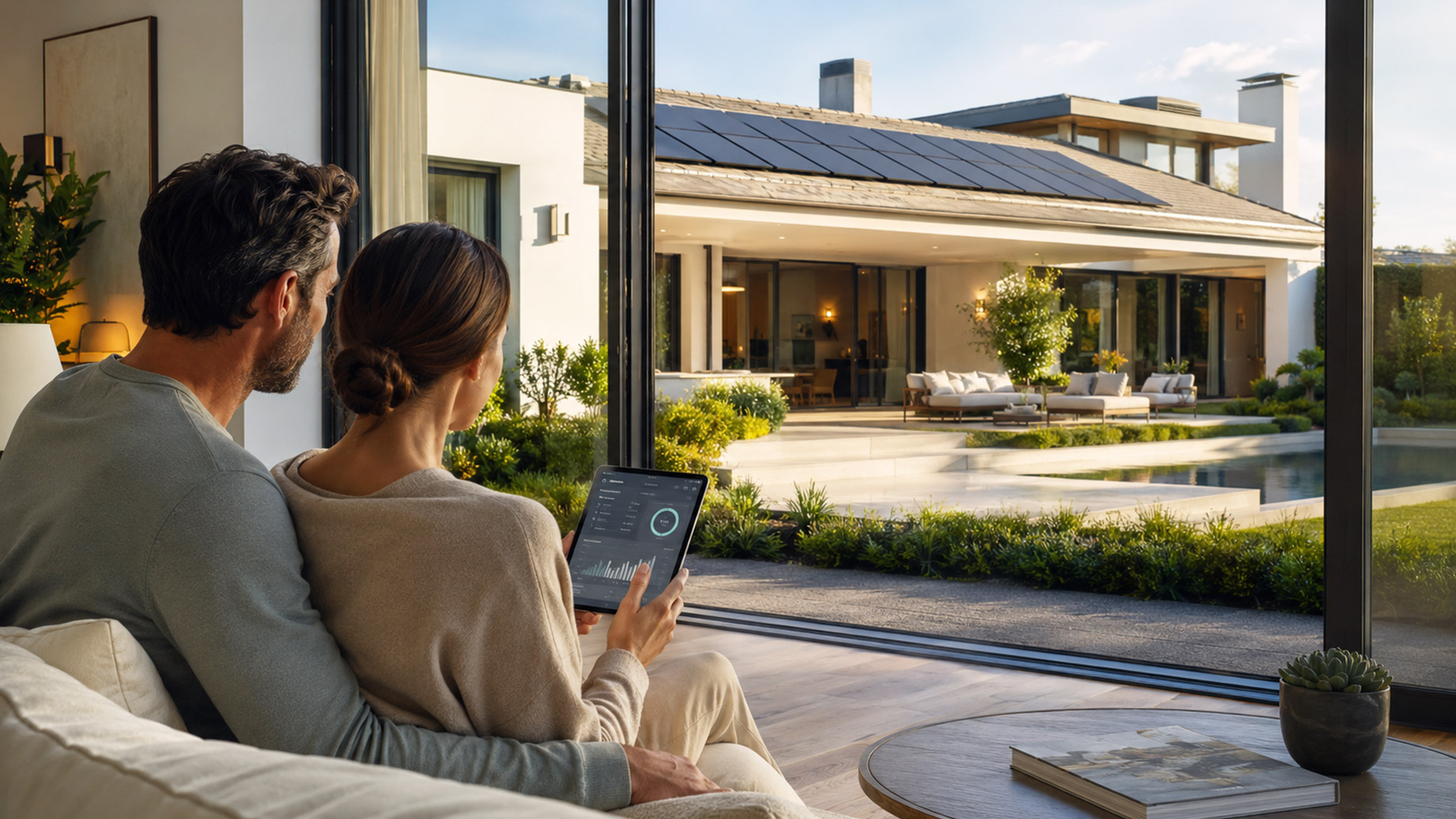
A solar monitoring system is the dashboard for your energy investment. It collects data from your inverter and system components, transmits it to a cloud platform, and presents it in a form you can read and act on from any device.
Think of it the way you think about the instrument panel in a car. You do not need to understand exactly how the engine works to know that the fuel gauge, the temperature warning, and the check engine light are essential. Without them, you are driving blind. A solar system without monitoring is the same situation: the panels are generating power, but you have no way to know how much, whether it is what you should expect, or whether something is quietly wrong.
The SEW monitoring app is available on iOS, Android, and as a web portal at portal.solarenergyworld.com. It is updated continuously, works on any device, and does not require manual updates. Customers receive login access as soon as they sign a contract, not just after installation, so they can follow the system through design, installation, and activation before a single panel ever goes on the roof.
What the app tracks
The SEW monitoring app tracks four core areas: energy production, energy consumption, battery usage for systems with storage, and long-term savings and environmental impact.
Energy production is the most fundamental metric. The app shows how much electricity your panels are generating at any given moment, broken down by day, week, month, year, and the lifetime of the system. It compares your actual output against expected benchmarks so you can see at a glance whether your system is producing what it should.
Energy consumption shows how much electricity your home is using. This is available when a consumption meter is installed alongside your solar system, and it reveals patterns that most homeowners have never seen before. When your panels produce more than your home uses at any given moment, the excess goes back to the grid under net metering. When they produce less, you draw from the grid. Seeing that flow in real time lets you make informed decisions, like running the dishwasher or charging an EV during peak production hours rather than pulling from the grid in the evening. Homeowners who actively shift consumption to align with production can increase their solar savings by 10 to 20%.
Battery usage is tracked for homeowners with storage systems. The app shows charge levels, charge and discharge patterns, and how much backup power is available at any given time. For homeowners using batteries for peak shaving or grid outage protection, this visibility is essential for getting the most out of the storage investment.
Long-term savings and environmental impact round out the picture. The app accumulates your savings data over time so you can see the return on your investment growing month by month and year by year. Environmental metrics, including CO2 emissions avoided and equivalent trees planted, translate your energy production into tangible impact numbers that are easy to share and understand.
Why monitoring is not optional
Research from KWh Analytics found that solar systems installed since 2015 have broadly underperformed expectations by 7 to 15%. The primary reason: problems that were never detected until it was too late to recover the lost production.
Every kilowatt-hour your system fails to produce is a kilowatt-hour you pay the utility company for instead. A 10% production loss on a system generating $1,500 per year in bill savings costs $150 per year. Over the remaining life of a 25-year system, an undetected and unfixed issue like that adds up to thousands of dollars in lost return. And 10% is on the modest end. Active monitoring can prevent production losses of 10 to 25% by catching issues early, before they compound.
Without monitoring, homeowners typically do not discover system failures until 30 to 60% of their system has already stopped working, often only after receiving an unexpectedly high electric bill. At that point, the lost production from the preceding weeks or months is unrecoverable.
With monitoring, production anomalies trigger alerts. A single underperforming panel shows up in the data. An inverter fault appears as an error code. A sudden production drop on a clear day points immediately to something other than weather. The difference between catching an issue on day two and catching it on month six is significant.
The most common issues monitoring catches
Solar systems are durable, but they are not immune to problems. Most of the issues that occur over a 25 to 30-year lifespan are detectable through monitoring data before they become expensive to fix.
Inverter faults are the most common source of system failures seen in the field. An inverter converts the DC electricity your panels generate into the AC electricity your home uses. When it fails or throws an error, production drops or stops entirely. Monitoring catches inverter events immediately, which means a service request can be filed before days of production are lost.
Soiling, meaning dust, pollen, bird droppings, or debris accumulating on panel surfaces, reduces output by 5 to 15% in typical conditions and can exceed 25% in high-dust environments. The gradual nature of soiling makes it invisible without monitoring. A homeowner checking their app regularly will notice a slow drift in production that does not track with seasonal expectations. One that never checks the app may not notice for months.
Shading changes are another category that monitoring catches cleanly. A neighbor’s tree grows taller. A new structure goes up nearby. The sun angle shifts seasonally. Any of these can introduce shading that reduces output, and a single small obstruction can cause up to 20% system-wide production loss depending on how the panels are wired. Monitoring data shows the impact immediately as a pattern in daily production curves.
Wiring and connection issues, including corroded connectors or loose terminations, typically show up as gradual or intermittent production drops. Critter damage, including rodent chewing on wiring under panels, appears similarly. These issues are unfixable until they are found, and they are unfindable without production data to flag them. SEW’s Triple Platinum 30-Year Warranty covers rodent damage when critter guards are installed at the time of installation, and monitoring is what makes those claims actionable.
Panel-level degradation above the expected rate of 0.5 to 0.8% annually is another monitoring catch. If a system is declining faster than normal, the historical data makes that visible in year-over-year comparisons. A sudden drop is a different story from natural degradation, and monitoring data tells you which you are dealing with.
Alerts and service requests through the app
When something needs attention, the SEW monitoring app does not make you go looking for it. Alerts notify you when production drops below expected thresholds, and service requests can be submitted directly through the app.
This is where the no-subcontractor model matters directly. When you submit a service request through the SEW app, the team that responds is the same company that installed your system. There is no third party, no referral to a separate service organization, and no question about who is accountable for the work. Every SEW crew member is a W-2 employee directly accountable to Solar Energy World.
Under the Triple Platinum 30-Year Warranty, all service-related labor is covered at no charge for the full 30-year term. That means no site visit fees and no labor costs when monitoring flags an issue and a technician comes to address it. The combination of monitoring that catches problems early and a warranty that covers the fix at no charge is what makes SEW’s post-installation support meaningfully different from what most homeowners experience elsewhere.
Monitoring and the first-year production guarantee
SEW’s Triple Platinum 30-Year Warranty includes a First-Year Energy Production Guarantee: if your system produces less than 90% of its estimated output in the first year, Solar Energy World reimburses you double the production difference.
That guarantee is only meaningful if the production data exists to verify it. The monitoring app is the mechanism that creates that record. Every kilowatt-hour your system produces is logged and timestamped. If year-one production falls short of the estimate, the data is right there to support the claim, documented and accessible through the same app you check every day.
Without monitoring, proving underperformance in year one requires piecing together utility bills and trying to reconstruct a production history that was never kept. With monitoring, the data is continuous, transparent, and held by a platform designed for exactly this purpose.
Why free monitoring is a meaningful differentiator
Residential solar monitoring platforms range from free to $100 or more per year depending on the installer and level of service. Some companies charge setup fees of $225 or more just to get monitoring configured. SEW includes live monitoring with every installation at no cost.
This is not a minor detail. Over a 25-year system lifespan, monitoring fees at $100 per year add up to $2,500 in costs that SEW customers simply do not pay. More importantly, the monitoring is integrated into the same app used for service requests, document management, referral rewards, and tracking the installation process itself. It is not a separate subscription bolted on after the fact. It is part of the complete SEW customer experience from contract signing through the last year of the warranty.
How to get the most from your monitoring data
Monitoring is most valuable when you know what normal looks like for your specific system. The first few months after activation are the best time to learn your system’s patterns so you can recognize when something is off.
Daily production follows a predictable curve: low at sunrise, peaking around solar noon between roughly 11 AM and 1 PM, and tapering off toward sunset. Output is naturally higher in summer than winter, sometimes 30 to 40% higher due to longer days and higher sun angles. These seasonal differences are expected and normal.
What is not normal: a sudden drop of 20% or more compared to expected output on a clear day; production that does not recover after a sunny stretch following a cloudy period; year-over-year decline that exceeds 1 to 2% annually; or zero production during daylight hours. Any of those patterns should prompt a service request.
When comparing performance, always compare the same month year-over-year rather than month-to-month. Comparing June to December will always show a difference. Comparing June this year to June last year tells you whether your system is healthy.
SEW’s own blog resource on reading your solar monitoring data walks through exactly how to interpret the data your app surfaces and what patterns to watch for over time.
Get started with a free solar estimate
A solar system that you can see and understand is a solar system you can trust. Solar Energy World includes live monitoring with every installation because protecting your investment over 25 to 30 years requires visibility, not assumptions.
Free in-home and virtual estimates are available for homeowners across Maryland, Virginia, Delaware, Pennsylvania, New Jersey, Washington D.C., and Florida. Your estimate includes a custom system design, a production projection, and a full overview of what monitoring will track from day one. To explore what solar looks like in your state, start there.
