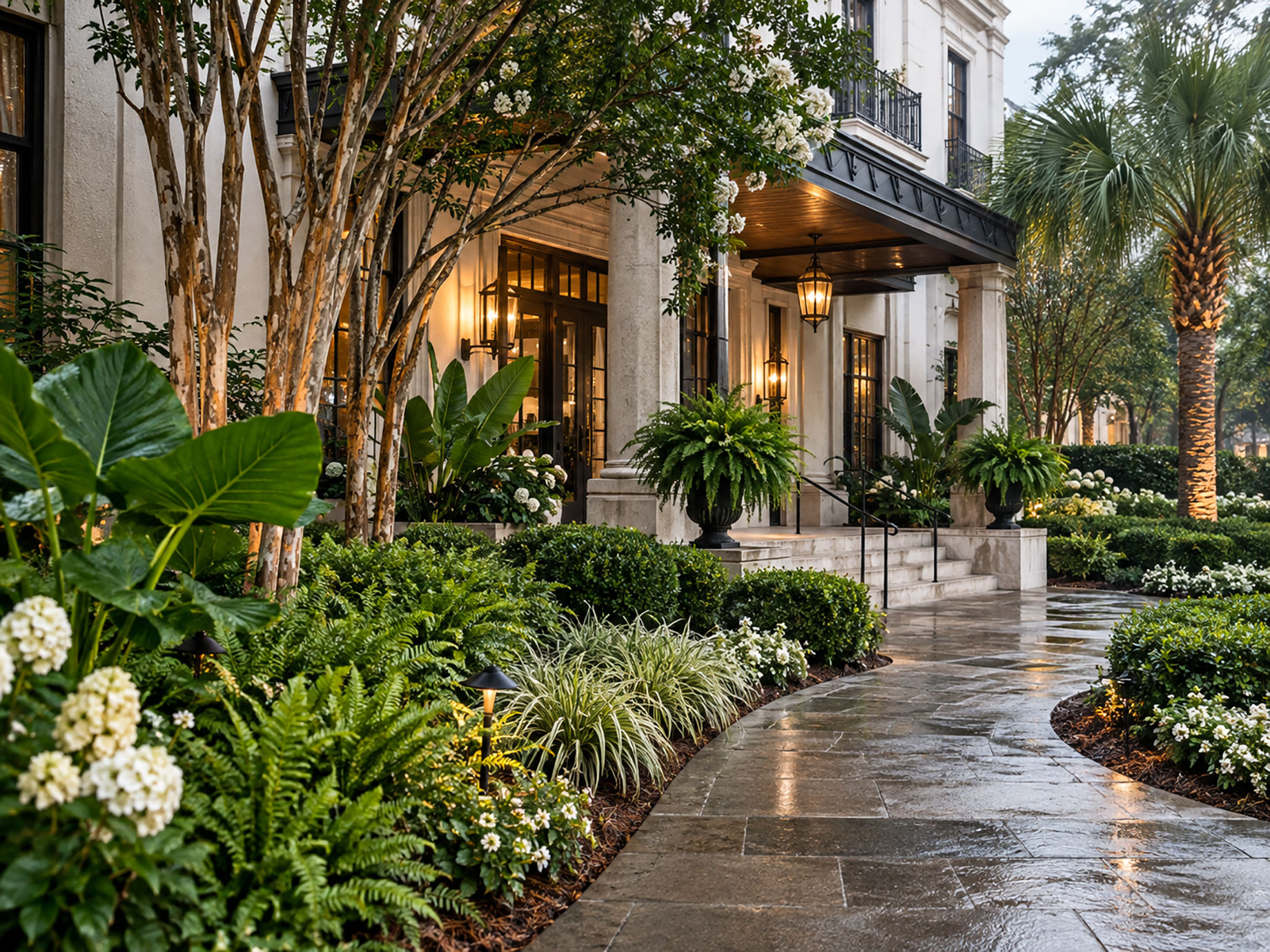
Choosing plants for a commercial property is not simply a matter of finding species that look good on installation day. Professional landscapers have to consider how those plants will perform through Southern heat, humidity, heavy rain, dry periods, foot traffic, maintenance cycles, and years of growth.
The best commercial landscaping plants fit the conditions and the job they are expected to do. That means balancing appearance with climate, property function, mature size, maintenance requirements, and long-term cost before a plant palette is finalized.
Start With the Southern Climate, Not the Plant Catalog
Commercial plant selection usually starts with the site itself. Sun exposure, soil conditions, drainage, rainfall, irrigation, and temperature all influence whether a planting will perform as intended.
Winter cold matters too. USDA plant hardiness zones describe average annual extreme minimum winter temperatures, helping landscapers assess cold tolerance. They do not replace separate checks for summer heat, drainage, light, or other site conditions.
Even within one property, conditions can vary considerably. A west-facing bed beside a parking lot may receive intense afternoon sun and reflected heat, while a courtyard on the same property stays shaded for much of the day. Low areas can remain wet after storms while elevated beds drain quickly. Coastal properties may also need to account for salt spray or saline irrigation water.
University of Florida guidance emphasizes the “right plant, right place” principle: plants should be matched to factors including climate, light, available space, soil, and water conditions.
That is why Southern landscaping plants cannot be selected according to region alone. Climate-adapted plants still need to match the specific microclimate in which they will grow.
Define What Each Planting Area Needs to Do
Plants for commercial properties are usually working as part of a larger design rather than functioning as isolated decoration.
At a hotel, landscaping might frame the entrance and help establish the arrival experience. A restaurant terrace may need greenery that creates separation without making the space feel enclosed. Office properties might use planting to soften large areas of masonry, define pedestrian routes, or screen loading and service areas.
Other plantings may provide shade, create privacy, add seasonal interest, or establish a visual transition between a building and surrounding outdoor spaces.
Those different objectives influence everything from height and density to texture and growth habit. Commercial landscape design therefore works best when the intended function of each area is decided before individual species are specified. A plant that performs well as a backdrop may be a poor choice beside a walkway, while an effective screening plant could become an obstruction near an entrance or window.
Match Plants to the Property’s Different Spaces
Large commercial properties are rarely treated as one uniform planting environment. Landscapers typically divide them into zones and select plants according to the demands of each space.
Entrances and High-Visibility Areas
Entrances, drop-off zones, and other customer-facing areas usually need plants with a predictable appearance and a scale appropriate to the architecture.
Because these areas influence first impressions, year-round structure can be particularly valuable. At the same time, plants need to remain manageable as they mature. A landscape that looks balanced when newly installed can become crowded if mature dimensions were not considered.
Plants should also be positioned so they do not obscure business signs, windows, doors, lighting, or architectural details.
Parking Lots, Walkways, and High-Traffic Zones
Parking areas and pedestrian routes create a different set of challenges. Pavement and nearby structures can produce hotter, drier conditions, while planting beds may have limited soil volume.
These locations also require careful attention to people and vehicles. Plants beside intersections, driveways, and pedestrian crossings need to preserve useful sightlines. Growth that extends into sidewalks can create ongoing trimming requirements and interfere with circulation.
UF/IFAS landscape guidance similarly recommends considering plant form, mature size, and the way a space will be used, including avoiding inappropriate plant forms around pedestrian areas.
Shaded, Covered, and Interior-Adjacent Spaces
Covered hotel entrances, courtyards, protected patios, atriums, and lobby-adjacent planting areas often receive very different levels of light from open landscape beds.
Where light, temperature, and moisture conditions are suitable, foliage plants can help add depth and texture without relying primarily on flowers. Some ferns suit shaded outdoor beds, while others are better suited to interiors or seasonal container displays. Light requirements and cold tolerance vary by species and cultivar, so a shaded or covered location alone does not establish suitability.
Scale also changes procurement. A hospitality or commercial installation may call for dozens or hundreds of repeated plants at comparable sizes so the finished space feels intentional. For projects specifying ferns across multiple shaded or protected areas, landscapers and interiorscapers may need to buy ferns wholesale rather than source individual containers one at a time. That makes quantity, uniform sizing, availability, and delivery part of the design process rather than an afterthought.
Calculate Maintenance Before Choosing the Plant
Installation cost is only one part of what a landscape costs over its lifetime. Irrigation, pruning, fertilization, pest management, cleanup, and replacement can continue for years.
That makes maintenance an important part of commercial plant selection.
A fast-growing shrub, for example, may look economical initially but become expensive if it repeatedly grows beyond its allotted space and requires frequent pruning. Flowering plants that continuously shed onto walkways or outdoor dining areas can also create more cleanup than the property team wants to manage.
Professional landscapers therefore assess low-maintenance landscaping plants at the scale of the entire property. A small difference in the attention required by one plant becomes significant when that plant is repeated hundreds of times.
Matching plants to existing soil moisture, light, and space can also reduce unnecessary intervention. UF/IFAS notes that selecting plants suited to natural site conditions can reduce the need for measures such as additional irrigation or drainage.
Lower long-term water needs do not eliminate establishment care. Newly installed plants, including native and drought-tolerant selections, may still need supplemental irrigation while their roots establish, so that period should be included in the maintenance budget.
Use Native and Adapted Plants Where They Make Sense
Native plants for commercial landscaping can be useful because they have evolved within regional environmental conditions. Regionally adapted non-native plants may also perform well, but selection should include checking local invasive-species guidance and any applicable planting restrictions.
Neither category should be treated as an automatic shortcut to a low-maintenance landscape.
A native plant that prefers moist woodland conditions may still struggle in a hot parking island. Likewise, drought-tolerant landscaping plants will not necessarily thrive in poorly drained soil simply because they can withstand periods with little rainfall.
The practical question is always whether the plant fits the site.
Native and adapted plants can also help reinforce local landscape character, which may be especially relevant for hotels, restaurants, event venues, and developments that want their outdoor spaces to feel connected to the surrounding region. The choice still needs to account for light, soil, moisture, size, and the plant’s intended function.
Plan for Mature Size, Visibility, and Foot Traffic
Mature height and width influence sidewalk clearance, access to buildings, windows, signage, vehicle visibility, and the amount of pruning needed later. Roots and canopy spread can also become important where planting space is restricted.
University of Georgia and UF/IFAS guidance both emphasize mature size as a fundamental part of plant placement. Selecting a plant that will eventually overwhelm its space often creates continuing pruning or replacement problems.
Think Beyond Individual Plants When Sourcing for Large Properties
Plant selection for a large property eventually becomes a logistics exercise as well as a design decision.
Landscape teams have to determine whether the required quantities are available, whether plants can be supplied in consistent sizes, and what substitutions are acceptable if the original specification cannot be filled.
Project timing matters too. Plants may need to arrive within specific installation windows, sometimes alongside irrigation, hardscape, lighting, or construction work. Transport conditions and unloading requirements can become more important as order volume increases.
For larger commercial property landscaping projects, sourcing multiple plant types from dependable channels can simplify coordination. The goal is not merely to find each plant individually, but to assemble the complete plant palette in the sizes, quantities, and sequence required to execute the design properly.
Build a Plant Palette That Still Works Years Later
Successful commercial landscapes are designed around more than their appearance at opening. Professionals consider site conditions, plant function, maintenance, mature dimensions, design intent, and procurement before the first installation begins.
That process helps create outdoor spaces that can develop without constantly fighting their surroundings.
The strongest commercial plant palettes are therefore not necessarily the most elaborate. They are the ones that remain attractive, functional, and manageable as the plants mature, the property changes, and everyday commercial use puts the original design to the test.
