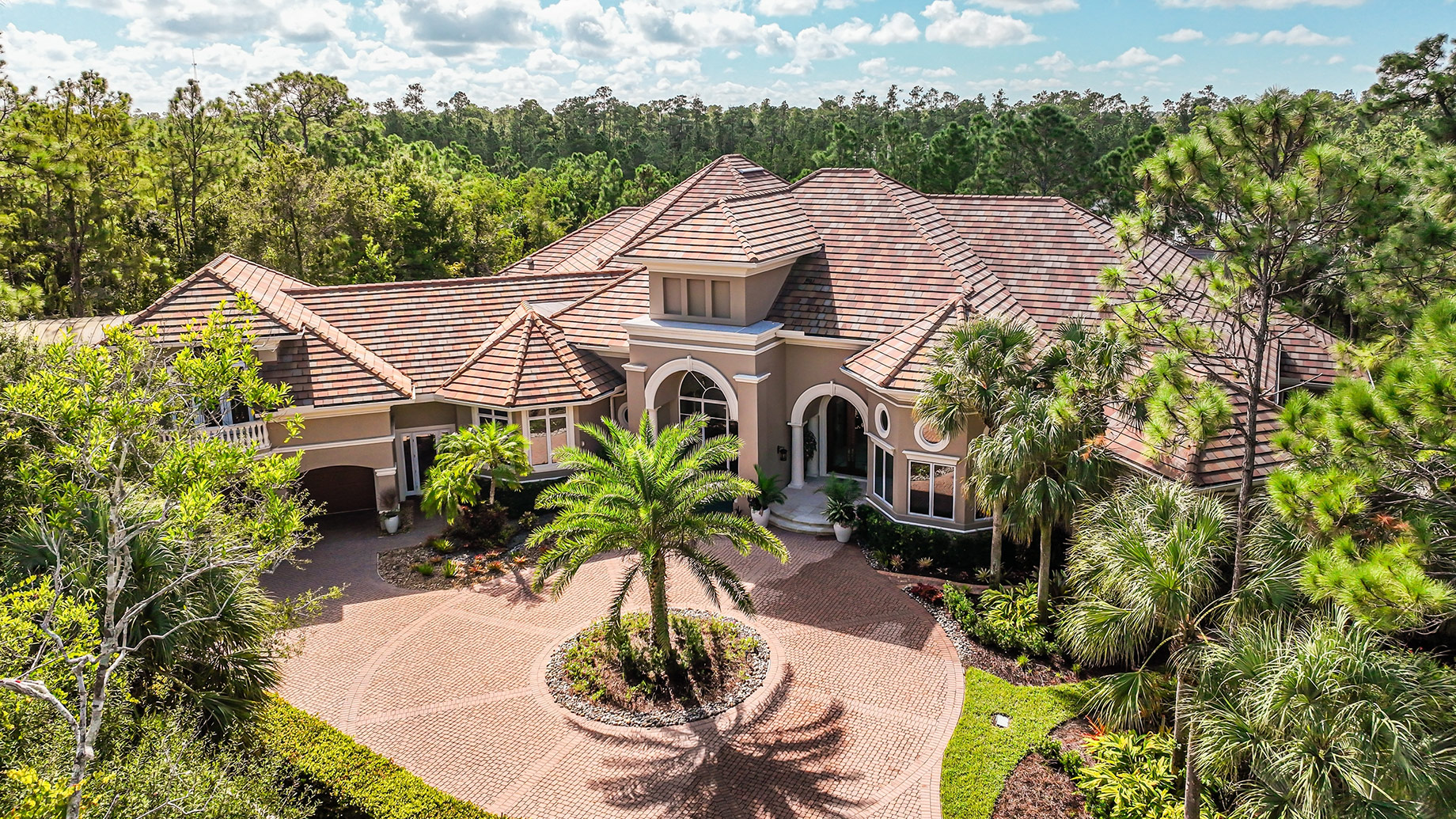
Ask a luxury real estate agent in Naples or Fort Myers what buyers notice first, and the answer rarely begins at the front door. It begins at the street: the driveway, the walkway, the geometry of the approach. Before a single interior finish registers, the hardscape has already told the buyer what kind of property this is — and whether the owners understood that the ground plane is architecture too.
That understanding has shifted noticeably in Florida’s high-end market over the past several years. Hardscaping — pavers, pool decks, outdoor kitchens, retaining walls, courtyard paving — has moved from a finishing detail to a headline feature. In listing photography for premium properties, the pool deck now gets nearly as many frames as the kitchen. There are practical reasons for this, and there are aesthetic ones, and in Florida the two are unusually intertwined.
The Ground Plane as Architecture
Contemporary Florida design — the clean-lined coastal modern and transitional Mediterranean styles that dominate new construction from Marco Island to Sarasota — depends heavily on strong horizontal planes. Flat roofs, deep lanais, walls of sliding glass that erase the boundary between living room and pool terrace. When the interior floor flows visually into the outdoor deck, the paving is no longer landscaping. It is the largest continuous surface on the property.
This is why material selection has become so deliberate at the top of the market. Large-format porcelain pavers in 24-by-48-inch panels create the monolithic, shadow-lined look that modern architecture calls for. Travertine and shellstone deliver the barefoot-friendly, heat-dissipating surface that Florida pool decks demand — a genuine performance consideration when deck temperatures in July can make lesser materials unusable. Tumbled concrete pavers in oversized formats bridge the two worlds at a more accessible price point, with color blends engineered to complement coastal palettes rather than fight them.
Pattern discipline matters as much as material. The current luxury vocabulary favors restraint: single-format layouts, tight joints, linear orientations that extend the architecture’s sight lines. The busy multi-pattern installations of fifteen years ago now read as dated in the same way that heavy Tuscan interiors do.
Why Florida Rewards Pavers Specifically
There is a structural reason paver systems dominate high-end Florida hardscaping over poured concrete or stamped alternatives, and it comes down to the ground itself. Southwest Florida sits on sandy, shifting soils with a high water table and a rainy season that delivers a substantial share of the year’s precipitation in violent afternoon bursts. Monolithic slabs crack under these conditions — it is a question of when, not if. A segmental paver system over a properly compacted base flexes with the ground, sheds water through its joints, and can be lifted and re-laid in sections if a root, a utility repair, or settlement ever demands it.
Permeability is the quiet second advantage. As counties across the region tighten stormwater management requirements, permeable paver installations that return rainfall to the ground rather than sending it to the street are becoming a genuine asset in permitting — and a talking point in resale.
None of this works without the substructure, which is precisely the part no one photographs. Base depth, geotextile separation over Florida’s fine sands, compaction in lifts, edge restraint, joint sand selection — these decisions determine whether a driveway still lies flat in year twelve or begins rippling in year three. It is why discerning homeowners tend to vet the installer more rigorously than the material, and why established paver installation specialists in Southwest Florida build their reputations on what happens beneath the surface rather than on the catalog they sell from.
The Pool Deck as the New Great Room
If the driveway sets the first impression, the pool deck now carries the lifestyle argument. Florida’s luxury buyers are effectively purchasing an outdoor room — one that hosts more entertaining hours per year than any interior space in the house. The current generation of estate pool decks reflects that: sun shelves wrapped in the same stone as the surrounding deck, integrated fire features, outdoor kitchens with paver or stone surrounds, and lighting designed into the hardscape itself rather than added afterward.
The materials conversation here is also a safety and comfort conversation. Textured travertine and shellstone remain the reference standard for wet-edge areas precisely because they stay cooler and grip better than polished alternatives. Porcelain systems have closed the gap with dedicated anti-slip finishes and now offer something stone cannot: near-perfect continuity with interior tile, so the living room genuinely appears to continue into the pool terrace.
What It Returns
Hardscaping occupies unusual territory in renovation economics: it is one of the few exterior investments that improves both the daily experience of the property and its marketability in roughly equal measure. Industry remodeling-impact studies consistently place paver patios and landscape upgrades among the stronger exterior projects for cost recovery, and agents in seasonal markets add a less quantifiable observation — properties with resolved, high-quality outdoor spaces simply show better and sell faster, because the buyer can picture the February evening on the terrace without doing any imaginative work.
For owners of significant Florida properties, the practical takeaway is straightforward. The lot’s ground plane — driveway, walkways, courtyard, pool surround — is a single design system, and it is increasingly the system by which the property is judged from the street and from the listing photos alike. Treating it with the same seriousness as an interior renovation, from material selection down to the compacted base no one will ever see, is what separates the estates that photograph well for a season from the ones that hold their composure for decades.
