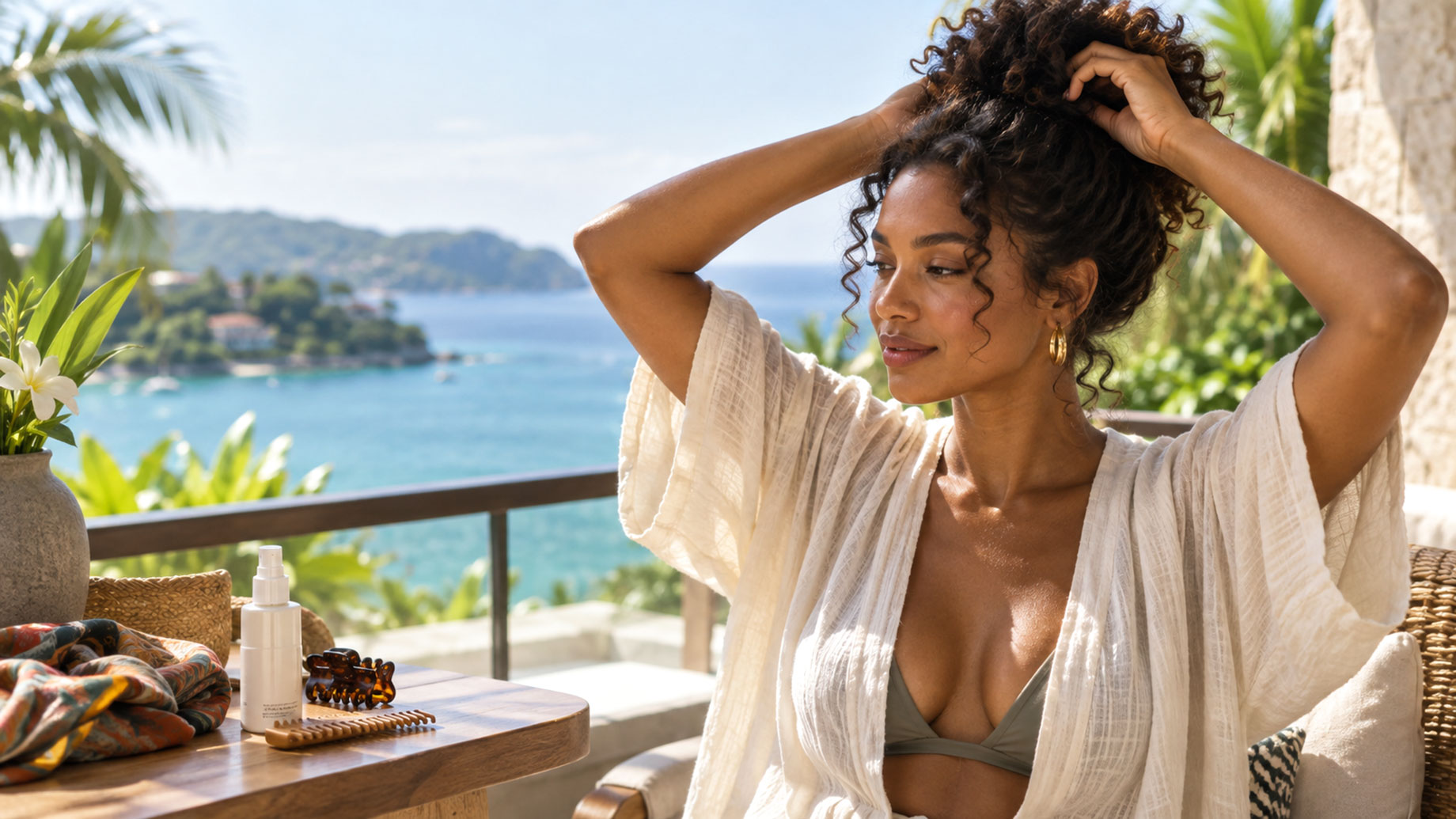
A trip somewhere warm sounds effortless until your usual hair routine meets heat, humidity, strong sun, swimming, and several hours spent outside. A style that behaves perfectly at home can suddenly become harder to manage before you have even reached lunch.
The answer is not necessarily packing twice as many products. Hot-weather hair is often easier to manage when the routine becomes simpler and focuses on moisture, protection, and styles that can handle a little unpredictability.
Rather than waiting until the first humid morning of the trip to experiment, make a few changes before you leave.
Give Your Hair the Moisture It Needs
Humidity does not mean hair cannot feel dry. Sun exposure, swimming, frequent washing, and air conditioning can all change how hair feels during a trip, while textured and curly hair may need particular attention to maintaining moisture.
This is a good time to understand which ingredients already work well with your hair rather than introducing an entirely new routine on vacation. For Black hair in particular, the question is aloe vera good for black hair can be useful when considering aloe as part of a moisture-focused routine for tightly curled and coiled textures.
Whatever products you choose, test them before traveling. Knowing how your hair responds is much better than discovering on the first morning of a holiday that a new product leaves it heavy, stiff, or difficult to style.
Stop Fighting Your Natural Texture Every Morning
Hot weather can make a high-maintenance style feel like a daily battle.
If your normal routine depends on getting every strand perfectly smooth, think about whether you really want to recreate that process each morning while traveling. Choosing a style that works with your natural texture can reduce both preparation time and frustration.
That does not mean abandoning styling altogether. It means giving yourself some flexibility.
Curls, twists, braids, buns, ponytails, and other practical styles can often handle changes in weather better than something that needs to remain exactly as it looked when you left the hotel.
Try your planned vacation styles at home first. You will quickly discover which ones still look good several hours later and which require more maintenance than expected.
Pack for the Hair Problems You Actually Have
It is tempting to prepare for every possible hair emergency and end up traveling with half the bathroom.
Instead, think about what usually happens to your hair in warm weather.
Does it become dry? Does frizz appear around the hairline? Does your scalp need more frequent cleansing? Does swimming leave your hair feeling different? Do certain styles lose their shape quickly?
Build your travel kit around those specific problems.
A compact collection might include your usual shampoo and conditioner, a leave-in or moisturizing product, styling product, a few reliable hair ties, clips, a scarf or bonnet, and whatever tools you genuinely use.
Keep a few essentials in your day bag too. There is little benefit in packing the perfect emergency product if it is sitting in your hotel room when you need it.
Plan Around Swimming Before You Reach the Pool
Pool and beach days can completely change your hair schedule, so decide beforehand how you want to handle them.
If you know you will be swimming regularly, choose styles that are easy to refresh afterward rather than requiring a complete restart every time.
It can also help to rinse hair with fresh water after swimming rather than leaving pool or seawater in it for the rest of the day. Your usual post-swim care will depend on your hair type, style, and how frequently you are getting into the water.
Do not schedule your most complicated hairstyle immediately before a day built around swimming.
Sometimes the easiest vacation routine is simply accepting that beach days and polished-hair days do not have to be the same days.
Give Your Hair a Break From Constant Heat Styling
A hot destination already exposes you to plenty of heat without adding a long blow-drying or straightening session every morning.
If possible, reduce how often you rely on heated tools while away. Air-drying, partially air-drying, or choosing styles that require less heat can shorten the morning routine and make spontaneous plans easier.
If you do bring styling tools, check whether they are compatible with the electrical system at your destination. A favorite tool is not very helpful when it cannot safely be used.
Also consider whether it deserves the luggage space.
For a short trip, spending forty minutes styling your hair every morning may be a poor trade when a simpler routine gets you outside much faster.
Have a Backup Style for the Really Humid Days
Sometimes the weather wins.
That is much less frustrating when you already know what you are going to do about it.
Choose one reliable backup style that you can put together quickly when humidity, wind, swimming, or an unexpectedly busy day makes the original plan unrealistic. Pack the accessories required for it in one place.
This could be a bun, braids, twists, a ponytail, a scarf-based style, or another option suited to your hair.
A backup removes the temptation to spend an hour trying to rescue a style that clearly does not want to cooperate.
It can also be useful for travel days, excursions, or evenings when you have very little time between returning to your accommodation and heading back out.
Make the Routine Short Enough to Enjoy the Trip
A good vacation hair routine should help you enjoy your appearance without making your hair the main project of the holiday.
If getting ready is taking significantly longer than it does at home, simplify something.
Use fewer products. Repeat a style that worked well yesterday. Save more elaborate styling for a particular dinner or event rather than treating every morning like an occasion.
Humidity may still change your hair during the day, and that is not necessarily a problem. Hair can look slightly different in a tropical climate without looking bad.
Prepare for the conditions, keep moisture and practicality in mind, and bring a few dependable options for the days when the weather refuses to cooperate.
The goal is not to defeat humidity completely. It is to build a routine flexible enough that humidity no longer gets to decide how much of your holiday you spend getting ready.