For millions of city dwellers, the car is the most expensive and least-used tool they own: parked most of the day, taxed and insured all year, and rarely faster than cycling over short distances. An e-bike cannot carry a family on a holiday, but it can replace a surprising share of everyday car trips — and the money saved is bigger than most people expect.
This guide compares real-world costs and commute times between a car and an e-bike, explains what one e-bike can and cannot do, and helps you decide whether the switch is worth it for your routine.
The short version: if most of your trips are under 15 km in a town or city, an e-bike usually replaces them faster, cheaper and with zero parking stress. The gaps appear when you need long distances, big loads or bad-weather certainty.
The Real Cost of Driving vs. Riding
Car costs are mostly fixed: purchase or lease, insurance, tax, parking, and maintenance add up even when the car sits still. An e-bike’s costs are mostly variable and tiny — a few cents of electricity per full charge and occasional brake pads and chains.
| Cost item | Car (typical, per year) | E-bike (typical, per year) |
|---|---|---|
| Purchase / financing | €4,000–€8,000 | €800–€1,500 one-off |
| Insurance | €400–€1,200 | €50–€150 (optional) |
| Fuel / electricity | €800–€2,000 | €10–€30 |
| Maintenance | €400–€1,000 | €50–€150 |
| Parking | €200–€1,500 | Usually free or minimal |
These are typical European estimates, not guarantees — costs vary by country, distance and vehicle. But the pattern is consistent: running an e-bike costs roughly 90% less per kilometre than driving, and the purchase price is repaid within one to two years for most daily commuters.
Commute Times: Door-to-Door Reality
Over short distances, the e-bike usually wins on time. In congested cities, door-to-door car trips under 8–10 km are often slower than cycling because of traffic and parking searches. An e-bike rides past queues, uses cycle paths, and parks at the door — which is why many riders report faster commutes than their driving colleagues.
Above roughly 15–20 km per trip, the car pulls ahead on pure speed unless a train can take over. The e-bike is not a universal time machine: it is a tool that wins exactly where cars are weakest — the short, congested, parking-hostile trips that dominate city life.
The average e-bike commuter maintains roughly 20–25 km/h with moderate effort, which means a 5 km commute takes about 15 minutes door to door — in city traffic, that frequently beats a car, and it does so without parking fees or a single traffic jam.
What an E-Bike Can Carry
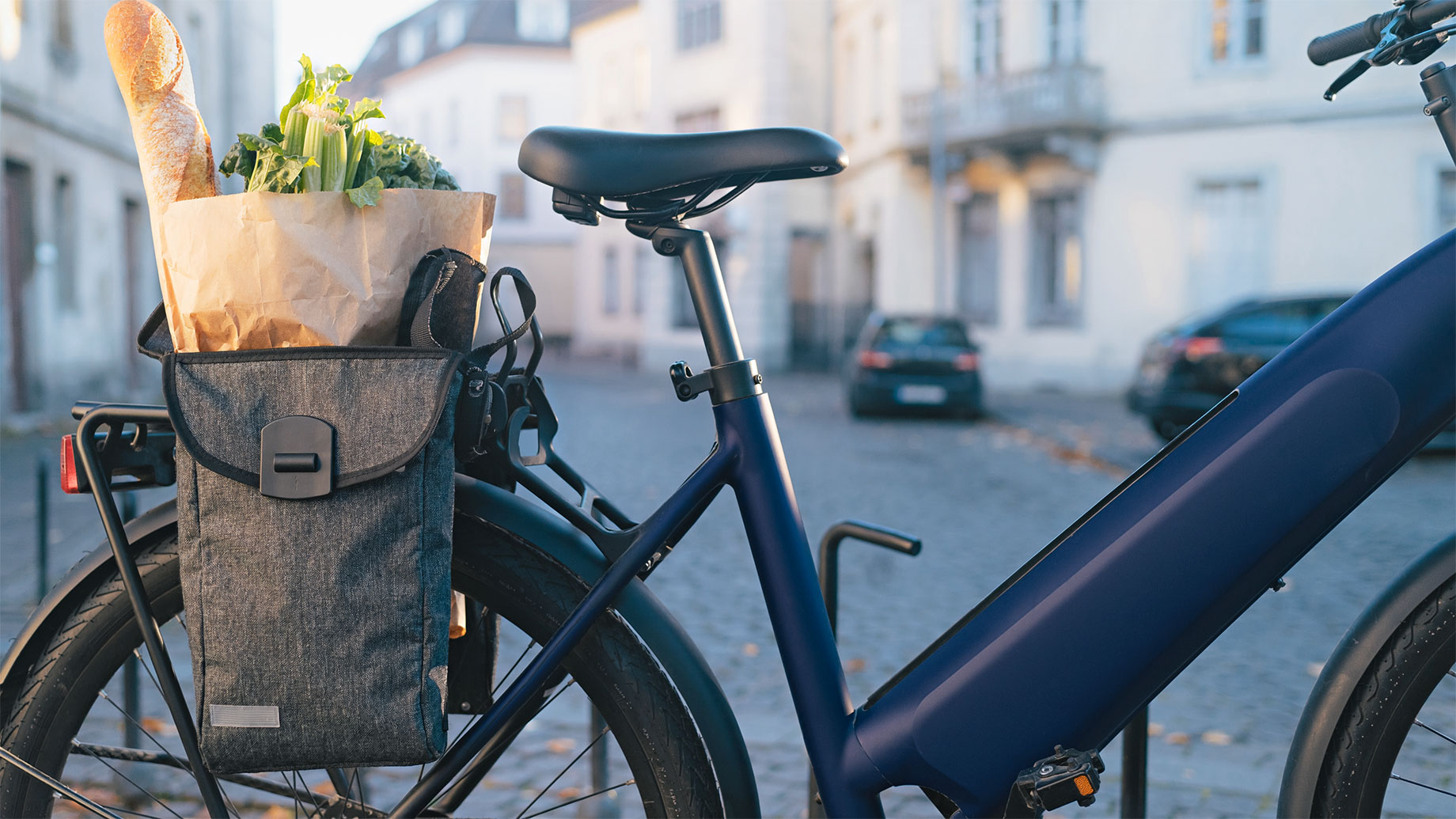
Modern e-bikes carry far more than a shoulder bag. Rear racks and front baskets handle weekly groceries, and load-rated frames accept 150 kg or more — several European models, including PIXAR’s commuter range, are rated for 250 kg of total load. For one adult with shopping, an e-bike replaces a car for the majority of errands.
The honest limits: no e-bike substitutes for moving furniture, driving children in bad weather, or highway journeys. If those trips are frequent in your week, treat the e-bike as the daily vehicle and keep the car (or car sharing) for the rest — that combination is usually cheaper than owning a second car.
For bigger loads, purpose-built cargo e-bikes extend the limit further: long-tail and front-loader designs carry two children plus shopping, which is how many families drop a second car entirely. If cargo is your main reason for driving, test a cargo e-bike before assuming an ordinary bike will not do.
The Hidden Savings
The biggest savings are the ones never counted. Parking disappears from your day. Insurance becomes optional. Your car’s resale value drops more slowly when it is used less. And riders who swap short car trips for an e-bike typically add meaningful physical activity to their week, which has its own value — healthier riders spend less on health care and miss fewer workdays.
Even the electricity is trivial: charging a 500–650 Wh battery costs a few cents, so a full year of daily commuting often costs less than a single tank of fuel.
Depreciation tells the same story: a car loses thousands of euros of value in its first years even if you barely drive it, while a €1,000 e-bike loses only a fraction of that over the same period. The less you need the car, the faster the e-bike wins the comparison.
When an E-Bike Is Not Enough
Be honest about the gaps before you sell the car: journeys over 25 km each way, carrying large or heavy loads, rural roads without safe cycling infrastructure, and days when weather or health rule out riding. For these, a combined strategy works best — an e-bike plus public transport, or an e-bike plus occasional car rental or car sharing.
Making the Switch Work
The most successful switchers start by replacing one trip type: the daily commute or the school run. A city e-bike with a rack, fenders and integrated lights handles the typical errand and commute pattern from day one.
A folding e-bike adds a second superpower: it rides to the station, folds into the train, and rides to the office at the other end — replacing a car trip that no single vehicle can cover.
Before committing, do the two-week test: track every trip you make and mark which an e-bike could cover. Most riders find the e-bike covers 60–80% of their weekly car trips. If that is your number, the savings calculation runs itself.
One practical note: buy the accessories that remove friction — a strong lock, mudguards (usually fitted on commuter models), and a spare charger. Every friction point you remove makes the two-week test more likely to end with the car parked for good.
Frequently Asked Questions
How much does an e-bike save compared with a car?
Most riders save €1,000–€3,000 per year when an e-bike replaces a meaningful share of car trips, mostly through fuel, parking, insurance and maintenance. Savings depend on how many trips you actually swap. If you also drop a second car, the saving jumps to several thousand euros a year.
Can an e-bike replace a car for a family?
Not entirely, but it replaces the daily school run, shopping and short errands. Families usually combine one e-bike (or a cargo e-bike) with one car, and drop the second car entirely — that is where the savings are largest.
How far can an e-bike realistically take me?
With a typical 500–650 Wh battery, most riders get 40–80 km of real-world range depending on assist, terrain and weight — enough for round-trip commutes up to roughly 15–20 km with a charge left to spare.
Do I need a licence or insurance for an e-bike?
For a legal 250 W pedelec limited to 25 km/h assistance, no licence, registration or compulsory insurance is needed in most European countries. Theft and liability insurance is optional but recommended.
What if I need the car occasionally?
Combine the e-bike with car sharing or occasional rentals. For a few trips a month, pay-per-use beats owning a car you drive once a week — this hybrid model is the fastest way to capture most of the savings.
Final Words
Can an e-bike replace your car? For the trips that dominate city life — commuting, errands, school runs — yes, and the savings are real and quick. For long journeys and big loads, no single vehicle replaces a car. The winning strategy is honest: replace the 60–80% of trips an e-bike does brilliantly, keep or share a car for the rest, and watch the fixed costs of car ownership disappear.