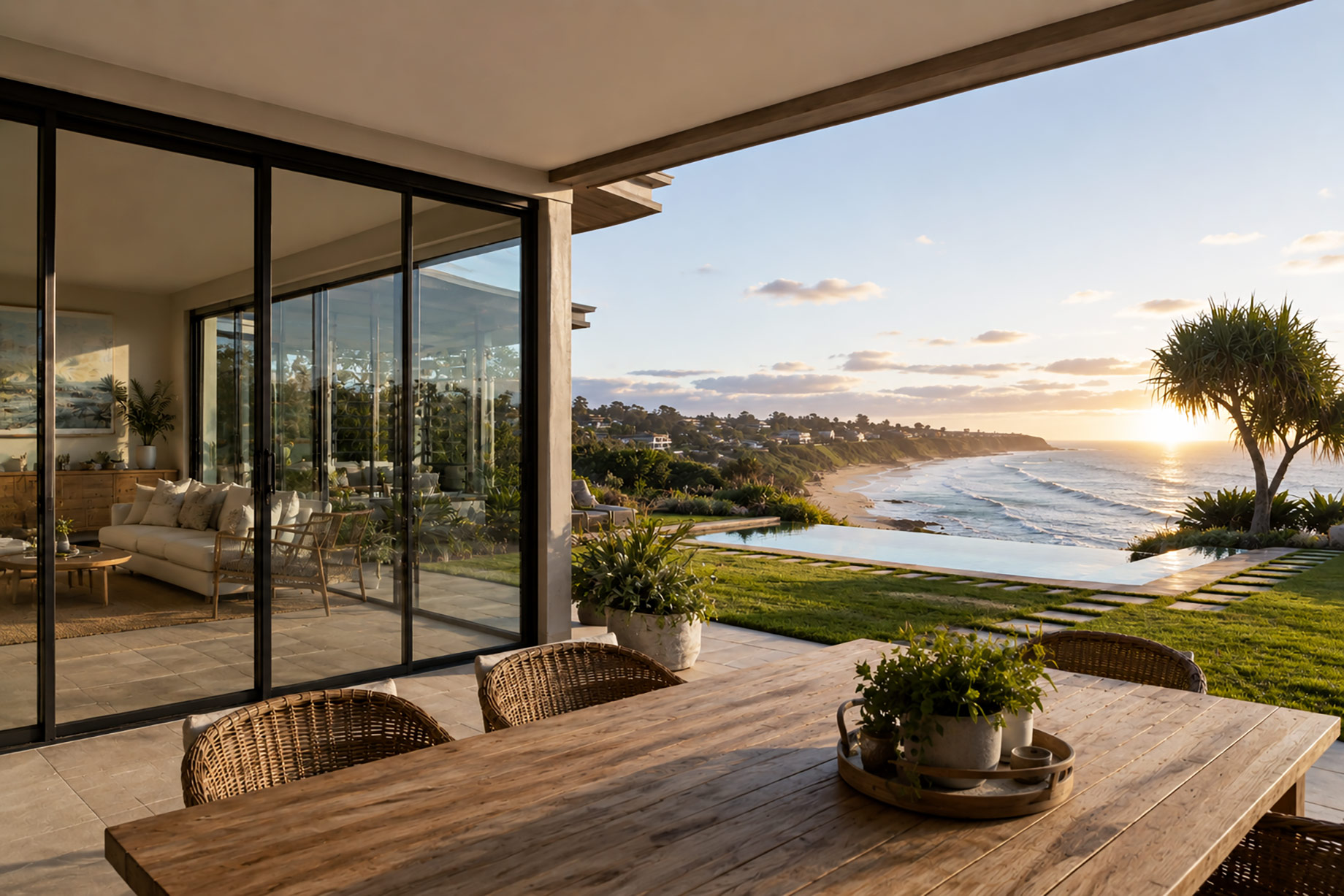
Walk into an older home near the water and you can usually feel what the decade got wrong. The living room sits on the wrong side for the afternoon sun, so it bakes from two o’clock on. The kitchen is boxed off from the spaces you’d actually want it to open onto. Windows are small, doors are solid, and the sea breeze that should be doing half the cooling never makes it past the hallway.
The house isn’t the problem. The assumptions it was built on are.
For decades, coastal homes were designed the way homes everywhere were designed: to a floor plan, not to a site. Orientation was an afterthought. Cross-ventilation barely rated a mention when air conditioning was cheap to run and nobody was counting the carbon. Live in one of those homes through a warming summer and the gap between how it was built and how you want to live starts to show.
Why Older Coastal Homes Work Against You
The most common fault is orientation. A home turned the wrong way to the sun spends the cooler months dim and the warmer months overheating, and no amount of retrofitted blinds fully undoes that.
Then there’s the layout. Older homes tend to carve the ground floor into separate boxes, which traps heat and blocks the airflow a coastal block is practically begging to use. Add single-glazed windows, thin insulation and dark, heat-absorbing materials, and you have a house that leans on its air conditioner for half the year.
None of this made those homes bad. They met the standards of their time. They simply weren’t built for today’s electricity prices, today’s summers, or the open, connected way most of us want to live now.
What A Climate-Designed Home Actually Does
Get the fundamentals right and a home starts doing the work the machinery used to do.
Orientation comes first. Position the main living spaces to catch the winter sun and shade them from the harsh western afternoon, and the house begins to regulate itself before a single appliance switches on. Line the openings up so the prevailing breeze runs clean through the plan, and on most days you can cool the place by opening two doors.
The feel is the part that’s hard to put into words until you’ve stood in it. A well-oriented, well-ventilated home is quietly comfortable. Rooms stay bright without glare. The air moves. The temperature holds steady through the afternoon instead of creeping up, and the aircon becomes something you reach for now and then rather than run on a timer. Thermal mass in the floor, deep eaves, cross-flow, decent glazing: none of it is glamorous, but you feel every piece of it, every single day.
When It’s Worth Rebuilding Rather Than Compromising
Here’s the honest part. You can renovate your way around some of these problems. Knock out a wall, add a window, bolt on an alfresco. But orientation is fixed the moment a house is standing, and a plan built around 1980s assumptions stays a plan built around 1980s assumptions, just with nicer finishes.
That’s why a growing number of owners who love their street, but not the house sitting on it, decide to start again. Keeping the location and replacing the home is often the more sensible long-term play, and it’s the reasoning behind a growing share of the knockdown rebuild in Gold Coast projects going ahead on well-chosen blocks: same address, a brand-new home built for the climate from day one, and none of the workarounds a renovation leaves behind.
It isn’t the right answer for every block. A structurally sound home with good bones and sensible orientation is usually worth keeping and improving. But when the fundamentals are pulling against you, dressing them up rarely pays off.
A Home Shaped Around Your Life
Strip away the spec sheets and this comes down to designing around one household rather than a template. Where the morning light lands. Which rooms should open to the garden. How air and people actually move through the place on an ordinary Tuesday.
That’s the quiet luxury of building new. Not a bigger house, but a home that fits the climate it sits in and the life you lead inside it.
So if you’re weighing up a home near the coast, start with the site before the style. Ask where the sun rises, where the breeze comes from, and whether the house in front of you is working with them or against them. More often than not, the answer tells you what to do next.
