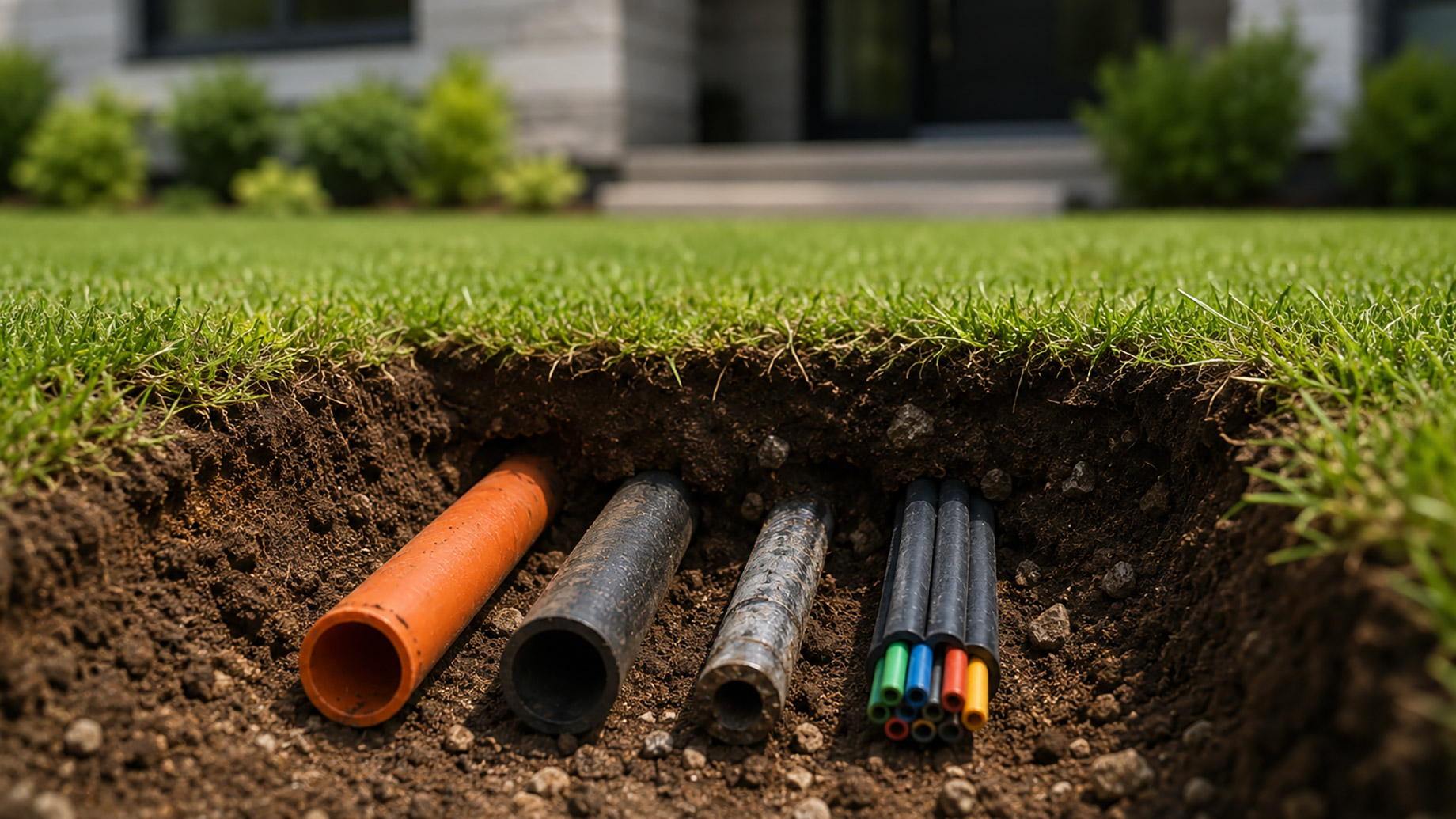
Luxury buyers are trained to look up. They notice the millwork, the stone, the sightlines, the quality of light through a south-facing window. What they rarely think to look at is what’s underneath the property entirely: the utilities, conduits, and concrete that nobody sees but that quietly determine how safely, and how profitably, a renovation or addition can move forward.
In a city like Ottawa, where housing stock spans everything from century-old stone homes in the Glebe to recently built estates in Kanata and Manotick, what’s buried beneath a property can vary enormously, and the records describing it are often incomplete, outdated, or simply missing. For buyers planning a renovation, an addition, a pool installation, or any kind of excavation, that gap between what’s documented and what’s actually there can turn an exciting project into an expensive one. Here are six infrastructure risks worth understanding before the first shovel goes in the ground.
1. Undocumented Underground Utilities
Older Ottawa neighbourhoods were often built and rebuilt in phases, with utility lines added, rerouted, or abandoned over decades. Gas lines, water mains, electrical conduits, and telecommunications cables don’t always appear on the records a buyer receives at closing, and city utility maps are frequently out of date by the time a property changes hands. A line that was installed in the 1970s for a structure long since demolished can still be live and buried a few feet under a backyard that’s about to become a pool.
This matters because the consequences of striking an unmapped utility aren’t limited to a delay. They range from service outages for the surrounding neighbourhood to serious safety incidents, and the liability for damage typically falls on whoever was digging regardless of whether the records they were given were accurate. Before any excavation begins, having underground utilities properly located and mapped is a small upfront step that removes a significant unknown.
2. What’s Hidden Inside Existing Concrete
Foundations, driveways, and slabs aren’t just structural, they’re often full of embedded material that was never documented. Rebar, post-tension cables, radiant heating lines, and old electrical conduits can all be present inside concrete that looks, from the surface, like a blank canvas for renovation. This is especially common in properties that have been renovated multiple times by different contractors, each of whom may not have left a complete record of what they added.
For anyone planning to core, cut, or drill into existing concrete. whether to run new plumbing, install a hot tub, or extend a foundation, knowing what’s inside that slab beforehand prevents both safety incidents and the kind of structural damage that’s expensive to repair and even more expensive to explain to an insurer.
3. Aging or Abandoned Underground Storage Tanks
Many Ottawa properties, particularly those built before the 1980s, were originally heated with oil, which meant an underground storage tank somewhere on the property. Some of those tanks were properly decommissioned and removed. Many were simply abandoned in place when the property switched to gas or electric heat, and the paperwork documenting that switch didn’t always make it into the property’s permanent record.
An undetected underground tank is more than a curiosity. It can affect financing, insurance, and resale value, and in cases where a tank has begun to corrode, it can become an environmental liability that’s far more costly to remediate than it would have been to simply locate and address early. For older properties in particular, confirming whether a tank is present is a due diligence step worth taking before, not after, a purchase closes.
4. Voids and Settlement Beneath Slabs
Not every problem beneath a property is a utility or a tank. Soil erosion, poor original compaction, or water infiltration over time can create voids beneath a concrete slab that aren’t visible from above until cracking, settling, or uneven flooring starts to appear. By the time those symptoms are obvious, the underlying issue has often been developing for years.
Detecting these voids early before they progress into a structural problem gives buyers and owners the chance to address a foundation issue on their own terms, rather than discovering it mid-renovation or, worse, after closing on a property.
5. Buried Cable and Electrical Faults
It isn’t only utility companies that bury cable. Properties with detached garages, pool houses, guest cottages, or extensive landscape lighting often have underground electrical runs installed by past owners or contractors, sometimes without permits and rarely with a diagram that survives the next sale. Over time, those cables can degrade, develop faults, or simply become impossible to trace using surface-level methods especially once landscaping has matured over top of them.
This becomes a real problem the moment something stops working and nobody can say why. Tracing a buried electrical fault without first knowing roughly where the cable runs usually means digging speculatively, which is slow, disruptive to mature landscaping, and not guaranteed to find the fault on the first attempt. It also becomes a safety issue the moment any other excavation work is planned nearby, since a live underground cable is just as dangerous to strike as a gas line.
6. The Real Cost of Skipping Verification
The common thread across all six risks above is that none of them are visible from a standard walkthrough or even a typical home inspection. They require a different kind of verification one that uses non-destructive technology like ground-penetrating radar to confirm what’s actually beneath a surface, rather than relying on records that may be incomplete or simply wrong.
This is the work that companies like Ottawa Locators specialize in. Using GPR and complementary detection methods, their team can locate underground utilities, identify what’s embedded inside concrete, and confirm or rule out the presence of underground tanks before any cutting, drilling, or excavation begins. For a buyer planning a major renovation, or an owner preparing to break ground on an addition, that verification step typically costs a fraction of what a single utility strike, a damaged foundation, or an undisclosed tank would cost to resolve after the fact.
Luxury real estate has always rewarded attention to detail. The properties that hold their value over time tend to be the ones where every system visible and invisible was properly understood before anyone started building on top of it. In a market like Ottawa’s, where property history can run deep and records don’t always keep up, what’s underground deserves the same scrutiny buyers already give to everything above it.
