Technology is advancing, and WebAR and AI 3D model generators are two new innovations that are helping to bring 3D experiences to life. WebAR is web-based Augmented Reality, which means you can experience Augmented Reality without downloading a mobile application. AI 3D model generators are tools that use AI to generate detailed 3D models based on text, images, or any other digital input.
Combining both opens up new, exciting opportunities for businesses, designers, developers, and many others. Businesses can use AI to create 3D assets and place them in real life using WebAR.
In this article, we will look into how these technologies work, what benefits they offer, their uses, and why they are becoming essential for the future.

What is an AI 3D model generator?
An AI 3D model generator is a piece of software that can create 3D digital objects using AI. Instead of having to design each part manually, the user can simply enter a text prompt, image, or other supported input.
For example, if the user enters a prompt such as “a modern wooden dining chair with curved legs and a minimalist design,” an AI-powered platform can create a 3D model based on the text.
Some AI 3D generation tools can also generate 3D models from images. Simply upload a picture of an object, and it will create a 3D version.
This helps reduce the time and knowledge required to create 3D content.
How does an AI 3D model generator Work?
Most AI-powered 3D generation platforms work by:
Step 1. Enter a description or image.
Step 2. The AI will process the input and identify the shapes, textures, structure and visual elements.
Step 3. The AI will generate a 3D model. The model can be edited to improve the design.
Step 4. Export the asset as a compatible 3D file.
Step 5. Depending on the platform, the generated model may support formats such as GLB, GLTF, OBJ or FBX.
However, not all models generated using AI will be optimised for real-time use. Developers may need to edit the number of polygons, textures, materials, and file size.
What is WebAR?
WebAR is a kind of augmented reality technology that can be used directly within web browsers. No app downloading is required. So users can view and interact with digital objects within their physical environment using a smartphone, tablet, or other compatible device.
A great example would be if a furniture company wanted to allow their customers to place a virtual sofa in their living room using their smartphone camera. They can see how big, what it looks like and where it will sit. Fashion brands can offer virtual products, and education can offer interactive 3D learning.
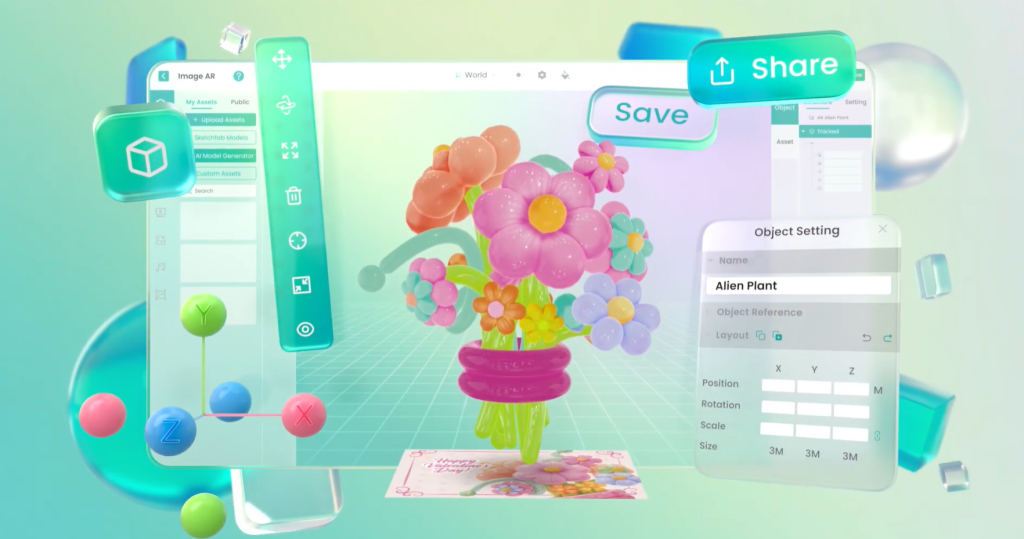
Key Features of WebAR
1. No app downloads – Can be accessed via compatible web browsers.
2. View digital objects in real life.
3. Can be used on mobile devices.
4. Interactive 3D objects can be rotated, scaled and explored.
5. Easy to share – Can be shared via web links and QR codes.
6. Can be incorporated into websites, online stores and marketing.
This makes WebAR a great option for companies who want to increase engagement with their customers.
How do WebAR and AI 3D model generators Work Together?
Using WebAR and AI 3D model generators together can create an efficient workflow.
AI 3D model generators can quickly create digital objects, and WebAR can place them in real life using your browser.
For example, an online furniture business can use AI to create 3D models of their different furniture designs. These can then be used with WebAR to allow customers to place furniture in their homes.
Process:
- Generate a 3D model using your AI generator.
- Optimise the 3D model for web-based 3D.
- Export the asset as a compatible file.
- Import into your WebAR platform.
- Publish via a website or QR code.
- Allow users to interact with the virtual object within their physical environment.
- This makes it easier for businesses to create interactive products.
Benefits of WebAR and AI 3D Model Generation
- Faster 3D Content Creation
Traditionally, creating 3D content can take time and require specialised software and professionals. However, using AI 3D model generators can make it easier and quicker.
Businesses and creators can create basic 3D assets more quickly and spend less time focusing on customising.
- Improved Engagement
Using WebAR can help improve engagement with your customers. Instead of just seeing images of products, customers can interact with 3D objects.
This can help customers understand products better.
- Reduced Costs
Creating 3D content using AI can help reduce the amount of manual work needed, and using WebAR means many users don’t need to download an application.
This can help make immersive digital experiences cheaper.
- Improved Product Visualisation
Customers often struggle to understand the true size, shape, and look of a product using traditional photographs.
Using WebAR means they can view digital versions of products in their own environment, giving a more realistic view.
- More Creative Opportunities
Designers, marketers, developers, and entrepreneurs can use AI-generated 3D content to try out different ideas.
They can create prototypes, marketing materials, virtual objects, and interactive experiences.
Top Uses of WebAR and AI 3D model generators
eCommerce
Online retailers can use AI-generated 3D models to create interactive product catalogues. Using WebAR, customers can place furniture, home accessories, electronics, and more in their real lives. This can help customers understand products better.
Architecture and Interior Design
Architects and interior designers can use AI to create 3D furniture, decorative objects, and design ideas. Using WebAR, clients can view these in real-life rooms or properties.
Education
Educational institutions can use AI-generated 3D models to create interactive learning. Students can view virtual objects such as science objects, historical objects, machines, and anatomy using WebAR. This can make complex subjects easier to understand.
Marketing
Brands can create memorable marketing campaigns using WebAR. AI-generated 3D assets can be used to create interactive marketing, product demos, and virtual brand experiences. Customers can be linked directly to AR content using QR codes.
Gaming
Game developers and digital artists can use AI 3D model generators to create characters, environments, props, and more. WebAR can be used to bring these to life in the real world with interactive content.
The Future of WebAR and AI 3D model generators
The future of WebAR and AI-powered 3D creation looks bright. As AI improves, 3D Model Generation will become more accurate, flexible, and accessible.
AI tools will become more advanced with improved geometry, realistic textures, animations, and more consistent results using simple text or images.
As mobile technology, browsers, and real-time rendering improve, WebAR will continue to improve.
Businesses may start to use AI-generated 3D assets to create interactive product catalogues, virtual showrooms, personalised shopping experiences and immersive marketing campaigns.
Using AI with Augmented Reality could mean anyone can create digital content without any experience in 3D modelling or software development.
Conclusion
WebAR and AI 3D model generators are transforming the way digital content is created. Using AI makes creating 3D models quicker and easier. WebAR allows users to interact with them in real life using their browser.
Whether you are using them for eCommerce, architecture, education, marketing, or entertainment, they can offer great opportunities for businesses and creators.
As AI and Augmented Reality improve, it will become increasingly important to incorporate WebAR with AI 3D Model Generation to create interactive, immersive, and easy-to-use digital solutions. If you want to stay ahead in the digital world, it is important to look into these technologies.