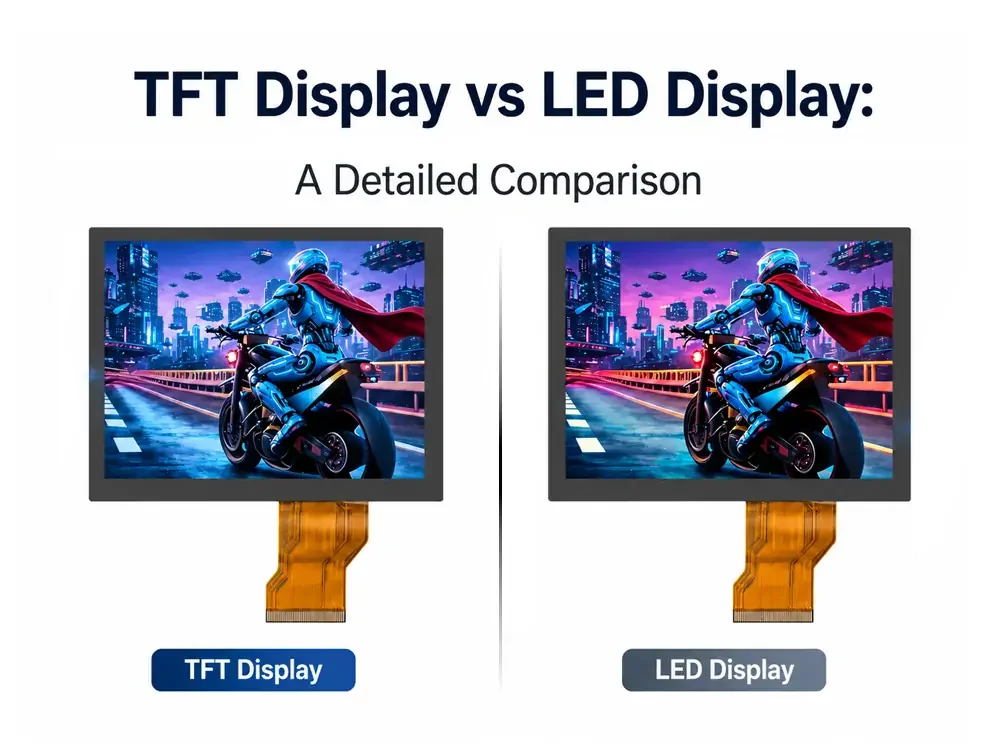
In recent years, display technologies have undergone significant development in display technology. Contemporary gadgets have several kinds of display screens. There are two popular types: TFT and LED displays. At other times, however, it can be confusing when using these terms. The acronym “TFT” stands for Thin-Film Transistor. LED is a technology for Light Emitting Diodes. These talk about various parts of the display apparatus. This difference is important to understanding and choosing the appropriate user display.
What you need to know about TFT Displays.
The acronym TFT is used to mean Thin-Film Transistor. This is a form of LCD. TFT is based on the idea that it controls each part of the display using transistors. These transistors regulate the amount of light that comes through each pixel. TFT displays use an external light source as the source of light since the pixels in the display themselves do not emit light. LED backlighting is usually employed in modern TFT displays. They are widely used in many items such as monitors, smartphones, vehicles, and industrial equipment. Even the sharpness of pictures and the color reproduction can be accomplished using TFT technology.
What is an LED Display?
Light-Emitting Diode…what does that mean? Well, it’s LED. It can refer to several display technologies. There are a good number of products that claim to be LED displays, but are really just LCDs with LED backlighting. These displays have an LCD panel under them. LEDs illuminate behind the LCD frame and form the images. LED backlighting can enhance illumination and enhance energy efficiency. But direct-view LED displays are quite different. Each LED that they make gives off light. This is typical for large screens, video walls, and digital signage.
TFT Display vs LED Display
The primary difference is the way that the display emits light. In order to be illuminated, the TFT LCDs have to be backlit, meaning a different light source is used behind each pixel. In the case of LED-backlit LCDs, the backlight is provided by LEDs. True LED displays are able to create the light in individual pixels. It impacts brightness, contrast, thickness, and energy consumption. Thus, users need to know their exact display technology primarily to perform comparisons between products and choose between TFT Display vs LED Display.
Brightness and Contrast
Thanks to LED-backlit displays, great brightness can be achieved. This helps them to be beneficial in bright rooms inside the house. Even greater brightness levels are possible for outdoor applications. High-quality LED screens can, of course, also deliver superb contrast. Individual pixels can be turned down or off altogether as desired. It will also make dark areas look darker and bring out the contrast. TFT displays rely upon their backlight system to become bright. There may be some light leakage through dark pixels. For this reason, blacks might look slightly gray on some of the TFTs.
Viewing Angle & Image Quality
The quality of the picture in a TFT display is very dependent on the type of TFT panel. Typically, IPS TFT panels offer large viewing angles. These can also be colour consistent across them from different angles. Other kinds of TFT panels can have any mindre viewing angle. Also, the quality of the LED depends on the Know-how it is based on. DV LED screens can offer excellent viewing angles. They could also keep to be excellent bright in an enormous screen display. So, consumers should emphasize real-life specs rather than LED.
Power Consumption
The size of the display and the brightness of the display will affect the amount of power consumed. LED backlights are typically more efficient than the older fluorescent lights. It also helps manufacturers to make thinner displays. The key differences lie in the way that True Self-emissive LED Displays operate. When it’s on, it creates its own light. It is possible, therefore, for some applications to use less power with darker pictures. One of the key factors for battery-operated systems is power efficiency. It’s also essential for big display systems for sale.
Size and Applications
TFT displays can be used in a wide variety of compact electronic devices. They are found in the control panels and in industrial equipment. In addition, they can also be employed in medical devices and automotive systems. A touchscreen interface is easily created with TFT displays. For larger vision-related applications LEDs displays will often be utilized. They can easily be seen in screens used for advertising, such as digital signage. Huge LED video walls can produce stunning and cohesive visual environments. This will relate to what it is going to be used for and how it is going to be displayed.
How to Choose the Right Display
There is no common ground where TFT displays and LED displays go head to head for the victory. It depends on their application in which they will be used. Small and embedded systems can benefit from the use of TFT displays. They can offer high-resolution pictures and touch screen operation. Large-scale LED displays need direct-view LED displays. They can deliver bright, vibrant colors and an excellent amount of contrast. Customers need to consider resolution, illuminance, angle of view, and electricity usage when they’re shopping. They should also take into account the working conditions and space to be installed.
A trusted supply of displays is preferable.
Both technology and manufacturing quality come into play when considering display quality. For the appropriate display setup, you can get it from a reliable supplier. There are varying sizes and specifications depending on the application. It’s also important to take customization options into account when selecting displays for businesses. The HYS-Display solution is used for the display of different electronic applications. It has several products that can fulfill various industrial and commercial needs.
Conclusion
There are different technical approaches, TFT and LED, which are applied to displays. TFT is a technology for LCDs – Liquid Crystal Display – that uses transistors to control its operation. LED can mean backlight or direct-view display technologies. LEDs are commonly used to light up the modern TFT display. Thus, there may be occasions on which these technologies can be complementary. If you’re a buyer, you can think about those differences and determine which aspects are suitable for you. Only you will be able to know if they have complete specifications before purchasing a display. The best one for use and performance, along with the size and budget.