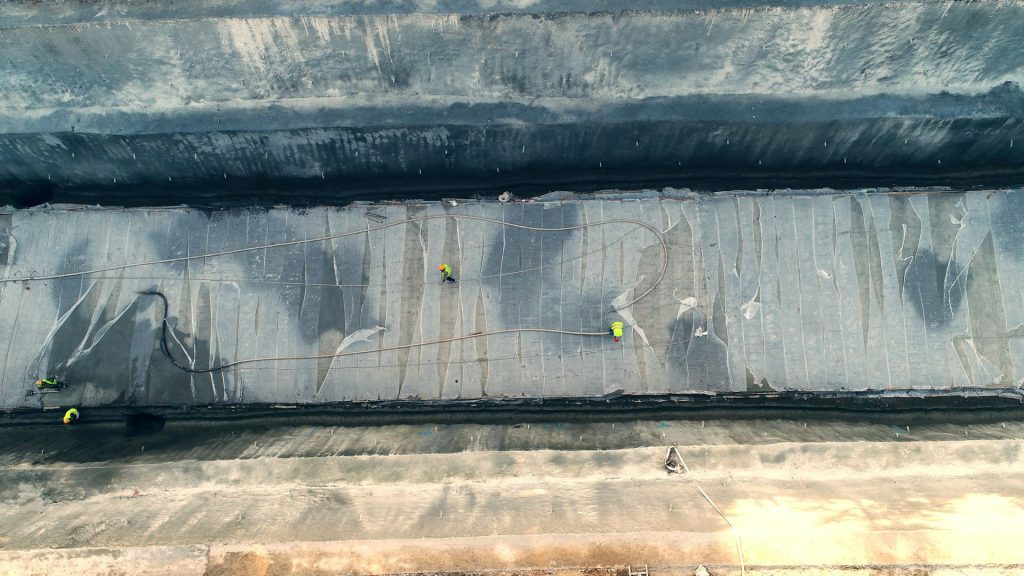
Water is the single most destructive force acting on commercial buildings over time. It doesn’t announce itself dramatically — it works quietly, incrementally, finding the smallest crack in a facade, the most minor failure in a sealant joint, the barely visible gap where a window meets a wall. And then, given enough time and enough freeze-thaw cycles, it dismantles a building from the inside out. By the time the damage becomes visible on the interior — stained ceilings, peeling paint, efflorescence blooming across a masonry wall — the real deterioration has already been underway for months or years.
Waterproofing restoration is the professional, systematic response to this problem. For commercial building owners in New Jersey, the question isn’t really whether water infiltration is a threat — it is, for virtually every structure of meaningful age. The real question is whether investing in waterproofing restoration is worth it compared to simply managing problems as they appear. The answer, almost universally, is yes. But understanding why requires looking honestly at what the work involves, what it costs, and what happens to buildings where it’s deferred.
What Waterproofing Restoration Actually Is
Waterproofing restoration is not a single product or a single application. It is a comprehensive approach to identifying, addressing, and preventing water infiltration across the full building envelope — the exterior skin of the structure that separates interior conditioned space from the elements outside.
For commercial buildings, the envelope includes the facade masonry or cladding, the mortar joints between masonry units, window and door perimeters, expansion joints, parapets, roofing transitions, below-grade walls, plaza decks, and any penetrations through the exterior for mechanical, electrical, or plumbing systems. Each of these components can fail independently, and each failure creates a pathway for water to enter the structure.
A proper waterproofing restoration scope begins with a thorough condition assessment — identifying where water is entering, tracing it back to its source, understanding the underlying causes of failure, and developing a prioritized repair strategy. The repair work itself might include repointing deteriorated masonry joints, replacing failed caulk and sealants at expansion joints and window perimeters, applying penetrating water repellents or elastomeric coatings to masonry surfaces, restoring or replacing waterproof membranes at plaza decks and roofing transitions, and addressing drainage deficiencies that concentrate water against vulnerable building components.
The distinction between waterproofing restoration and simple waterproofing maintenance matters. Maintenance addresses surface-level issues on a building that is fundamentally sound. Restoration addresses a building where deterioration has progressed to the point that a comprehensive, systematic intervention is needed — not just a coat of sealer and a few caulk joints.
The Real Cost of Doing Nothing
Before examining what waterproofing restoration costs, it’s worth being honest about what deferred waterproofing costs. Because for commercial building owners, the financial argument for restoration becomes most compelling when set against the alternative.
Water infiltration that goes unaddressed does not stabilize. It accelerates. What begins as moisture seeping through a deteriorated mortar joint reaches the interior wythe of a masonry wall, where it saturates insulation, wets the backup structure, and creates conditions for mold growth. In cold climates — and New Jersey experiences genuinely harsh winter conditions — that moisture freezes and expands within the masonry units themselves, causing spalling and cracking that compromises the structural integrity of the wall assembly.
Interior finishes are damaged. Flooring, drywall, ceiling tiles, and millwork absorb moisture and deteriorate or mold. Building systems — electrical panels, mechanical equipment — are exposed to moisture that shortens their service life and creates safety hazards. Tenants complain. Lease renewals become more difficult. The building’s market value erodes in ways that compound over time.
The repair costs that accumulate from deferred waterproofing consistently dwarf the cost of the restoration work that would have prevented them. Replacing a compromised masonry wall section, remediating mold in an interior wall cavity, repairing water-damaged structural elements — these interventions routinely cost five to ten times what the waterproofing restoration would have cost if addressed at the right time.
For owners of commercial buildings in New Jersey, partnering with a qualified restoration specialist like adriaticrestoration.com before deterioration reaches this stage is not a discretionary expense. It is straightforward asset protection.
What Waterproofing Restoration Costs for Commercial Buildings
Pricing for commercial waterproofing restoration in New Jersey varies considerably depending on building size, the extent and type of deterioration, the components being addressed, and access requirements. Broad ranges by component give a general orientation:
Masonry repointing, which is often a central component of waterproofing restoration on older brick or stone buildings, typically runs $15 to $30 per square foot depending on the depth of deterioration, the mortar formulation required, and the complexity of the work area. Sealant replacement at expansion joints and window perimeters ranges from $8 to $20 per linear foot. Elastomeric coating application to masonry facades typically falls between $4 and $12 per square foot depending on the product system and surface preparation required. Plaza deck waterproofing membrane restoration is among the more expensive components, often ranging from $20 to $50 per square foot depending on the existing assembly and the extent of membrane failure.
For a mid-sized commercial building addressing multiple envelope components comprehensively, total waterproofing restoration budgets commonly fall between $150,000 and $800,000. Large commercial or mixed-use structures with significant deterioration can exceed this considerably.
These numbers sound substantial in isolation. Set against the cost of interior damage remediation, structural repair, and the building value erosion that results from unaddressed water infiltration, they consistently represent the more economical path.
The Importance of Correct Diagnosis
One of the most common and costly mistakes in commercial waterproofing is treating the symptom rather than the source. Water that appears on an interior wall at the third floor may have entered the building at the parapet twelve feet above. A wet basement wall may be receiving water that is draining toward the building from a grade condition fifty feet away. Treating the visible manifestation of the problem without tracing it to its actual source produces repairs that fail, often quickly, and leaves the underlying problem intact.
This is why the condition assessment phase of a waterproofing restoration project is not optional overhead — it is the foundation of everything that follows. A qualified contractor should be able to explain, specifically, where water is entering the building, why it is entering there, and what repair approach will address the root cause rather than just the visible damage.
Diagnostic tools used in professional waterproofing assessment include infrared thermography, which can reveal moisture-saturated areas within wall assemblies that aren’t yet visible on the surface, and water testing protocols that simulate rainfall conditions to confirm or isolate infiltration pathways. These methods add rigor to the diagnosis and reduce the risk of expensive misdiagnosis.
Choosing the Right Contractor
The waterproofing restoration market includes contractors of widely varying competence and specialization. General waterproofing contractors, general masonry contractors, and specialized building envelope restoration firms all operate in this space — and they are not equivalent.
For commercial building restoration, the contractor you engage should have specific experience with the building type, age, and materials relevant to your structure. They should be able to explain their diagnostic methodology, specify the products and systems they intend to use and why those choices are appropriate for your building, and provide references from comparable commercial projects in New Jersey.
Product specification matters considerably. The waterproofing and sealant products used in commercial restoration vary significantly in quality, durability, and compatibility with different substrate types. A contractor who defaults to whatever is most convenient or least expensive rather than what is most appropriate for the specific substrate and exposure conditions is not providing genuine restoration — they’re providing a temporary cosmetic fix that will require retreatment far sooner than properly specified work would.
Protecting Your Building Before Water Does the Deciding
Waterproofing restoration is worth it for commercial buildings in New Jersey — not as a matter of opinion, but as a matter of straightforward financial and asset management logic. The cost of systematic, properly executed waterproofing restoration is consistently lower than the cumulative cost of the damage that results from deferring it. The buildings that fare best over time are those whose owners treat the envelope as what it is: the primary defense against the most persistent threat any structure faces.
Water will find every weakness a building presents to it. Waterproofing restoration is how building owners stay ahead of that reality rather than spending decades reacting to it.