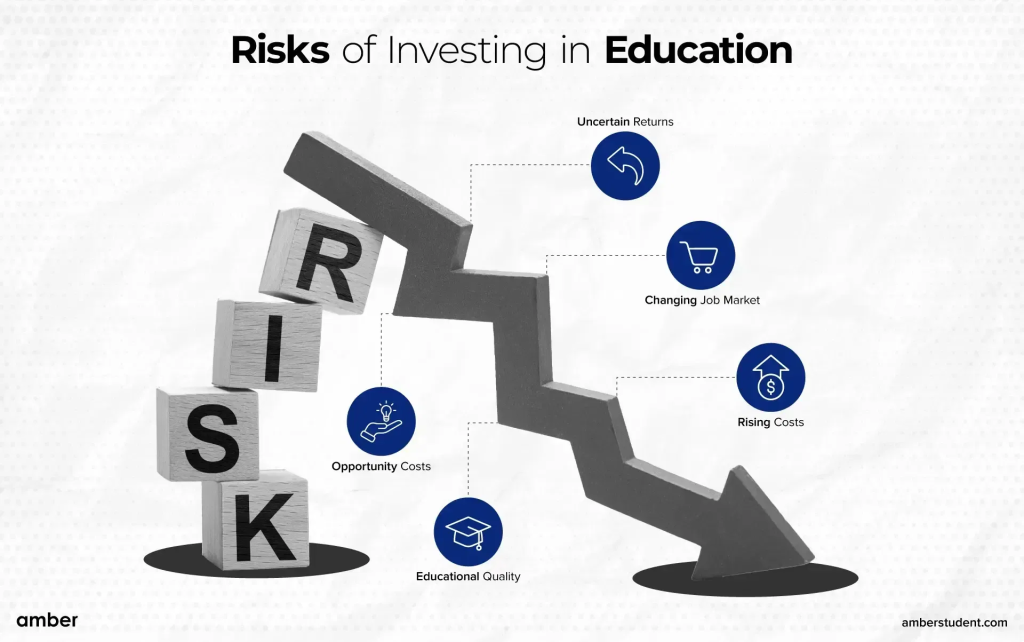
Every year, families, schools and students pour extraordinary sums into education , new devices, private schools, stacks of revision guides, crash courses the week before exams. Yet two students with near-identical budgets often walk away with wildly different results. The uncomfortable truth is that spending and outcomes are only loosely connected. What separates a student who improves from one who stalls is rarely how much was spent. It is whether that money was aimed at the handful of things that genuinely change how a person learns , and almost everything else is noise dressed up as progress. Understanding that distinction is worth more than any single purchase, because it turns education from a guessing game into something you can actually steer.
Why “Spend More” Is the Wrong Starting Question
It is tempting to treat education like a shopping problem: buy the premium version and expect a premium result. But research on educational spending has long shown that, beyond a basic threshold, raw budget is a weak predictor of achievement. A more expensive school or a shinier laptop does not teach anyone anything by itself. What matters is how a resource is converted into actual learning behaviour , and most expensive purchases quietly skip that step.
Consider the money that regularly disappears with little to show for it:
- Glossy revision guides bought in bulk and never opened past chapter two
- Premium tablets and apps used mostly for everything except studying
- Last-minute cramming courses that pile on content with no time to absorb it
- Extra textbooks that duplicate what is already free online
None of these are useless in principle. They simply do not move the needle on their own, because none of them touch the two variables that actually decide outcomes: what a student practises, and how well they practise it. Until money is spent on changing those two things, it is mostly decoration , comforting to buy, but invisible on results day.
Start With the Target, Not the Tools
Before spending a penny, the highest-leverage move is getting brutally clear about the target. For any student on an exam track, that means understanding exactly what they will be measured against , because the fastest progress almost always comes from working backwards from the assessment, not forwards from an undifferentiated pile of content. Two students can put in identical hours; the one who knows precisely what a question is asking for will convert those hours into marks, while the other burns effort on things that were never going to be tested.
This is where enormous effort leaks away. Students revise broadly, “cover the topic,” and hope it is enough, without ever studying how the marks are actually awarded. Reading the specifications and mark schemes for AQA’s exams, or whichever board a student sits, tells you precisely what examiners reward: the command words, the anatomy of a top-band answer, the recurring question types that reappear year after year. An hour spent understanding the target quietly changes the value of every subsequent hour of study , because now that effort finally has a direction.
Match the Support to the Specification
Once the target is clear, the next question is who , if anyone , helps a student hit it. This is where money, spent well, genuinely earns its return. Generic academic help is weak; support matched to the exact subject and exam board is where the gains show up. A tutor who knows one specific specification inside out can spot in ten minutes what a student might take a full term to work out alone: the misread command words, the marks routinely dropped on extended-response questions, the topics that reliably appear.
It lines up with the wider evidence base, too. Education researchers consistently rank one-to-one and small-group tutoring among the most effective interventions available, frequently delivering several extra months of progress when it is well targeted. The operative word is targeted: tutoring that drills the actual specification beats tutoring that wanders around “the subject” in general, and that is the difference between paying for reassurance and paying for results. That precision is exactly why specialist AQA subject tutors tend to produce faster results than broad, one-size-fits-all tuition; the aim is not more hours with someone knowledgeable, but fewer, sharper hours pointed squarely at what a student keeps getting wrong.
The Habits That Compound (and Cost Nothing)
Here is the part no one can buy: the day-to-day habits that quietly compound over months. A few techniques, all backed by decades of cognitive-science research, out-perform almost every paid resource on the market , and they are available to every student regardless of budget.
Active recall beats re-reading
Re-reading notes feels productive, but it builds weak, fragile memory. Testing yourself , closing the book and retrieving the answer from scratch , is uncomfortable, which is precisely why it works. Every act of retrieval strengthens the memory far more than another pass of passive review ever could.
Spaced practice beats cramming
Revisiting material across days and weeks beats marathon sessions, even when the total study time is identical. Spacing forces the brain to reconstruct what is beginning to fade, and that effortful reconstruction is exactly where durable learning is built.
Fast feedback beats delayed grades
A quick, specific correction today is worth more than a grade handed back three weeks later. Tight feedback loops let a student fix a misunderstanding before it hardens into a habit that is far more expensive to unlearn.
Put these three together and you have the engine behind almost all real improvement. None of it requires a budget. It requires structure, honesty about what is not sticking, and the patience to keep going when passive methods would feel easier.
What Actually Deserves the Budget
So where should limited money and time actually go? A rough order of priority, from highest to lowest return:
- Clarity on the target , the specification, mark schemes and past papers. Usually free, and it reshapes everything downstream of it.
- Targeted expert help , well-matched tutoring for the specific subjects and boards where a student is genuinely stuck, not blanket tuition across everything.
- Tools that force active practice , past-paper banks, flashcard systems, anything that makes a student produce answers rather than passively consume content.
- A working environment , a quiet, distraction-controlled place to study, which is far more about habits and boundaries than about money.
Notice what sits near the bottom: generic content. Most students already own more material than they could ever get through. What they usually lack is direction and deliberate practice , so that is where the spending, and the attention, should concentrate. The chart below sums up the same idea at a glance:
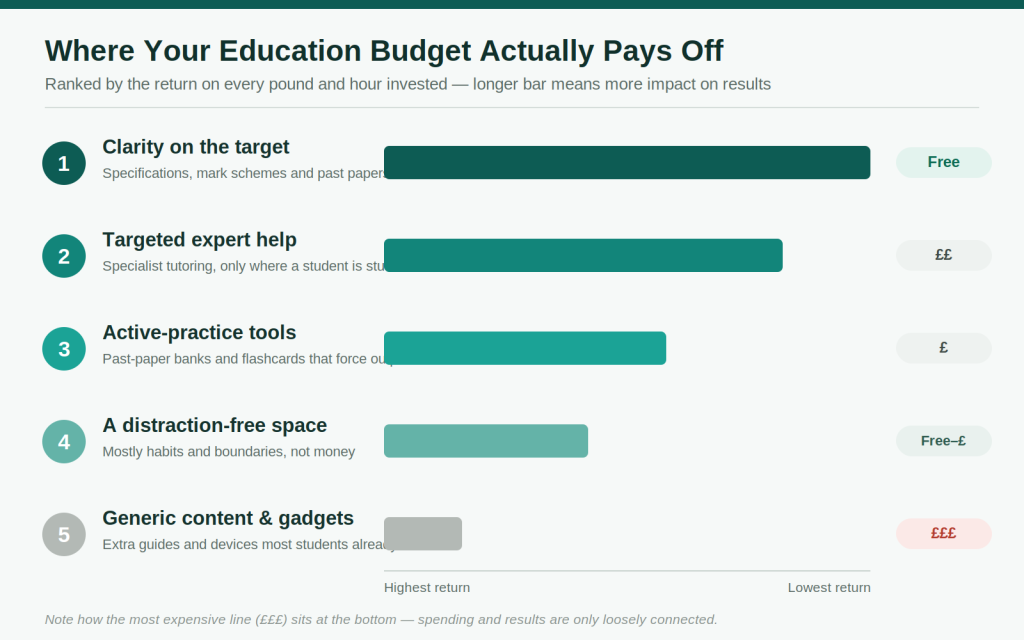
Return on education spending, ranked , the most expensive line often delivers the least.
How to Tell If It Is Actually Working
A good investment shows up as evidence, not vibes. If you cannot see progress, you cannot manage it , and a surprising amount of education spending is never checked against anything at all. A few simple signals keep the whole thing honest:
- Rising marks on past papers under timed conditions , the closest proxy for the real thing
- Fewer repeated mistakes , the same error twice is a sign that feedback is not landing
- The student explaining concepts unprompted , teaching something back is strong evidence it is genuinely understood
If a resource, course or tutor is not visibly shifting these over a few weeks, it becomes a candidate to cut or change. The point is not to be ruthless for its own sake, but to keep money and energy flowing towards whatever is actually working and away from whatever only looks busy. Treating education spending like any other investment , reviewed against results rather than good intentions , is itself one of the higher-return habits a family can adopt, and it costs nothing but a little attention.
The Long Game: Environment, Wellbeing and Motivation
Finally, the returns on everything above are capped by factors no invoice ever covers. A student who is exhausted, anxious or disengaged will not convert even the best tutoring or the cleverest study method into results. The unglamorous fundamentals do more than most parents expect:
- Sleep, which is when memory is consolidated , trading rest for cramming is almost always a bad deal
- Consistency, since small, regular effort beats heroic last-minute bursts every single time
- Ownership and motivation, because a student who understands why they are working will outlast one who is merely told to
These cannot be bought, but they can be protected and encouraged , and they quietly set the ceiling on the return of every other pound and hour invested. Get them wrong and even excellent resources underperform; get them right and modest ones stretch remarkably far.
The Simple Rule of Thumb
Investing in education was never really about how much you spend; it is about aiming a smaller amount at the right things. Get clear on the target, get precise help exactly where a student is genuinely stuck, build the habits that compound, and protect the fundamentals that make all of it stick. Do that consistently, and a modest budget will out-perform a lavish one poured into the wrong places nearly every time. The needle does not move with more. It moves with better aimed.