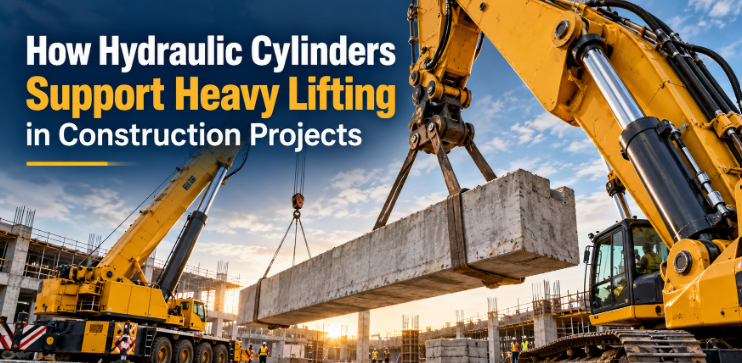
Lifting heavy is a significant aspect of the construction industry.Tons of soil are excavated and heavy parts are lifted by cranes and wheel loaders transport materials to different job sites .These machines have a well-designed lifting, lowering and positioning control system.
Many of these movements are possible by means of hydraulic cylinders employed in construction. They change the pressure of hydraulic fluid into mechanical force, enabling equipment to lift heavy loads without the need for big mechanical lifting systems. Hydraulic cylinders play a vital role in ensuring productivity, controlled movement and efficient material handling from the movement of excavator booms to the elevation of dump truck beds.
Having a basic understanding of how they can assist a contractor, equipment operator and maintenance team in making better decisions regarding equipment performance and safety.
How Do Hydraulic Cylinders Generate Lifting Force?
The hydraulic cylinders are used to generate straight line motion through the use of pressurized fluid. They are used in larger hydraulic power systems such as pumps, hoses, valves, reservoirs and other components.
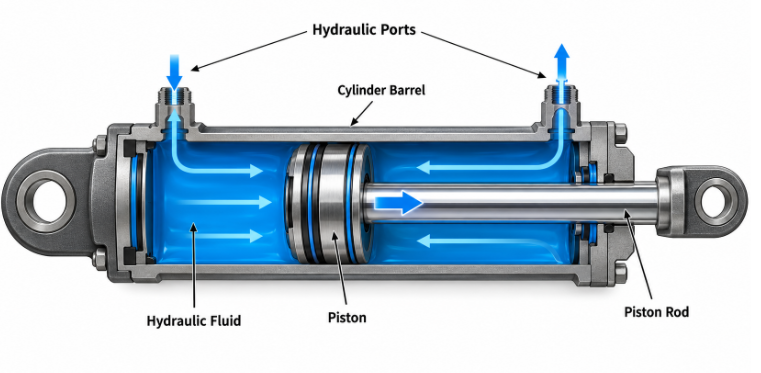
How Hydraulic Pressure Moves the Piston and Piston Rod
A hydraulic pump is used to push fluid against a control valve which pushes fluid to the cylinder. The fluid goes into one part of the cylinder and is used to produce force on the hydraulic piston.
The piston is forced to slide in the cylinder barrel, allowing the piston rod to be pulled or pushed. This action is used to convey mechanical force to other mechanical components of the equipment such as lifting arms, buckets and booms.
The double acting cylinder is capable of performing motion in both directions, using the fluid for both. This enables the cylinder to be extended and retracted as necessary by the operators. Control valves are used to control the direction and flow of the fluid which assist the operators to control the movement of the equipment.
Why Cylinder Bore Diameter and Pressure Affect Lifting Force
The principles of hydraulic lifting are based on Pascal’s law which describes how pressure is transmitted through a confined fluid.
The fundamental equation is:
Force = Pressure x Piston Area (F = P x A)
The bigger the cylinder bore diameter the more piston area there will be. The larger the piston, the greater the force that it can produce at a given hydraulic pressure.
For instance, at 200 bar operating pressure, a cylinder having a bore of 100 mm has a theoretical extension force of ~157 KN. However, several factors other than mechanical leverage also influence the actual lifting capacity of the equipment – cylinder angle, friction, rod strength and manufacturer restrictions. See Parker Hannifin’s hydraulic cylinder engineering information for more details.
Where Are Hydraulic Cylinders Used for Heavy Lifting in Construction?
Hydraulic cylinders are employed in various kinds of construction equipment to lift, tilt and position.
Excavators: Raising Booms and Controlling Heavy Buckets
Hydraulic cylinders are used to operate the arms, buckets and booms of excavators.
The boom cylinders are used to extend and retract the main boom and the arm and bucket cylinders are used for digging and movement of materials. The coordinated operations enable excavators to trench, doze, load and place materials.
Mobile Cranes: Boom Positioning and Stabilization
Hydraulic cylinders play a crucial role in the operations of many mobile cranes, raising and lowering booms . Others have telescopic hydraulic systems to extend boom sections
Hydraulic cylinders are also utilized in outriggers – these are utilized to stabilize gear while lifting.But a crane’s rated lifting capacity can vary with his configuration, boom position, load radius and his approved load chart and is not just based solely on cylinder force.
Wheel Loaders and Dump Trucks: Lifting and Tipping Loads
A hydraulic cylinder is equipped with wheel loaders to lift lifting arms and to tilt buckets. This assists an operator to grab and move gravel, sand and other materials. Telescopic cylinders can be found in a wide variety of dump trucks.Often dump trucks will be equipped with telescopic cylinders to lift their beds up and to dump loads.
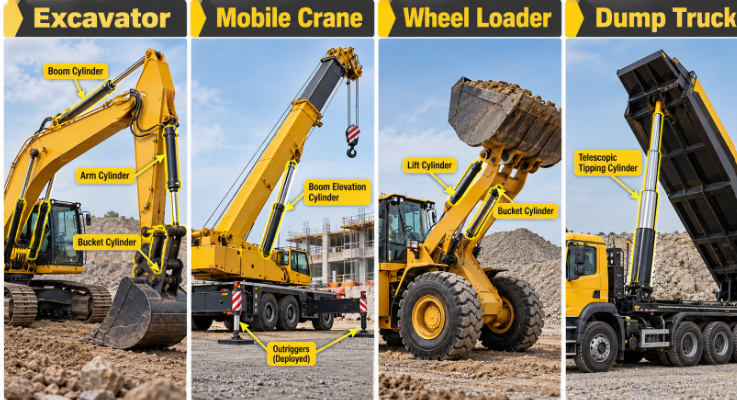
Below is a list of some of the more common hydraulic cylinder applications in the construction industry.
| Construction equipment | Hydraulic cylinder function |
| Excavators | Boom, arm, and bucket movement |
| Mobile cranes | Boom elevation and outriggers |
| Wheel loaders | Lift-arm and bucket control |
| Dump trucks | Raising and lowering dump beds |
| Bulldozers | Blade lifting and positioning |
Which Hydraulic Cylinder Types Handle Heavy Construction Loads?
Various types of lifting activities call for various types of cylinder designs. The selection of the type to be used depends on the loading, the direction of movements, space enclosure and conditions of operation.
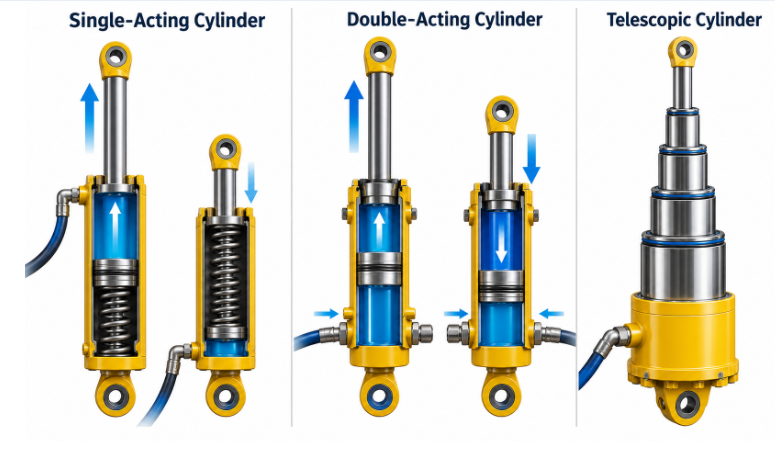
Single-Acting vs. Double-Acting Hydraulic Cylinders
Single acting cylinders generate force in one direction, and are powered by hydraulic pressure. The return movement is achieved by gravity, springs or other forces.
They are frequently employed in hydraulic jacks and some lifting plans. Double Acting Cylinders have hydraulic pressure applied in both directions, for extension as well as retraction. They are ideal for powered movement, both forward and reverse, for excavators, loaders and other units.
Telescopic Cylinders for Extended Lifting and Tipping
A Telescopic cylinder consists of several stages that can be extended within the cylinder. They are small and need not have a long retracted cylinder for a long working stroke.
They are particularly useful in applications that need a low profile installation, like that in dump trucks and equipment.Heavy duty hydraulic cylinders are designed to be strong and durable, and can be repeated in use in harsh construction sites.
Key Benefits of Hydraulic Lifting Systems on Construction Sites
Hydraulic lifting systems have several benefits for equipment that carries out heavy-duty construction-related jobs.
High Lifting Force From Compact Equipment
Hydraulic cylinders can provide a lot of power in a relatively small package.
This is useful as they can be used when heavy loads need to be lifted in confined equipment space.
Hydraulic fluid pressure and piston area enable engineers to build strong lifting devices without having to build up large mechanical components.
Controlled Movement When Positioning Heavy Materials
Hydraulic systems enable the speed and direction of equipment movement to be controlled by the operator. This control is important especially when installing pipes, placing structural components or loading materials. Valves and controls, if designed properly, will ensure that the equipment moves loads smoothly and with decreased momentum changes.
Reliable Performance Under Demanding Jobsite Conditions
Construction machinery working conditions can be dusty, muddy and difficult. Quality hydraulic cylinder components from construction equipment are made of appropriate materials, seals and protective parts to endure repeated operating cycles. But, good performance is still dependent on properly installing, using the right hydraulic fluid, regular checks and maintenance.
What Determines a Hydraulic Cylinder’s Safe Lifting Capacity?
Theoretical force is just one aspect of safe operating an equipment. There are several engineering considerations that determine if it can accommodate a specific load.
Working Pressure, Bore Size, and Rod Strength
A cylinder’s operating pressure and piston area affect the amount of force a cylinder can generate. But the piston rod must be able to resist the forces imposed upon it as well.
Compressed long rods can buckle, especially when stretched. Other performance factors include cylinder mounting and stroke length and off-center loading. A method to assess this risk is given in the ISO/TS 13725 standard for hydraulic cylinders buckling.
Force calculation should never be the only method to determine operator safety limits for the equipment, as the rated limits of the equipment are always of the highest priority.
Load Control, Inspection, and Maintenance
Maintenance decreases hydraulic failures and unwanted equipment movements.
Key inspection areas are:
- Leaks of hydraulic fluid and broken hoses.
- Worn cylinder seals
- Piston rods that are scratched and bent.Bent or scratched piston rods.
- Loose mounting pins and connections,
- Contaminated hydraulic fluid
- Overloaded load/control valves
Avoid working under an unsupported hydraulic load. All equipment should be installed with acceptable mechanical restraints and the manufacturer’s maintenance method.
FAQs
How do hydraulic cylinders lift heavy loads in construction?
Hydraulic cylinders are a cylinder barrel filled with fluids that are used to move the piston
This results in linear force which is used to move parts of equipment linked to it, allowing equipment, or machinery, to lift, lower or position heavy equipment.
What construction machines use hydraulic cylinders?
Hydraulic cylinders are found on excavators, wheel loaders, bulldozers, dump trucks and numerous other mobile cranes. These work on lifting arms, buckets, blades, outriggers and other moving parts.
What is the difference between single-acting and double-acting hydraulic cylinders?
Because of the hydraulic pressure the single acting cylinders move in one direction. . Double acting cylinders operate hydraulically in both directions, giving powered control in both directions.
How does hydraulic pressure affect lifting capacity?
The higher the hydraulic pressure, the more force the cylinder will have if the area of the cylinders are the same.The lifting capacity of the cylinder should not be exceeded beyond the cylinder rated pressure, structural limits and manufacturer’s specifications
Why is hydraulic cylinder maintenance important for safe lifting?
Through regular maintenance, leaks, worn seals, rod damage and other issues can be found that may decrease performance or create unsafe movement. Inspections can also help to prevent planned downtime for equipment.
Conclusion
Hydraulic cylinders are also a critical part in the construction machinery industry. Used for lifting heavy loads, controlling equipment movement and to aid in difficult tasks.
In construction, hydraulic cylinders are used in a variety of machines, such as excavators, loaders, cranes, and dump trucks, which rely on them for precise lifting operations and increased efficiency. They rely on correct choice of cylinder, design of the hydraulic system, training of the operator and routine maintenance.
Construction workers can work more efficiently on the jobsite and avoid unnecessary dangers by understanding these factors. For more information on suitable hydraulic cylinders for construction machinery, take a look at the different types of equipment specifications and learn more about hydraulic solutions for heavy lifting.