For years, there’s been an unspoken assumption in hospitality: if you want the latest in-room tech, book a room at a major chain. Big brands had the capital, the R&D budgets, and the scale to roll out smart locks, connected entertainment systems, and app-based room controls long before smaller properties could even consider it. Independent hotels and boutique properties were left comparing themselves to a moving target they couldn’t afford to chase.
That gap has started closing, and faster than most people in the industry expected.
Why Independent Hotels Fell Behind in the First Place
The reasons boutique properties lagged were never really about vision or willingness. It was almost always about cost and complexity. Smart building systems used to require significant upfront infrastructure investment, dedicated IT staff, and long-term vendor contracts that made sense for a 400-room chain property but were completely impractical for a 20-room independent inn.
On top of that, a lot of early smart hotel technology was built with chain-scale deployment in mind. Systems were priced and packaged for properties buying hundreds of units at once, not for a single boutique hotel trying to upgrade room by room within a modest renovation budget.
What’s Actually Changed
A few things have shifted at once, and together they’ve made a real difference. Hardware costs have come down significantly across the smart building category generally, not just in hospitality. Cloud-based systems have replaced a lot of the on-site infrastructure that used to make smart upgrades so expensive, which means smaller properties no longer need a dedicated server room or IT department just to run connected systems.
Vendors have also caught on to the fact that independent hotels represent a real, underserved market. Instead of only building for chain-scale rollouts, more companies now offer modular systems designed to work for a handful of rooms just as easily as a few hundred, without forcing smaller properties to pay for capacity or complexity they don’t need.
Where Boutique Properties Are Actually Investing
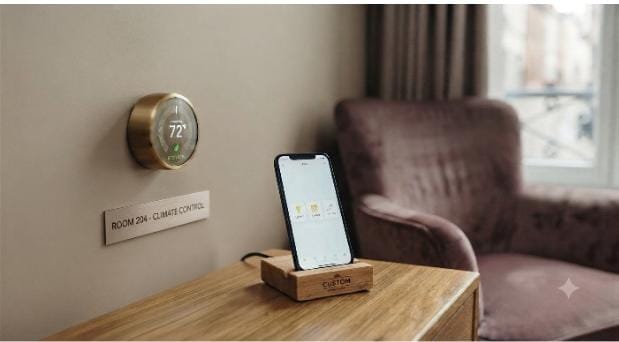
Climate control has become one of the more common starting points, and it’s easy to see why. Comfort is one of the first things guests notice, and one of the first things they complain about when it’s inconsistent. A reliable hospitality thermostat gives smaller properties a way to modernize guest comfort without the scale or cost of a full smart building overhaul, since it can often be installed room by room as budget allows, rather than requiring an all-at-once rollout across the entire property.
Keyless entry has followed a similar path, along with smarter lighting controls that adjust based on occupancy rather than running on a fixed schedule regardless of whether the room is in use. None of these are flashy, headline-grabbing upgrades. They’re practical, guest-facing improvements that happen to also reduce operating costs, which makes them an easy sell to ownership groups working with tighter capital budgets than a major chain.
The Guest Experience Angle Matters More for Independents
There’s a reason this shift matters more to boutique hotels than it might seem at first. Independent properties compete almost entirely on guest experience and differentiation, they don’t have brand loyalty programs or massive marketing budgets working in their favor the way chains do. A guest who books a boutique property is often doing so specifically because they want something that feels more personal, more considered, and more comfortable than a standardized chain room.
That makes small technology upgrades disproportionately important. A guest who notices their room stays consistently comfortable, or that check-in felt seamless, is forming an impression that directly shapes whether they book again or leave a strong review. For independents, these details carry more weight precisely because there’s no brand name doing the heavy lifting.
Research Backs the Shift Toward Smaller-Scale Tech Adoption
This isn’t just anecdotal. Cornell’s Center for Hospitality Research, which has studied hospitality innovation and technology adoption for decades, has documented how meaningfully guest experience and operational performance are being reshaped by evolving hospitality technology, both at large chains and increasingly at smaller, independent properties. Their work has tracked how technology adoption in hospitality is no longer solely a scale advantage reserved for major brands, but a strategic option now genuinely accessible to smaller operators.
What This Means Going Forward
None of this means independent hotels are suddenly on equal footing with major chains across every category of technology. Chains still have advantages in loyalty infrastructure, centralized booking systems, and negotiating power with large vendors. But the specific gap in in-room comfort technology, the stuff guests actually interact with directly, has narrowed considerably.
For boutique and independent properties, that’s a meaningful shift. It means competing on comfort and guest experience no longer requires chain-level capital, just a willingness to prioritize the upgrades that guests notice most. And for an industry where a single inconsistent stay can cost a property a repeat guest, that’s not a small thing.