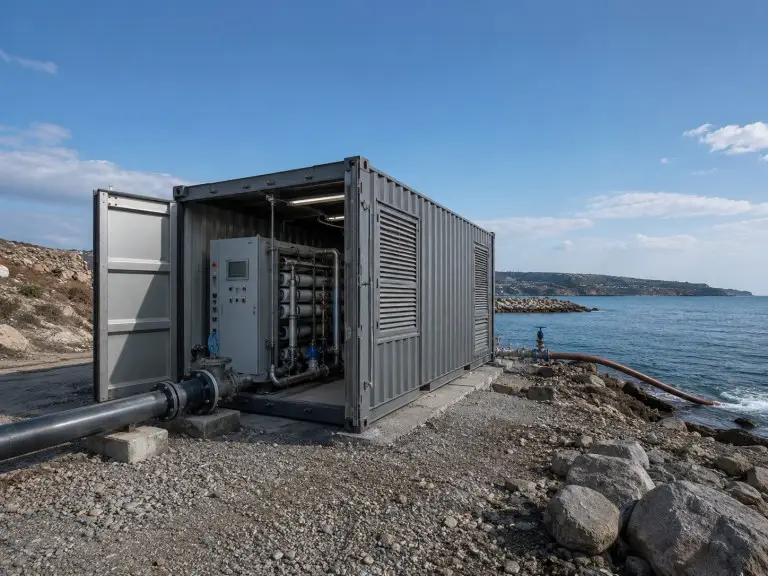
Many of the coastal locations that command the highest property values have no municipal water supply. Across the Turks and Caicos, the Bahamas, the Cyclades, Bali, the Maldives and the Pacific coast of Costa Rica, fresh water on a private estate is caught, trucked, drawn from a local well, or produced on site from seawater. Above a certain property size and occupancy level, on-site production is generally the only option that scales.
Desalination has consequently become standard infrastructure at the upper end of the coastal market. It is also among the least well understood systems on such properties, and specification errors tend to be expensive to correct once construction is complete.
Conventional sources have known limits on coastal sites
Three assumptions commonly carried over from mainland projects do not hold on island and near-shore locations.
The first concerns groundwater. Coastal aquifers are typically thin, and sustained abstraction draws seawater inland. A borehole that tests fresh at commissioning can turn brackish within a few years, particularly on small islands and during dry seasons when abstraction along a coastline peaks simultaneously.
The second concerns rainwater catchment. Catchment can be adequate for a modest dwelling in a high-rainfall climate under disciplined use. It is rarely adequate once a pool, landscape irrigation and variable occupancy are included, and it produces least during the months when demand is highest.
The third concerns delivered water. Trucked supply functions as a fallback until site access becomes difficult, seasonal demand peaks, or road conditions deteriorate. Delivered water on island locations is also priced such that payback on an on-site plant is frequently measured in a small number of years.
Demand assessment precedes equipment selection
Undersized and oversized installations generally trace back to a demand figure that was estimated rather than calculated. Industry practice is to build daily demand from components before any equipment discussion begins.
- Domestic consumption — bathing, kitchens, laundry and staff accommodation. Consumption per occupant at this property tier runs considerably above standard residential figures, and resort-standard laundry represents a significant load in its own right.
- Pool and water features — evaporation and backwash replacement rather than initial fill, which is a one-time volume. Evaporation rises sharply in hot, windy conditions.
- Irrigation — on estates with established landscaping this is frequently the largest single demand, in many cases exceeding combined domestic use.
- Occupancy profile — the difference between caretaker-only periods and full seasonal occupancy can exceed a factor of five.
The occupancy range drives a structural decision: whether to size the plant to peak demand or closer to average, buffering the difference in storage. Storage capacity is generally less expensive than additional membrane and pump capacity, but requires tank volume, footprint and a disinfection regime for water held over extended periods.
Source water classification determines the system type
Feed water salinity is the largest single cost variable in the specification.
Open-ocean seawater carries approximately 35,000 mg/L total dissolved solids, with higher concentrations recorded in the Mediterranean, the Red Sea and the Arabian Gulf. Overcoming the corresponding osmotic pressure requires operating pressures in the region of 55 to 70 bar, corrosion-resistant materials throughout the high-pressure section, and membranes rated for seawater service. Recovery — the proportion of intake converted to product water — typically falls between 35 and 50 percent, with the balance leaving as concentrate.
Brackish water, whether from a saline-intruded well or an estuarine source, generally ranges from around 1,000 to 10,000 mg/L. It represents a materially cheaper problem: lower operating pressure, lower energy consumption, recovery commonly in the 65 to 80 percent range, and less demanding materials specification.
The distinction has practical consequences. A brackish-rated system supplied with genuine seawater will not produce water at design output. A seawater-rated system supplied with brackish water will operate, but at capital cost several times higher than the duty requires. Correct classification depends on laboratory analysis of the actual source, sampled during the dry season, rather than on regional averages.
Suppliers active in off-grid installations generally publish the scope they design against. The overview of seawater desalination systems for remote sites published by Hiju lists a representative variable set — feed salinity and temperature, daily output, intake arrangement, available power, storage volume and expected service interval. Establishing those values before tendering is what allows competing quotations to describe the same plant rather than three different ones.
System components
Membranes attract the majority of attention during procurement, but they represent one element among several and are rarely the first to fail.
Intake. Open intakes are less expensive and faster to construct but deliver whatever the water column contains on a given day, including algae, suspended sediment and post-storm debris. Beach wells and infiltration galleries use the seabed as a natural filter and deliver substantially more stable feed quality at higher capital cost. On coastlines subject to seasonal algal blooms, this selection largely determines plant availability.
Pretreatment. Multi-media filtration, cartridge filtration and chemical dosing. This stage exists to protect the membranes, and reduced pretreatment specification is among the more common false economies in the package.
High-pressure pump and energy recovery. The pump is the dominant energy consumer. An energy recovery device transfers pressure from the concentrate stream to the incoming feed, and its inclusion or omission affects operating cost more than any other single decision in the specification.
Membranes and pressure vessels. Consumable items with defined service lives rather than permanent installations.
Post-treatment. Addressed below, and frequently absent from budget-stage quotations.
Storage, repressurisation and disinfection. Product water requires holding capacity, protection while held, and delivery to the building at usable pressure.
Energy consumption and operating cost
Large modern seawater plants fitted with efficient energy recovery achieve specific energy consumption in the range of approximately 2.5 to 4 kWh per cubic metre of product water. Systems without energy recovery run materially higher, with commonly cited figures spanning 4 to 10 kWh per cubic metre; small-capacity units sit toward the upper end of that band.
On properties dependent on diesel generation, that differential compounds daily across the service life of the asset. It also interacts with solar generation: a plant fitted with energy recovery may operate largely within a daytime solar window, while an equivalent plant without it may require generator hours or substantially greater battery capacity. Energy recovery adds capital cost and an additional serviced component, so its inclusion is not automatic at small scale, but it warrants an explicit operating-cost comparison rather than omission by default.
Post-treatment requirements
Permeate leaving a reverse osmosis membrane is of very low mineral content, which creates two issues.
The first is organoleptic. Demineralised water is widely described as flat, and occupants at this property tier register the difference immediately.
The second is material. Water stripped of dissolved minerals is chemically aggressive toward copper pipework, brass fittings and cement linings. On properties with specified fixtures and extended pipe runs, the resulting degradation is slow to appear and expensive to remedy. Remineralisation — typically a calcite contactor or dosing arrangement with pH correction — is established engineering practice and belongs in the base specification. Its absence from a quotation is a question to resolve before comparing prices.
Concentrate discharge and permitting
Each cubic metre of product water generates a concentrate stream at roughly twice the salinity of the source. Its disposal is a permitting matter in most jurisdictions and an environmental consideration in all of them.
Discharge into shallow, enclosed water with limited exchange raises local salinity and can damage seagrass beds and reef systems. Properly engineered outfalls place discharge where prevailing currents disperse it, in some cases with diffusers to accelerate mixing. On environmentally sensitive coastlines, discharge approval is frequently the longest lead item in the permitting process and is best established before equipment is ordered.
Maintenance and service logistics on remote sites
Maintenance requirements diverge sharply between remote installations and mainland industrial plants.
Cartridge filters require routine replacement. Membranes require cleaning-in-place when differential pressure rises or product flow declines, and eventual replacement; service life varies considerably with feed quality and pretreatment discipline, which is the principal reason intake and pretreatment decisions carry weight. High-pressure pumps require seal replacement and scheduled servicing. Instrumentation requires calibration to remain meaningful.
None of that is unusual in itself. The logistics are. A mainland industrial site can generally secure a technician within hours and a replacement element within a day. An island installation may face a week for parts and scheduled travel for an engineer, during which the property operates on stored volume alone.
Two practices follow. On-site spares — membranes, cartridges, seals and dosing chemicals — are held rather than ordered on demand. And supplier selection weights demonstrated regional service capability at least as heavily as equipment price, since a lower-cost plant supplied from a base with no regional presence carries a materially different availability profile.
Storage capacity and redundancy
Two parameters determine the resilience of the installation.
Storage duration. Three to five days of average demand is a common working target for remote sites, providing margin to absorb a component failure, a part in transit or a planned maintenance window without service interruption.
Train configuration. A single larger unit carries lower capital cost. Two smaller units in parallel cost more but permit servicing of one while the other produces, and allow the plant to turn down efficiently during low season rather than cycling. For properties operated commercially or located beyond practical service reach, the redundancy premium is generally judged justified.
Pre-contract verification
- Laboratory analysis of the actual source water, sampled in the dry season
- Demand calculated by component, with the peak-versus-average sizing basis stated explicitly
- Specific energy consumption quoted in kWh per cubic metre, with energy recovery inclusion confirmed
- Post-treatment and remineralisation itemised
- Concentrate discharge arrangement and its permitting status
- Membrane and cartridge replacement intervals with indicative costs
- Supplier’s nearest service base and documented response time
- Recommended on-site spares list, and whether it forms part of the supply
Summary
A desalination plant functions as a utility rather than an appliance, with an intake, an energy demand, a waste stream, a permitting file and a maintenance schedule. Projects that specify it alongside the building, rather than retrofitting it into remaining plant space, consistently produce lower operating costs and higher availability.
Specified correctly, on-site production removes the water constraint that has historically limited development on remote coastlines. Specified late, it becomes the factor that determines whether a property can be occupied at full capacity during peak season.