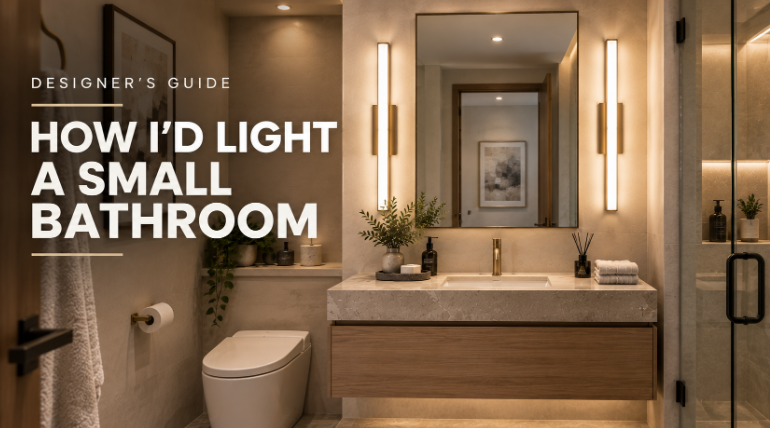
Lighting a small bathroom is less about adding more fixtures and more about putting the right light in the right places. When space is limited, every fixture has a visual impact, so I focus on balance, proportion, and how the light actually works around the mirror and vanity.
If I were designing a small bathroom from scratch, I would start with the vanity area, build the lighting around the mirror, and then add enough ambient light to keep the rest of the room comfortable.
Start With the Mirror, Not the Light Fixture
The mirror is usually the visual center of a small bathroom, so I would decide on its size and position before choosing the lighting.
A common mistake is buying a beautiful fixture first and trying to make it work around the mirror. That can leave the vanity looking unbalanced or make the fixture appear too large for the room.
Instead, consider the mirror, vanity width, ceiling height, and available wall space together. Once those proportions are established, the right lighting style becomes much easier to choose.
My First Choice: Light From Both Sides of the Mirror
If I have enough wall space, I generally prefer placing light on both sides of the mirror. This creates more even illumination across the face and helps reduce the shadows that can occur when all the light comes from above.
Wall sconces work particularly well for this approach. A pair of slim fixtures can provide useful task lighting without taking up much visual space.
For a small bathroom, I would keep the fixtures relatively compact and make sure they don’t visually compete with the mirror.
When I’d Use a Light Above the Mirror
Side lighting isn’t practical in every bathroom. Sometimes the wall is too narrow, the mirror takes up most of the available space, or the existing electrical layout only allows for a fixture above it.
In those situations, I would choose a horizontal bathroom vanity light fixture that fits the scale of the mirror.
The important part is proportion. A fixture that is dramatically wider than the mirror can make a small bathroom feel crowded, while one that is too narrow may look disconnected from the vanity.
I’d also pay close attention to mounting height. The goal is to illuminate the face without creating uncomfortable glare or strong shadows.
Choose the Right Vanity Light Size
Size is one of the easiest details to get wrong in a small bathroom.
I would generally look at the vanity and mirror as a visual unit rather than choosing the fixture based on the wall alone. A 24-inch vanity, for example, needs a very different lighting scale from a 48-inch vanity.
Before buying a fixture, check its actual dimensions and compare them with the mirror width. Also consider how far the fixture projects from the wall. In a tight bathroom, even a fixture with the right width can feel oversized if it sticks out too far.
I’d Use Layered Lighting Instead of One Bright Fixture
One bright ceiling fixture might technically illuminate a small bathroom, but it rarely creates the best atmosphere.
If I were designing the space, I’d think in layers:
- Vanity lighting: focused illumination around the mirror.
- Ambient lighting: general light for moving around the bathroom.
- Accent lighting: optional lighting that adds depth or atmosphere.
This approach allows each light source to do a specific job. It also prevents the bathroom from feeling like a single bright box of light.
Choose Warm, Comfortable Light
Color temperature can completely change how a bathroom feels.
For a residential bathroom, I usually prefer a comfortable white light rather than an extremely cool, blue-looking light. Very cool lighting can make white surfaces feel harsh and can be less flattering around a mirror.
The exact temperature should also work with the rest of the home. If the adjoining bedroom and hallway use warm lighting, choosing an extremely cool bathroom light can create an abrupt transition.
Consistency matters more than chasing a particular number.
Don’t Ignore CRI When Choosing LED Vanity Lights
Brightness isn’t the only thing that matters around a bathroom mirror. Color accuracy is important too.
This is one reason I pay attention to CRI when selecting LED vanity lights. A higher color rendering index can help colors appear more naturally under the light, which is particularly useful when you’re getting ready, applying makeup, shaving, or choosing clothing.
I would rather have well-balanced, color-accurate lighting than simply install the brightest fixture available.
Use the Walls to Your Advantage
Small bathrooms don’t give you much room to work with, so wall-mounted lighting can be especially useful.
A pair of slim sconces can frame the mirror without consuming floor or counter space. Vertical fixtures can also draw the eye upward, which can help emphasize the height of the room.
If the bathroom is extremely narrow, I would avoid bulky fixtures that extend too far into the room. A low-profile design can keep the walls feeling cleaner and the space more open.
Match the Vanity Light to the Bathroom’s Design
I wouldn’t choose a vanity light in isolation. Its shape and finish should support the overall bathroom design.
For a modern bathroom, I’d lean toward clean lines and simple silhouettes. In a more traditional space, a decorative fixture may make more sense.
The finish matters too. Black can create contrast, brass can add warmth, while chrome can work well with a cleaner or more contemporary palette.
You don’t necessarily need every fixture in the bathroom to have exactly the same finish. I prefer coordinating finishes rather than trying to make every piece identical.
Small Bathroom Lighting Mistakes I’d Avoid
There are a few things I’d reconsider immediately when reviewing a small bathroom lighting plan:
- Using one extremely bright ceiling fixture as the only light source
- Choosing a fixture that’s too large for the mirror
- Placing the main light directly behind the person using the mirror
- Using an unnecessarily cool light
- Ignoring shadows around the face
- Installing bulky fixtures in an already narrow space
- Mixing too many unrelated fixture styles
- Choosing a fixture purely because it looks attractive in a product photo
A good bathroom light needs to look good and perform well.
My Designer Formula for a Small Bathroom
If I had to simplify the entire lighting process, I’d approach it in this order:
Mirror → Vanity Lighting → Ambient Lighting → Color Temperature → Finish
First, determine the mirror and vanity proportions. Then decide whether side-mounted or overhead lighting makes more sense. Add ambient lighting if the vanity light doesn’t adequately illuminate the rest of the room.
After that, choose a comfortable color temperature and finally select a fixture finish that works with the bathroom’s materials.
This keeps the design process simple and prevents the decorative details from taking over the practical decisions.
Final Designer Take
A small bathroom doesn’t need a complicated lighting setup. It needs lighting that works with the proportions of the space.
I’d prioritize even illumination around the mirror, use layered lighting where possible, and choose fixtures that feel appropriately sized for the vanity. Whether you choose sconces or a linear fixture, the goal should always be the same: good light without making the room feel crowded.
And when you’re comparing bathroom vanity light fixtures, don’t judge them only by their appearance. Look at their size, light distribution, color quality, mounting position, and how they’ll work with the rest of the bathroom.
The best fixture is the one that makes the entire space feel intentional—not the one that simply stands out the most.