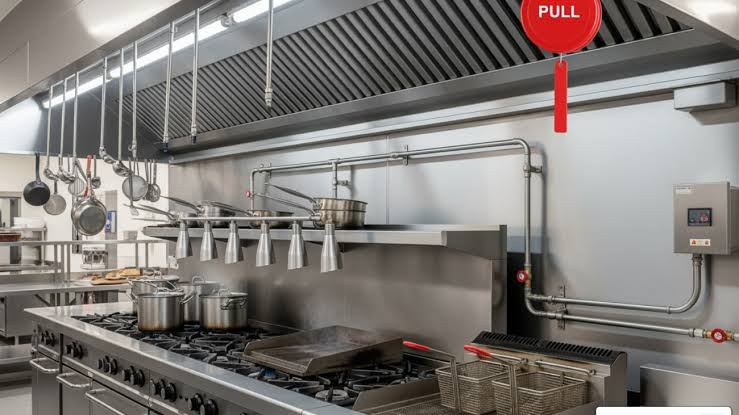
Cooking equipment is the leading cause of fires in restaurants, and the reason most of those fires stay small is a system that most restaurant staff never think about: the fire suppression system built into the exhaust hood over the cooking line. It sits there for years doing nothing, and then, in the seconds after a fryer flares, it is the only thing between a contained incident and a building loss. Whether it works in that moment depends entirely on what was done to it in the months before.
This guide explains how a modern kitchen hood suppression system detects and extinguishes a fire, what the standard it is built to requires, what the semiannual inspection actually involves, the ways systems fail in practice, and what an operator should expect from the company that services it.
What the System Is
A kitchen hood suppression system is a pre-engineered wet chemical system installed in and around the exhaust hood above commercial cooking appliances. It has four parts:
- Detection. Fusible links or heat detectors mounted in the hood plenum and exhaust duct, held in tension by a cable. When a fire heats a link past its rated temperature, the link separates and releases the cable.
- Release and actuation. The released cable trips a mechanical release in the control head, which punctures or opens a cartridge of expellant gas, pressurizing the agent tank. Most systems also have a manual pull station near an exit from the kitchen so staff can trip the system by hand.
- Agent and distribution. A wet chemical agent, typically a potassium-based solution, is forced through piping to nozzles aimed at each appliance, into the hood plenum, and into the exhaust duct. The nozzles are specific to the appliance below them: a fryer nozzle differs from a griddle nozzle, and each is positioned and aimed to the manufacturer’s listing.
- Interconnects. On actuation, the system shuts off the gas or electric supply to the cooking appliances, so the heat source stops, and typically signals the building fire alarm. The exhaust fan usually continues to run to clear smoke and agent.
The agent works by saponification: it reacts with hot cooking oil to form a soapy foam layer that smothers the fire and insulates the oil surface so it cannot reignite as it cools. This is why ordinary dry chemical is wrong for cooking oil and why the agent in these systems is specifically wet chemical.
The Standard: UL 300
Since the mid 1990s, kitchen suppression systems in the United States have been required to meet UL 300, a test standard developed after the industry shifted from animal fats to vegetable oils and from older fryers to high-efficiency models that hold heat longer. Older dry chemical systems could not reliably extinguish these fires or prevent reignition. UL 300 systems use wet chemical agent, more nozzles, and appliance-specific coverage, and they are tested against the actual cooking conditions of modern equipment.
Codes and insurers require UL 300 compliance for commercial cooking operations, and a kitchen still protected by a pre-UL 300 dry chemical system is operating with equipment that is not listed for the fire it is meant to fight. Fire inspectors flag these systems for replacement, and some insurers will not write coverage on a kitchen with one.
Semiannual Inspection: What Actually Happens
NFPA 96, the standard for commercial cooking ventilation and fire protection, together with the system manufacturer’s requirements, calls for inspection and service of the suppression system at least every six months by a trained and certified technician. The service is more than a glance and a tag.
- Appliance and nozzle coverage check. The technician confirms that every appliance under the hood has the correct nozzle type aimed correctly at it, and that no appliance has been added, moved, or swapped since the last visit without the nozzles being updated. This is the most consequential item on the list.
- Fusible link replacement. Links are replaced at every semiannual service, because grease accumulation and heat cycling degrade them. The links are rated for the temperature appropriate to their location.
- Detection line and cable check. The cable runs, pulleys, and tension are verified so the release will trip when a link separates.
- Control head and cartridge. The release mechanism is tested and the expellant cartridge is weighed to confirm it is charged. Cartridges are replaced on the manufacturer’s schedule.
- Agent tank. The tank is inspected and, on the manufacturer’s interval, hydrostatically tested; the agent itself is replaced on its own schedule.
- Nozzle caps and piping. Nozzles are checked for grease blockage and their protective caps replaced; piping is checked for damage and correct routing.
- Manual pull station. Tested for function and checked for accessibility.
- Fuel shutoff and alarm interconnect. The gas valve or electrical shunt trip is tested to confirm the appliances actually shut down on actuation, and the alarm signal is verified.
- Documentation. A new tag on the system showing the service date and company, and a written report of findings, deficiencies, and any parts replaced.
A full semiannual service takes real time on site. A visit that lasts a few minutes and produces a new tag has not done this list.
Why Kitchens Still Burn
Suppression systems are reliable when maintained and installed correctly, and the fires that get away almost always trace to one of a few failures.
- Appliances moved without the nozzles being moved. A fryer relocated two feet down the line, or a flat-top replaced with a charbroiler, is now under a nozzle designed for something else or under no nozzle at all. This is the single most common deficiency found in kitchens, and it happens between service visits whenever the line is reconfigured.
- Grease-clogged nozzles. Nozzle caps that were not replaced, or that were removed and never put back, let grease plug the orifice. The system discharges, and nothing comes out over the fryer.
- Degraded fusible links. Links coated in grease respond slowly or not at all. Links that were not replaced at the last service are the usual cause.
- Disabled or bypassed fuel shutoff. A gas valve that was wired around after it tripped once, or that was never connected, leaves the burners running under the fire.
- Pre-UL 300 systems still in service. The system discharges dry chemical onto a modern fryer, the oil reignites, and the kitchen burns.
- Dirty hoods and ducts. Grease buildup in the plenum and duct is fuel. A suppression system can control the appliance fire while a duct fire above it spreads through the building. Hood and duct cleaning on its own schedule is part of the same protection.
- Nobody pulled the manual station. Staff who do not know the system exists or where the pull is will try to fight the fire with a portable extinguisher and lose time.
What an Operator Should Do
- Keep the semiannual schedule with a certified service company, and treat a missed visit as an urgent problem rather than an administrative one.
- Call the service company before changing the cooking line. Any appliance added, moved, or replaced requires the nozzle layout to be reviewed and usually changed.
- Keep hood and duct cleaning on its own schedule, which depends on cooking volume and type and is separate from suppression service.
- Train the staff. Where the manual pull is, when to use it, and that the hood system comes before the portable Class K extinguisher.
- Read the report. Deficiencies listed at the semiannual service are the system telling the operator what will fail. Fix them.
- Replace any pre-UL 300 system still in place, before an inspector or an insurer forces the issue.
In Wyoming, Crimson Fire Protection services UL 300 kitchen hood suppression systems for restaurants and commercial kitchens in Casper and across the state, with semiannual inspections by certified specialists including Ansul system service, written reports and deficiency lists after each visit, nozzle and coverage updates when cooking lines change, and Class K extinguishers, emergency exit lighting, and backflow testing available from the same provider so a kitchen’s fire protection is handled under one maintenance plan. For an operator anywhere, the questions to ask a service company are whether their semiannual visit covers every item above, whether they replace links and caps every time, and whether they will review the nozzle layout when the line changes, because those are the items that decide whether the system works on the day it matters.
Key Takeaways
- A hood suppression system detects with fusible links, releases mechanically or by manual pull, discharges wet chemical through appliance-specific nozzles, and shuts off fuel to the appliances.
- UL 300 is the required standard for modern cooking; pre-UL 300 dry chemical systems cannot reliably extinguish vegetable oil fires and should be replaced.
- Semiannual service covers nozzle coverage, link replacement, cable tension, cartridge weight, agent tank, nozzle caps, manual pull, fuel shutoff, and documentation.
- Kitchens burn when appliances move without nozzle updates, nozzles clog, links degrade, fuel shutoffs are bypassed, old systems remain, or ducts are dirty.
- Operators should keep the schedule, call before changing the line, clean hoods and ducts, train staff on the pull station, and act on the deficiency report.
Frequently Asked Questions
How often does a kitchen hood suppression system need service?
At least every six months, by a trained and certified technician, under NFPA 96 and the manufacturer’s requirements. Fusible links are replaced at each service.
What is UL 300 and why does it matter?
UL 300 is the test standard for kitchen suppression systems designed for modern vegetable oils and high-efficiency appliances. Pre-UL 300 dry chemical systems cannot reliably extinguish these fires or prevent reignition, and codes and insurers require UL 300 compliance.
Can I move a fryer or add an appliance under my hood?
Only after the suppression company reviews and updates the nozzle layout. Appliances moved without nozzle changes are the most common deficiency and the most common cause of system failure in a fire.
Does the hood system replace the need for a fire extinguisher?
No. A Class K portable extinguisher is required near the cooking appliances in addition to the hood system, for fires the system did not fully control or that occur outside its coverage. Staff should activate the hood system first.
Is hood and duct cleaning the same as suppression service?
No. Cleaning removes grease fuel from the hood and duct and runs on its own schedule based on cooking volume. Suppression service maintains the extinguishing system. Both are required.
What does the manual pull station do?
It trips the suppression system by hand without waiting for a fusible link to separate, discharging the agent and shutting off the appliances. Staff should know where it is and use it at the first sign of a fire the appliance controls cannot stop.
Conclusion
A kitchen hood suppression system is a mechanical promise that a cooking fire will be stopped in the seconds after it starts. The promise holds when the system is the right standard, the nozzles match the appliances beneath them, the links and cartridge are fresh, the fuel shutoff works, and someone has checked all of it within the past six months. Every kitchen fire that gets away is a case where one of those conditions was not met, and every one of them was preventable by a service visit that did its full job.