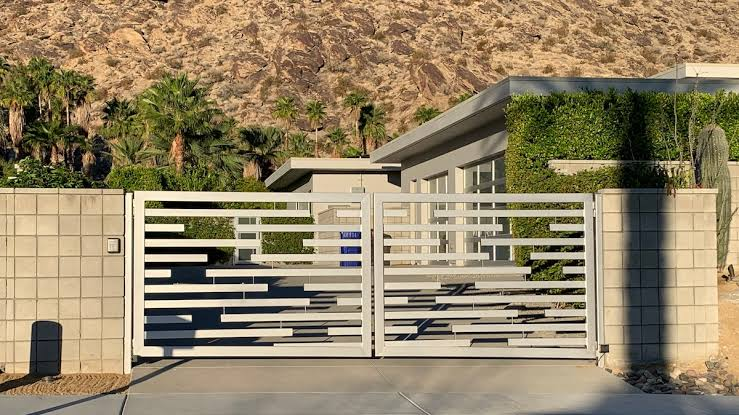
An entrance gate is the first thing a visitor touches and the last thing an owner sees leaving, and it does a job that nothing else on a property does: it decides who comes in. For that reason it is both a design object and a piece of machinery, and the best gates are planned as both. The ones that disappoint were chosen from a catalog photograph without anyone asking how the drive slopes, where the snow goes, how the opener will be powered, or whether the gate’s scale suits the house behind it.
This guide walks through the decisions in the order a good fabricator asks them: the operating type, the material and finish, the design and scale, automation and safety, and the site details that determine whether the gate works in February as well as it did in June.
Swing or Slide
The first decision is how the gate moves, and the site usually makes it.
Swing gates
One or two leaves hinged on posts, swinging inward or outward. The traditional form, and the one most people picture. A swing gate needs clear space on the side it opens toward: a flat or gently sloping area as deep as the leaf is wide, with nothing parked in it. It suits a level drive with room inside the gate line, and it allows the widest range of decorative design because the leaves are flat panels that can carry scrollwork, pickets, finials, and curved tops.
Swing gates struggle on drives that slope upward behind the gate, where the leaf would strike the ground, and in snow climates where the swing arc has to be cleared before the gate will open. Rising hinges and shorter leaves can address a mild slope; a steep one argues for a slide.
Slide gates
A single panel that moves sideways along the fence line. Cantilever slide gates are suspended from rollers on posts and never touch the drive, so they clear snow, gravel, and debris and work on sloped drives. Track-mounted slide gates roll on a rail set in the drive surface and need that rail kept clear.
A slide gate needs run-off room along the fence line equal to the opening width plus the cantilever counterbalance, so a sixteen-foot opening may need twenty-four feet of clear fence line beside it. Where that room exists, a slide gate is the more reliable choice for an automated entrance in a cold climate. Its design options are somewhat narrower than a swing gate’s, since the panel must be rigid and balanced, but a skilled fabricator can carry the same visual language across both.
Material and Finish
Three materials cover nearly every residential entrance gate.
- Wrought iron and steel. The strongest and most formal option, and the one that allows true custom work: forged scrolls, twisted pickets, hand-shaped finials, cast ornaments. Heavy, which matters for hinges and operators, and dependent on its finish for rust protection. Properly prepared, primed, and painted or powder-coated iron lasts for decades with periodic repainting.
- Aluminum. Light, rust-proof, and lower maintenance, with a powder-coated finish that does not need repainting. Available in many picket-style designs and increasingly in custom work, though it cannot reproduce the forged detail of iron. The weight saving eases automation.
- Wood, or wood over a steel frame. Warm and private, suited to contemporary and rustic houses. Wood alone moves with moisture and sags; a steel frame clad in wood gives the look with the stability. Needs regular finishing.
For iron and steel, the finish is the long-term maintenance question. Hot-dip galvanizing before painting or powder coating gives the best corrosion protection, and the owner should expect to repaint iron every several years to keep it. A fabricator who also offers metal painting can maintain the gate they built.
Design and Scale
A gate should look like it belongs to the house and the fence, and the common mistakes are mismatches of scale and style. A low, ornate gate on a tall, plain fence; a heavy traditional gate on a modern house; a gate so tall it reads as a barrier rather than an entrance. A few principles help.
- Match the fence. The gate’s picket spacing, rail positions, and top line should continue the fence’s. The gate can be more elaborate than the fence, but it should be recognizably related.
- Match the architecture. Classical houses carry scrollwork and finials well; modern houses want clean verticals or horizontals. The fabricator should see the house, not just the opening.
- Frame the view. An arched or raised center on a double swing gate draws the eye to the house behind it. A flat top is quieter and suits a slide.
- Consider privacy. Open pickets show the property; solid infill, horizontal slats, or perforated panels screen it. Solid gates catch wind and need heavier framing and operators.
- Add the pedestrian gate. A matching walk gate beside the drive gate saves cycling the main gate for visitors on foot and is almost always worth including.
Automation and Safety
Most entrance gates are automated, and automation should be designed with the gate rather than bolted on later.
- Operator type. Swing gates use arm or underground operators sized to the leaf’s weight and length; slide gates use a motor driving a rack or chain. Oversized leaves, solid infill, and wind exposure all push the operator specification up.
- Power. Running conduit to the gate posts is far easier during installation than afterward. Solar operators exist for sites without power but have limits in winter.
- Access control. Keypad, remote, intercom with video, phone app, vehicle tag reader, or some combination. The entry pedestal and its wiring belong in the plan.
- Safety devices. Photo eyes across the opening, edge sensors on the leaves, and obstruction reversing are standard, and the relevant safety standard for automated gates governs what is required. Reputable installers follow it; the owner should ask.
- Manual release. Every automated gate needs a way to open it by hand in a power failure, and the owner should know where it is.
Site Details That Decide Whether It Works
- Posts and footings. Gate posts carry the gate’s weight and the operator’s forces, and they must be heavy, set deep, and in a cold climate set below the frost line so they do not heave. A gate that sags or binds is almost always a post problem.
- Drainage and grade. Water should not pool at the gate line, and the drive should be graded so the gate clears it in every season.
- Snow. Where does the plow push it? A swing gate’s arc and a slide gate’s track or run-off zone must stay clear, and the gate should be placed where that is practical.
- Setback and sightlines. A gate set back from the road gives a vehicle room to stop while it opens without blocking traffic, and a driver leaving needs to see the road.
- Permits. Many municipalities require a permit for a fence or gate above a certain height, and some regulate automated gates specifically. The installer should handle this.
In Chicago, where entrance gates have to handle snow, salt, freeze-thaw, and city permitting, Americana Iron Works & Fence has designed and built custom wrought iron driveway, entrance, and walkway gates for more than thirty years, with gate installation that includes automation for homes and businesses, in-house custom ironwork for scrollwork and decorative detail, metal painting to maintain the finish, and licensed, bonded, and insured work with free estimates. For an owner anywhere, the right fabricator is the one who asks about the slope of the drive and the path of the snowplow before showing a catalog, because those questions are what separate a gate that is admired from one that is used.
Key Takeaways
- Swing gates suit level drives with room inside the gate line and allow the most decorative design; slide gates suit slopes, snow, and tight sites.
- Wrought iron offers true custom work and needs its finish maintained; aluminum is lighter and rust-proof; wood over steel gives warmth with stability.
- Match the gate to the fence and the architecture, consider privacy and wind, and include a pedestrian gate.
- Design automation in from the start: operator sizing, power, access control, safety devices, and manual release.
- Gate posts set deep and below the frost line, proper drainage, snow clearance, and setback decide whether the gate works year-round.
Frequently Asked Questions
Is a swing gate or a slide gate better for a driveway?
Swing gates suit level drives with clear space inside and allow more decorative design. Slide gates, especially cantilever, suit sloped drives, snow, and sites without room for a swing arc. The site usually decides.
How much does automation add to a gate project?
It depends on the gate’s weight, the operator, access control, and running power to the posts. Designing it in from the start is far less costly than adding it later.
Does a wrought iron gate rust?
Unprotected, yes. Galvanized, primed, and painted or powder-coated iron resists rust for years, and periodic repainting keeps it that way. Ask the fabricator about finish and maintenance.
How far from the road should a gate be?
Far enough that a vehicle can stop fully off the road while the gate opens. The exact setback depends on the drive and local rules, and the installer should advise.
Do I need a permit for a driveway gate?
Often, particularly above a certain height or when automated. The installer should confirm local requirements and handle the application.
Can a gate be made to match an existing fence?
Yes. A custom fabricator can replicate picket spacing, rail positions, scrollwork, and finish so the gate reads as part of the original fence.
Conclusion
A driveway gate is designed well when the site, the house, and the machinery are considered together: the drive’s slope and the snow’s path choose swing or slide; the architecture chooses the material and the design; the gate’s weight and the owner’s needs choose the automation; and the posts, footings, and finish decide how long it all lasts. A fabricator who works through those questions in that order delivers a gate that looks right on the day it is hung and still works on the coldest morning of the year.