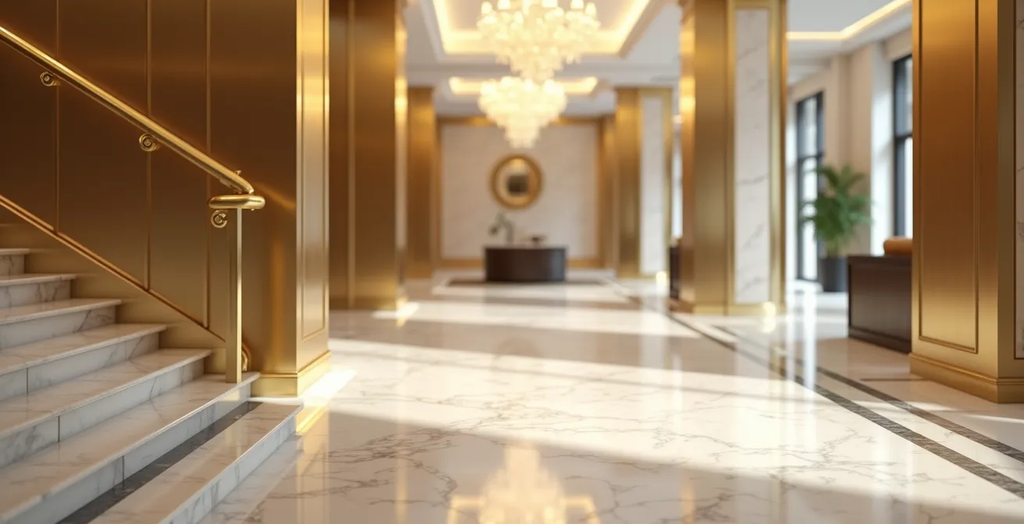
I look after marketing for a 22-room hotel on the coast, and every winter we rebuild the brochure. New photography means a crew, a closed floor and a week of styling. This year I wanted to know whether an AI image model could handle the mood pages, the ones that sell a feeling rather than a specific room, and whether it could hold up to the things guests notice: stone that looks like stone, brass that looks like metal, straight walls.
A friend who sells high-end apartments, Marta, joined in. Her question was narrower. Agents increasingly stage empty rooms digitally. Could a model furnish a vacant living room without quietly moving the windows?
We spent one afternoon measuring rather than admiring. Fourteen images, five tests, forty-one cents.
The setup
We used GPT Image 2.6, which offers two versions with identical settings and identical token prices: Flare, the default and faster one, and Sunburst, described as better for detailed work and repeated edits. Every brochure image was 1K resolution, medium quality, JPEG. A request in Python looked like this:
import requests
API_BASE = “https://api.apimart.ai”
HEADERS = {“Authorization”: “Bearer YOUR_API_KEY”}
payload = {
“model”: “gpt-image-2.6-flare”,
“prompt”: “Boutique hotel bathroom for a brochure. Honed white “
“marble vanity with soft grey veining, brushed brass tap, “
“brass-framed round mirror, folded natural linen towels, “
“soft morning light from the left. Realistic photograph, “
“35mm lens, no people, no text, no logos.”,
“size”: “3:2”, “resolution”: “1k”,
“quality”: “medium”, “output_format”: “jpeg”}
r = requests.post(API_BASE + “/v1/images/generations”,
headers=HEADERS, json=payload)
task_id = r.json()[“data”][0][“task_id”]
# then poll GET /v1/tasks/{task_id} until status is “completed”
Switching versions means changing the model name to gpt-image-2.6-sunburst. All 14 jobs completed. None failed.
Test 1: marble, brass and linen
Materials are where cheap renders give themselves away. Marble turns into wallpaper, brass goes yellow plastic, linen looks like cotton jersey.
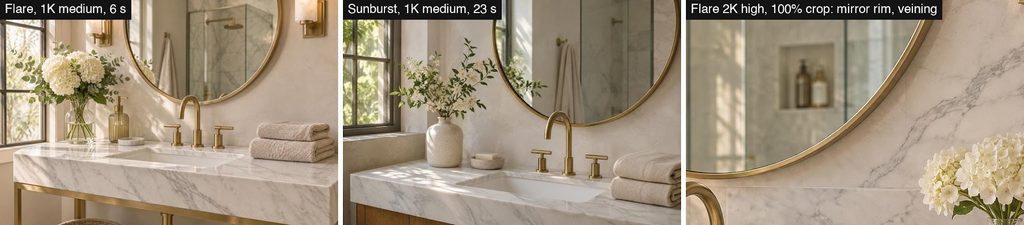
Both versions passed the first-glance test. The veining wraps around the vanity edge instead of stopping at it, the brass has the soft brushed sheen we asked for, and the towels have visible weave. Flare finished in 6 seconds, Sunburst in 23. I preferred Sunburst’s calmer light; Marta preferred Flare’s flowers. Neither is a technical win.
For print I also ran the Flare prompt through the GPT Image 2.6 API at 2K and high quality. It cost $0.044 instead of $0.027 and came back at 2048 by 1360 pixels. At 100% the veining stays fine and continuous. For a full-bleed A4 page we would still upscale or keep it to half a page.
Test 2: straight lines in a tall lobby
Architectural photographers spend money on shift lenses for one reason: walls must stand straight. I asked both versions for a double-height lobby with limestone walls and steel windows, “all vertical lines perfectly vertical and parallel”, then ran a line detector over each image and measured how far each near-vertical line leaned.
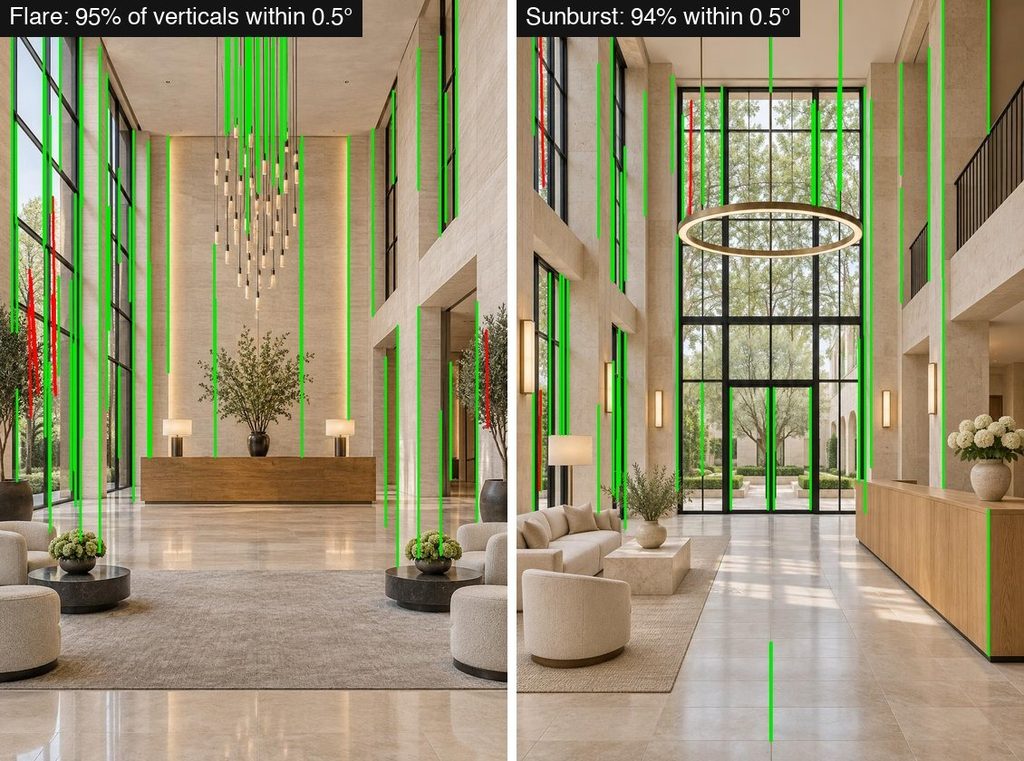
Flare had 95% of its 76 vertical lines within half a degree of true; Sunburst 94% of 52. The median lean on both was zero. The few red lines are almost all tree trunks seen through the glass, not walls or window frames. That is better than many handheld phone photos I have been sent by contractors.
Test 3: staging an empty room
Marta’s test. We generated an empty apartment living room (white walls, herringbone oak, two tall windows, a radiator, a cornice), then sent it back as a reference image with an instruction to add a linen sofa, a travertine table, a rug, a brass lamp and a plant, and to keep the room exactly as it was.
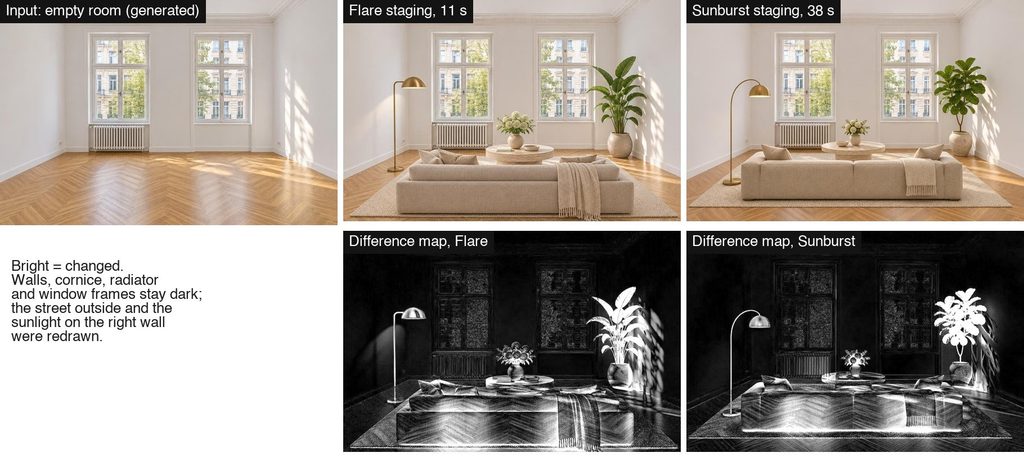
The furniture is convincing and sensibly scaled. The difference maps tell the more important story. In the upper half of the frame, 85% of pixels (Flare) and 88% (Sunburst) changed by less than 15 grey levels: walls, cornice, radiator and window frames sit where they were. But the street outside the windows was redrawn with different facades, and the sunlight pattern on the right wall moved. Two smaller notes: the edited images came back at 1024 by 672, smaller than the 1536 by 1024 original, and each edit cost $0.031 because the reference image counts as input.
A buyer will not notice the street. A buyer would be right to complain if the view or the light were presented as fact. More on that below.
Test 4: holding a brand palette
Our brochure lives in three colours: sage #8A9A7B, terracotta #C2693E and ivory #F2ECE1. I asked for a bedroom, a terrace breakfast and a spa reception in that palette on both versions, then measured how close the nearest 2% of pixels came to each colour using ΔE2000, where under about 3 is invisible and over 10 is obviously different.
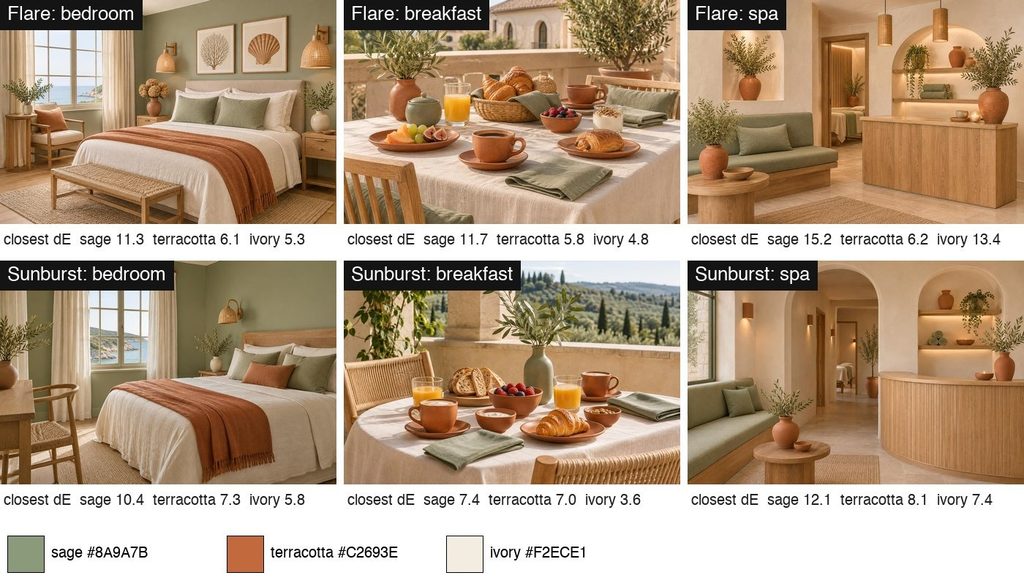
Terracotta was reliable everywhere, between 5.8 and 8.1. Ivory was fine in four scenes but drifted to a warm tan in Flare’s spa (13.4). Sage was the weak point: closest values of 10.4 to 15.2 in five of six images, only Sunburst’s breakfast scene got near (7.4). Under warm photographic light the model shifts greens toward olive. The series still reads as one hotel, but our designer will colour-correct sage in post, as she would with a real shoot.
Test 5: time and cost
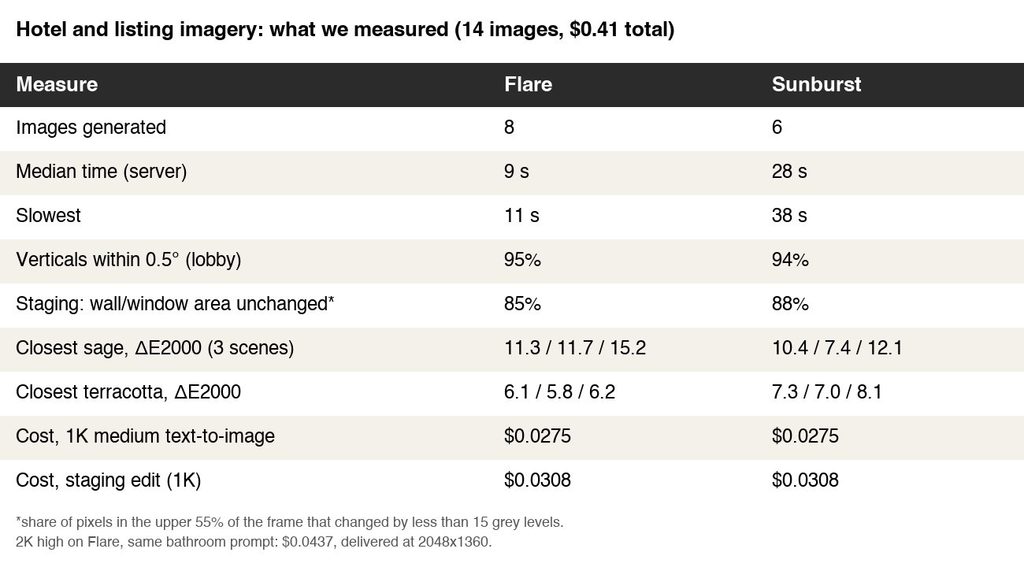
Flare’s median server time was 9 seconds, slowest 11. Sunburst’s median was 28, slowest 38. Prices were identical: $0.0275 per 1K medium image. The whole afternoon, 14 images including the 2K test and two edits, cost $0.41. Every image was usable as mood material.
The rule we will not bend
None of these rooms exist. That is fine for a page about the feeling of a morning on the terrace. It is not fine on a listing or a room-type page, where a guest or buyer is entitled to believe what they see.
- Generated interiors never appear as photographs of a real property or a bookable room.
- Staged listing images are labelled “virtually staged” and shown next to the real empty photo.
- Anything a buyer pays for, such as views, light and finishes, comes from a real camera.
- Brochure mood pages carry a small “illustrative, AI-generated” credit.
Our plan: Flare for drafts and quick variations, Sunburst for final mood pages where its calmer light and slightly better greens earn the wait, and a human eye on every colour before print.