Sharing a mattress often forces nightly compromise. You might melt into a plush, sink-in surface while your partner craves firm lumbar support—cue the 3 am blanket tug-of-war. Dual-zone smart beds end that drama by letting each side fine-tune its own firmness—and, on some models, temperature—without carving a canyon down the middle. In this guide, we’ll rank the five best dual-zone smart beds for couples, examine the tech behind them, and flag the hidden costs that can surprise first-time buyers.
What is a dual-zone smart bed?
Picture a mattress that keeps the peace. Instead of forcing both sleepers to accept one “average” feel, each side can change—softer here, firmer there—without carving a canyon down the middle. One half can cushion sore shoulders while the other steadies the lumbar, all under a single cover.
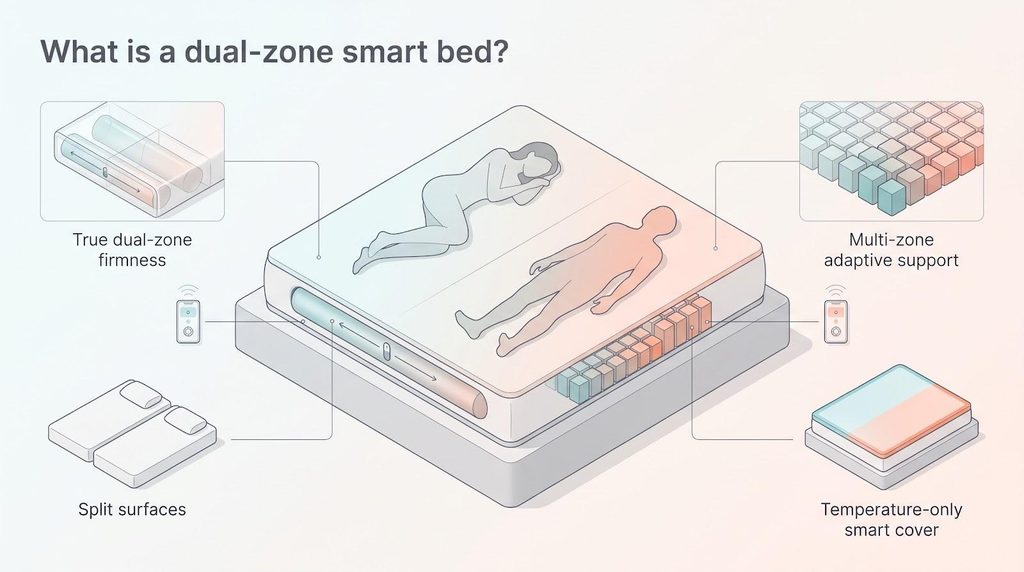
Engineers reach that goal in four main ways:
- True dual-zone firmness. Two long air chambers (or a similar mechanism) let you tap a remote or app to soften or firm your half within seconds.
- Multi-zone adaptive support. Dozens of small cells, sometimes called “balancers,” measure pressure in real time and adjust shoulder, lumbar, and hip areas automatically while you sleep.
- Split surfaces. Two separate Twin XL mattresses push together for full independence but create a visible seam and usually need separate fitted sheets.
- Temperature-only smart covers. Active-cooling toppers warm or chill each side yet never change firmness.
We spell this out because a “dual-firmness mattress for couples” can mean anything from a basic dual-air bed to an AI surface with dozens of zones. In this guide, we highlight queen-size (and larger) models that let both partners adjust firmness on demand from the same continuous surface; climate-only gadgets and discontinued models are out.
Keep this framework handy as we compare the five best dual-zone smart beds for couples with different comfort needs. Knowing where each product sits on the spectrum will show whether it can end your nightly conflict.
How we ranked the beds
Eligibility rules
Before scoring, we drew firm lines so you don’t waste time on outdated or off-category products. A mattress had to clear all four gates to qualify for our dual-zone smart-bed ranking:
- Current U.S. availability. The bed must be orderable today, not on close-out or “call for stock.” This rule alone drops legacy Sleep Number p- and i-series models and the once-famous ReST bed.
- Independent firmness in queen or larger. Both sleepers must adjust firmness on the same surface. Cooling toppers, flippable cores, and split kings with a seam down the middle don’t qualify.
- Powered, repeatable adjustment. A single press (remote, phone app, or built-in sensor) must change feel instantly; no midnight layer-shuffling allowed.
- Published trial, warranty, and service terms. If we can’t verify in writing how long you can test the mattress or what happens when a pump fails, we strike it.
We also apply a one-model-per-brand rule to keep the field balanced once those gates are closed. Together, these filters leave a tight lineup that earns a fair, point-by-point comparison in the next section.
How we scored each finalist
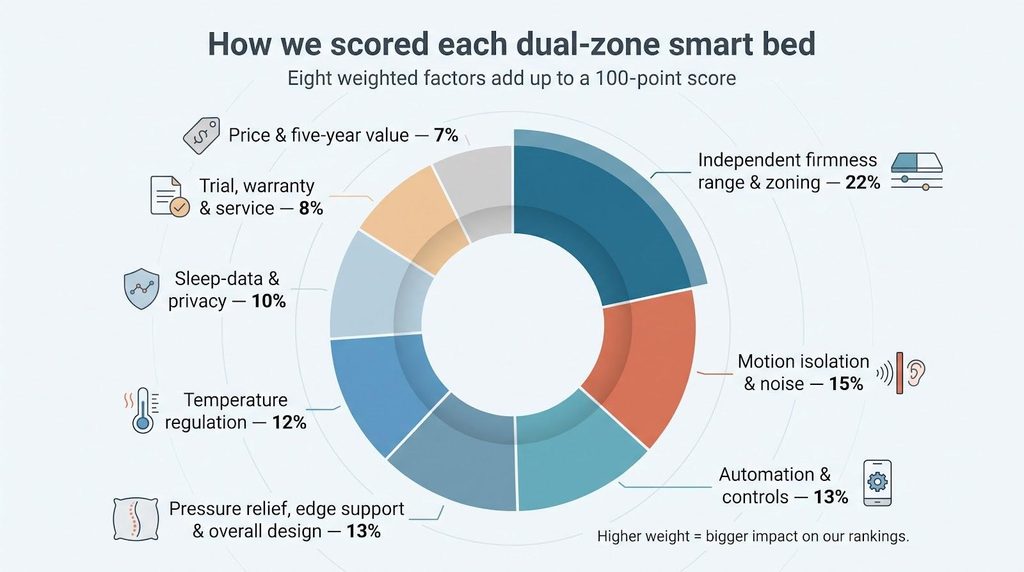
Every mattress went through the same eight-factor rubric, weighted by how much the average couple cares about each point. The scale tops out at 100.
| Factor | Weight |
| Independent firmness range & zoning | 22 percent |
| Motion isolation & noise | 15 percent |
| Automation & controls | 13 percent |
| Temperature regulation | 12 percent |
| Sleep-data quality & privacy/offline resilience | 10 percent |
| Pressure relief, edge support & overall design | 13 percent |
| Price & five-year value | 7 percent |
| Trial, warranty & service terms | 8 percent |
Why this order? A dual-zone smart bed that hardly changes feel, or wakes you with every toss, fails its core mission. After firmness and motion, we reward real-time pressure response, side-specific climate, and tech that keeps working if Wi-Fi or a subscription lapses. Design touches such as strong edges and a one-piece surface earn points because they shape daily use. Price matters, but we score total ownership costs, not just MSRP. Finally, long trials and clear, non-prorated warranties protect buyers if electronics sputter after year two.
We add the weighted subscores; the result is a single number out of 100 that powers the leaderboard you’ll see in each product section.
The top five at a glance
Need a fast comparison? The table below distills each finalist’s score, standout strength, price, trial, and warranty so you can spot the right dual-zone smart bed before diving into the detailed reviews.
| Rank | Model | Overall score | Key advantage | Queen list price* | Trial | Warranty |
| 1 | Bryte Balance PRO | 87.2 | Real-time multi-zone support and category-leading motion isolation | $6,499 | 100 nights | 10 yr (electronics full 2 yr) |
| 2 | Sleep Number Climate360 | 81.0 | Only mattress that pairs per-side firmness with active heating / cooling | $9,249 | 100 nights | 10 yr limited |
| 3 | iSense Hybrid Premier | 80.1 | Hybrid coil feel plus full 10-year electronics coverage | $3,499 | 180 nights | 10 yr full |
| 4 | King Koil SmartLife | 75.2 | 80-cell body-sensing automation at a mid-tier price | $4,999† | 100 nights (direct) | 25 yr (first 4 yr full) |
| 5 | Saatva Solaire | 67.4 | Luxury materials, remote control, and 365-night trial | $4,789 | 365 nights | Lifetime (first 5 yr full) |
*List prices exclude optional bases, subscriptions, delivery, and setup fees.
†Retailer pricing varies; figure shown reflects a typical direct-from-brand quote.
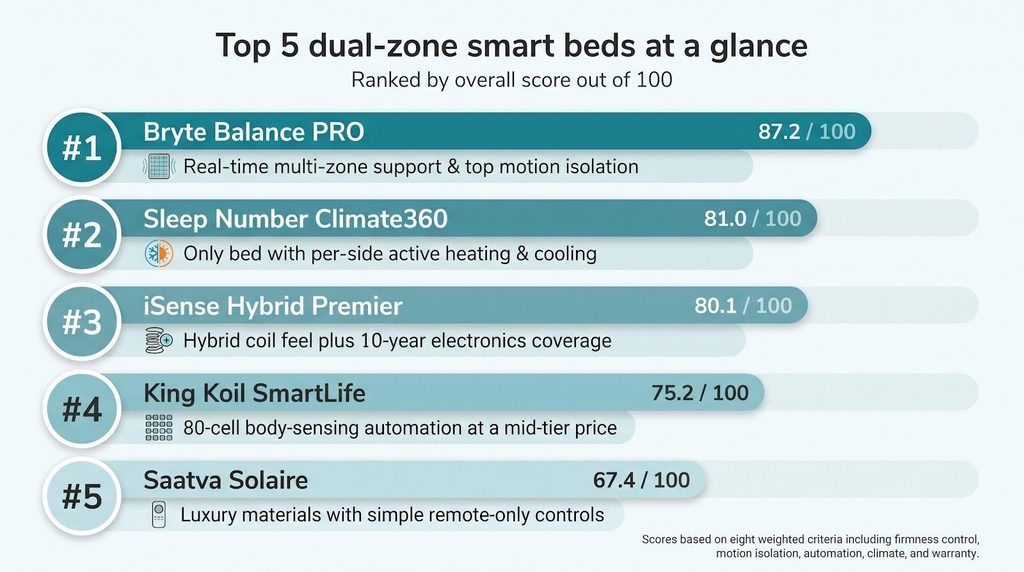
Match your biggest pain point—whether motion transfer, temperature conflict, or warranty anxiety—to the “Key advantage” column above, then jump to the full reviews for deeper context.
1. Bryte Balance PRO — best overall adaptive dual-zone smart bed
Bryte’s guide cites American Academy of Sleep Medicine data showing that 31 percent of U.S. adults have opted for a “sleep divorce,” sleeping in a separate bed or room. Its dual firmness mattress for couples explainer walks through the four kinds of beds sold as “dual-zone” and shows how a single continuous surface with 16 zones, 90 balancers, and real-time Active Pressure Relief removes that compromise: no seam, no center gap, and silent adjustments that help prevent 3 a.m. wake-ups. It even puts a Bryte Balance at about $1.31 per night over its 10-year warranty, helping couples judge value in dollars and sleep saved.
Snapshot
Inside the Balance PRO, 90 Balancers across 16 zones give each sleeper eight independently adjustable zones on a 0–100 firmness scale. The mattress earns an 87.2 overall score in our rubric. A queen lists for $6,499 and includes free in-home delivery and setup, a 100-night risk-free trial with free pickup if you return it, and a 10-year limited warranty on all mattress materials and technology components. There is no subscription fee.
Why it stands out for couples
When one partner moves, Bryte senses the pressure change and lifts or lowers only that sleeper’s Balancers. Your shoulder settles, your partner’s lumbar stays level, and the shift stays silent. Eight zones per side let a side sleeper soften shoulders while a back sleeper keeps firm support, and PRO models add Individual Zone Control and position-specific Contours for back, side, or stomach sleepers. Because Active Pressure Relief settles pressure before it triggers a position change, there are fewer movements for the other partner to feel, and Silent Wake uses gentle motion to wake one partner without an alarm.
Pro vs. Pro Conform: which feel is right for you?
The PRO has Bryte’s plushest adjustable comfort range. The PRO Conform pairs high-density, gel-infused memory foam with the same Active Pressure Relief system for a firmer feel and extra motion absorption. Both list at $6,499 for a queen; choose based on surface feel.
Pricing and ownership notes
The queen price covers free shipping, in-home delivery, and setup, with old-mattress haul-away on request. Bryte also sells a Premium Adjustable Base (head, leg, and zero-gravity positions), which is not part of the mattress trial refund. Financing at 0% APR is available through Affirm, and the beds are HSA/FSA eligible.
Pros, cons, and best-fit couple
Pros: Real-time Active Pressure Relief, granular eight-zone support per sleeper, seamless surface with no center gap, no subscription.
Cons: Premium price.
Best for: Couples with opposite pressure needs or movement sensitivity who want the most advanced per-partner support on one shared surface.
Ready for a cooler option? The next finalist adds active heating and cooling to its dual-zone firmness.
2. Sleep Number Climate360 — best for opposite temperature preferences
Snapshot
Climate360 is the only dual-zone smart bed in our lineup that actively cools or warms each sleeper while adjusting firmness on demand. Two air chambers deliver Sleep Number’s 0–100 scale, and a thermoelectric layer can pull the surface down to about 88 °F or raise it to 102 °F (sleepfoundation.org). A queen lists for $9,249, includes white-glove setup, a 100-night trial, and a 10-year limited warranty—full for two years, then prorated. Overall score: 81.0.
Why it stands out for couples
Thin tubing under each side circulates conditioned air every few minutes, preventing the hot-then-cold swings common in passive toppers. Meanwhile, Responsive Air inflates or deflates automatically as you change position, so side-sleep pressure relief and back-sleep lumbar support coexist with steady climate control.
At bedtime, you can preheat one side to 100 °F for an electric-blanket feel while the other chills to 90 °F. During sleep, the bed eases both zones toward the low 80s, then gently warms near wake-up.
SleepIQ tracking (heart rate, respiration, sleep stages) layers on nightly data without a subscription.
Performance evidence
- Cooling test: Sleep Foundation found the system can lower the surface temperature by roughly 15 degrees.
- Motion isolation: the same lab logged 8.0 / 10, good for an airbed but behind Bryte.
- Edge support: testers noted 4-inch compression at soft settings.
- Noise: pumps averaged 43 dB in auto mode, audible in a silent room yet below normal conversation.
Pricing and ownership notes
Delivery costs $249; returns trigger a $199 pickup fee plus any non-returnable base cost. Warranty proration climbs to 35 percent by year six and 65 percent by year ten.
Pros, cons, and best-fit couple
Pros: Only bed combining per-side climate and firmness, automatic support, validated SleepIQ tracking, no subscription.
Cons: Highest price here, soft edges, audible pumps, warranty proration after year two.
Best for: Couples locked in a hot-versus-cold battle who want a single mattress to solve both temperature and support, provided they secure service terms up front.
3. iSense Hybrid Premier — best hybrid feel and warranty
Snapshot
Pocketed coils add bounce and edge strength, while 14 air cylinders nestled in foam let each sleeper dial firmness from 10 to 99. The design scored 80.1 overall and 9.1 / 10 for motion isolation in NapLab’s 2026 test set (naplab.com). A queen lists at $3,499 with free doorstep delivery, a 180-night trial, and an industry-rare 10-year full electronics warranty.
Why it stands out for couples
Hybrid Premier feels like a traditional mattress, not an air raft. Coils provide spring for sex and easy movement; the cylinders fine-tune firmness without making the surface buoyant. Lab testers recorded only 2.5 inches of edge dip under a 200-lb seated load, so both partners can sprawl to the edge on a queen.
Motion transfer stays low because each cylinder localises pressure, while wrapped coils absorb ripple effects. Light sleepers barely notice nighttime trips to the bathroom.
One trade-off: firmness changes are manual. You tap the remote or app, then the bed holds that setting until you change it. Great for control, less ideal for automation fans.
Independent test highlights
- Firmness span: effective feel ranged 4.5–7 / 10 on the 10-point scale, soft enough for side sleepers yet never marshmallow.
- Noise: inflation measured 32 dB, quieter than Climate360’s 43 dB.
- Power draw: under 3 W on standby, a negligible energy cost.
Price and ownership notes
White-glove setup costs $199, but returns are free within the trial (promo extras deducted). The no-proration, parts-only freight warranty means a pump failure in year nine costs shipping, not parts. Profiles store locally, so comfort persists if Wi-Fi goes down, and there’s no subscription.
Pros, cons, and best-fit couple
Pros: Traditional hybrid feel, strong edge and motion scores, 180-night trial, full 10-year electronics coverage, no subscription.
Cons: Manual adjustment only, narrower firmness spread than “10–99” suggests, white-glove extra.
Best for: Couples who want coil responsiveness and a rock-solid warranty in a dual-zone smart bed without paying Bryte-level prices.
4. King Koil SmartLife — best multi-cell body-sensing alternative
Snapshot
SmartLife layers a plush Euro-top over more than 80 air cells that auto-adjust across eight body zones. A typical queen costs about $4,999 with basic delivery, but price, return, and trial terms vary by retailer. The brand lists a 100-night trial when bought direct and a 25-year warranty—full for four years, then prorated, with freight charges after year one. Independent lab scores are limited, so our 75.2 overall rating combines brief hands-on time with published specs.
Why it stands out for couples
Load sensors track pressure in real time. If one sleeper’s hips dip, the local cell cluster inflates; roll to your side and the shoulder zone softens within seconds. Because small cells span edge to edge, each partner keeps a personalised contour without a trench. A built-in Relax mode cycles gentle waves for post-workout recovery, and a vibration alarm can wake one partner without a blaring phone.
Evidence gaps and pricing cautions
No third-party lab has yet published motion-transfer or pressure-map data for SmartLife; treat the 80-cell, eight-zone spec as a capability, not a proven outcome. Pricing shifts by store and SKU name, so ask for:
- The exact model code.
- Written trial length and any pickup fees.
- Freight costs for future warranty service (the heavy control box can run about $150 each way).
The 25-year warranty sounds generous, but full coverage ends after year four; from month 13 you pay round-trip shipping on parts.
Pros, cons, and best-fit couple
Pros: Automatic multi-zone adjustment, edge-to-edge cell layout, massage and silent alarm features, mid-tier price.
Cons: Sparse independent testing, retailer-dependent pricing and trials, warranty freight costs, full coverage only four years.
Best for: Couples who can test the exact model in person and want hands-off zoning without paying Bryte prices, provided they secure written service terms before purchase.
5. Saatva Solaire — best luxury smart bed without app overload
Snapshot
Solaire skips sensors and Wi-Fi. Two quiet pumps feed dual air chambers with 50 firmness settings per side, controlled by a handheld remote. A queen lists at $4,789 and includes free white-glove delivery plus a 365-night trial. The lifetime warranty is full for the first five years, then follows a shared-cost schedule that reaches 75 percent. Manual adjustment and a potential center ridge at extreme splits keep its 67.4 overall score below fully automated rivals.
Why it stands out for couples
Press ▲ to firm or ▼ to soften, and each side responds in under 15 seconds before the pumps fall silent. No app, no account, no firmware surprises. Even a tech-averse partner can master the controls on night one.
Continuous chambers run head to foot, so pressure stays even. Talalay latex and gel memory foam add contour, giving side sleepers shoulder relief while back sleepers feel steady lumbar support. Premium fabrics, including an organic-cotton Euro top quilted with wool, create a hotel-suite look rather than hospital tech.
White-glove teams set up the mattress and haul away the old one at no cost, and they sync remotes on the optional Upper-Flex split-head base before leaving.
Couple-specific caveats
- Motion isolation varies with pressure. Below setting 20, latex absorbs most movement; above 40, the bed firms up and grows bouncier.
- Center ridge risk. Independent tests report up to a ¾-inch rise when one side sits at 10 and the other at 45; most couples land within a 10-click window, flattening the slope.
- Edge support. Stronger than classic airbeds yet softer than coil hybrids, with about 4 inches of compression when sitting.
Pricing and ownership notes
The sticker price covers delivery, setup, and haul-away. Returns deduct a flat $99 transport fee. Warranty co-pay starts at 50 percent in year six and reaches 75 percent by year eleven, plus round-trip freight. Pumps and hoses follow the same terms, so there is no electronics carve-out. Remotes cost roughly $60 to replace and pair instantly.
Pros, cons, and best-fit couple
Pros: Intuitive remote control, high-end natural materials, year-long trial, lifetime warranty, free white-glove service, no app or subscription.
Cons: No automatic adjustment or sleep tracking, possible center ridge at extreme splits, motion isolation drops at firmer settings, edge support trails hybrids.
Best for: Couples who want hotel-level comfort and independent firmness in a dual-zone smart bed but dislike apps, accounts, or monthly fees.
Notable runners-up and why they missed the Top 5
Below are six products that shine in one area yet fall short in another. If a particular strength matches your must-have list, consider adding these to your showroom demo plan.
| Product | Stand-out strength | Key reason it missed |
| Sleep Number ComfortNext Ultra | Automatic firmness at a lower price than Climate360 | One-model-per-brand rule keeps only the flagship in the Top 5 |
| Tempur-Pedic ActiveBreeze | Dual-zone climate plus Tempur motion isolation | Fixed medium feel, no independent firmness control |
| Air-Pedic 1000 | Three lumbar and shoulder zones per sleeper at a budget price | Manual adjustment and a 120-night trial fell short of Top 5 metrics |
| Eight Sleep Pod 6 (cover) | Precise heating and cooling with granular scheduling | Temperature-only cover, no firmness control, so not a true dual-zone smart bed |
| Personal Comfort Rejuvenate | Long 120-night trial and friendly list price | Mixed owner reports on long-term air retention and lighter build quality |
| ReST Original (clearance) | Five automatic zones per side | Discontinued, new orders unavailable and future warranty support uncertain |
These near-misses show how fast the dual-zone smart-bed category evolves and why up-to-date stock status, independent test data, and written service terms matter as much as flashy tech.
Which bed solves which couple problem?
| Your biggest conflict | Best dual-zone smart bed | Why it helps* |
| One partner’s tossing wakes the other | Bryte Balance PRO | Active Pressure Relief settles pressure before it triggers tossing, on one seamless surface |
| Hot sleeper vs. cold sleeper | Sleep Number Climate360 | Only model with per-side active cooling (≈ 88 °F) and heating (≈ 102 °F) while firmness auto-adjusts |
| Need coil bounce plus adjustable support | iSense Hybrid Premier | Pocket coils and 14 air cylinders let each side change feel in seconds without losing spring |
| Large weight difference | King Koil SmartLife | 80-cell, eight-zone system lifts heavier hips and softens lighter shoulders automatically |
| Tech fatigue, no apps wanted | Saatva Solaire | 50 remote-only settings, year-long trial, lifetime warranty, zero Wi-Fi or subscriptions |
*Data and specs drawn from NapLab, Sleep Foundation, and manufacturer documentation cited in the product sections.
Match this quick list to your top pain point, then move on to the detailed buying guide for deeper context.
Buying guide: how couples should choose
Identify the real mismatch
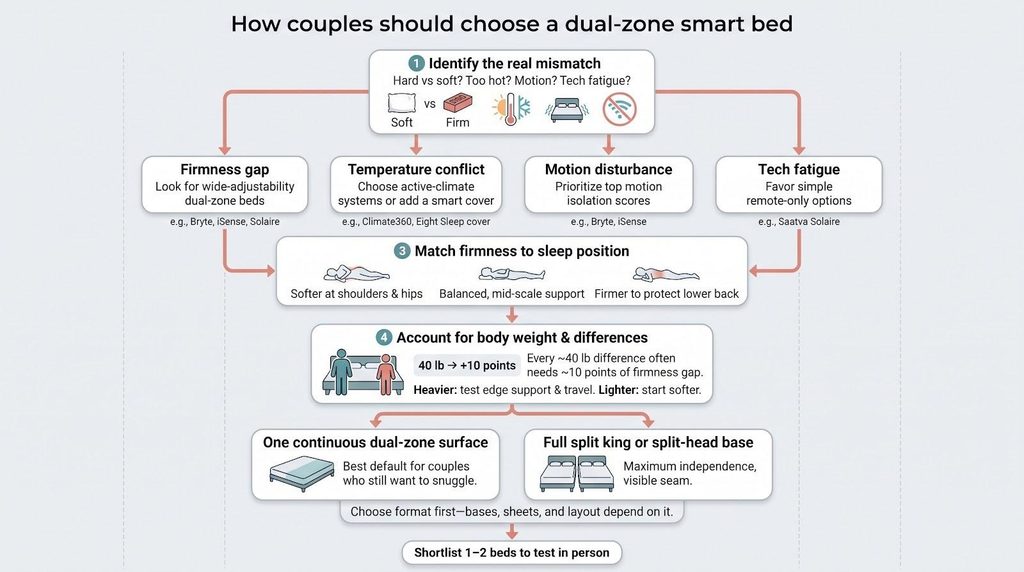
Start by naming the one thing that ruins your sleep most nights. Is it the hard–soft clash, a hot–cold standoff, or the jolt when a partner turns over? Spend seven mornings jotting a single note such as “too hot,” “edge sags,” or “partner woke me,” then look for the pattern. That pattern, not marketing copy, should decide which dual-zone smart bed you try first.
Match common problems to the right tech:
- Firmness gap: choose wide-adjustability models such as Bryte Balance PRO, iSense Hybrid Premier, or Saatva Solaire.
- Temperature conflict: pick active-climate options like Sleep Number Climate360 or add an Eight Sleep Pod 6 cover.
- Motion disturbance: prioritise beds that prevent or absorb movement—Bryte’s Active Pressure Relief (especially the memory-foam PRO Conform) or iSense (9.1 / 10 motion isolation).
Once you know the main mismatch, the next steps—sleep position, body weight, base compatibility, and budget—fall into place.
Match firmness to sleep position
Side sleepers usually need extra shoulder and hip cushioning. If you wake with numb arms, start softer—Bryte 20–40, iSense about 35, Solaire about 25. The added give lets your shoulder sink enough to keep your spine level.
Back sleepers thrive on balance. Too soft and the lumbar sags; too firm and the natural curve flattens. Aim mid-scale—Bryte 45–55, iSense about 45, Solaire 35–40. Climate360’s Responsive Air often lands here automatically, but check the morning number and adjust if you feel “hammocked.”
Stomach sleepers need the firmest ground to prevent lower-back sway. Try Bryte 60 plus, iSense high-50s, or Solaire 45–50. SmartLife’s auto-zoning also lifts the pelvis, yet heavier stomach sleepers should still test higher manual settings.
Combination sleepers should choose a setting that supports their dominant back or stomach posture, then use a pillow or topper for extra side-sleep comfort. Bryte’s zone logic can soften shoulders while keeping hips stable even when the overall number sits mid-firm.
Sync firmness with position first; most couples solve alignment issues before chasing more advanced tech.
Account for body weight
A 110-pound sleeper barely dents the surface a 230-pound partner compresses by an inch. Dual-zone smart beds let each side offset that gap—as long as you set firmness intelligently.
Rule of thumb: every 40 pounds of weight difference often calls for about a 10-point gap on adjustable scales. A 120-pound side sleeper might sit at Solaire 25, while a 200-pound back sleeper feels balanced near 35. On Bryte, run the lighter partner around 35 and the heavier closer to 50; the Balancers refine shoulder and hip zones automatically.
Heavier sleepers (above 250 pounds) should test edge strength and vertical travel. iSense’s coil cage holds firm, while some dual-air designs soften at the lip when highly inflated. Sit at the edge for two minutes before buying, especially on a queen where usable width matters.
Light sleepers under 130 pounds risk “floating” if pressure is too high. Start softer than you think, then add firmness one click at a time until hips and shoulders align with the mid-spine. A phone level placed across the lower back can confirm the setup.
Calibrating each side to real body weight, not just comfort preference, keeps spines neutral and extends mattress life.
Decide between one surface and two
A continuous dual-zone smart bed—every model in this guide except a true split—lets you share one fitted sheet, snuggle without a seam, and avoid mattress creep. It suits couples who change positions overnight yet want independent firmness on a single surface.
A full split king (two Twin XLs) offers the most independence when one partner needs head elevation for snoring or very different firmness. The downsides are a visible seam, separate fitted sheets, and the occasional gap. Hybrid formats such as Sleep Number FlexTop and Saatva Upper-Flex connect at the foot while letting each head section lift separately.
Start with a continuous surface unless you know you need separate head angles or expect a 30-point-plus firmness gap. If the seam later bothers you, a thin bridge pad can soften it, but you cannot erase it entirely.
Choose the format now; bases, sheet sizes, and even room layout hinge on this single decision.
Conclusion
With a clear picture of your top sleep conflict, matching the right dual-zone smart bed becomes far easier. Use the quick-reference tables, deep-dive reviews, and buying-guide checkpoints above to shortlist models, then test them in person whenever possible. The right mattress should let each partner sleep in their own comfort zone—without nightly compromise or a trench down the middle.