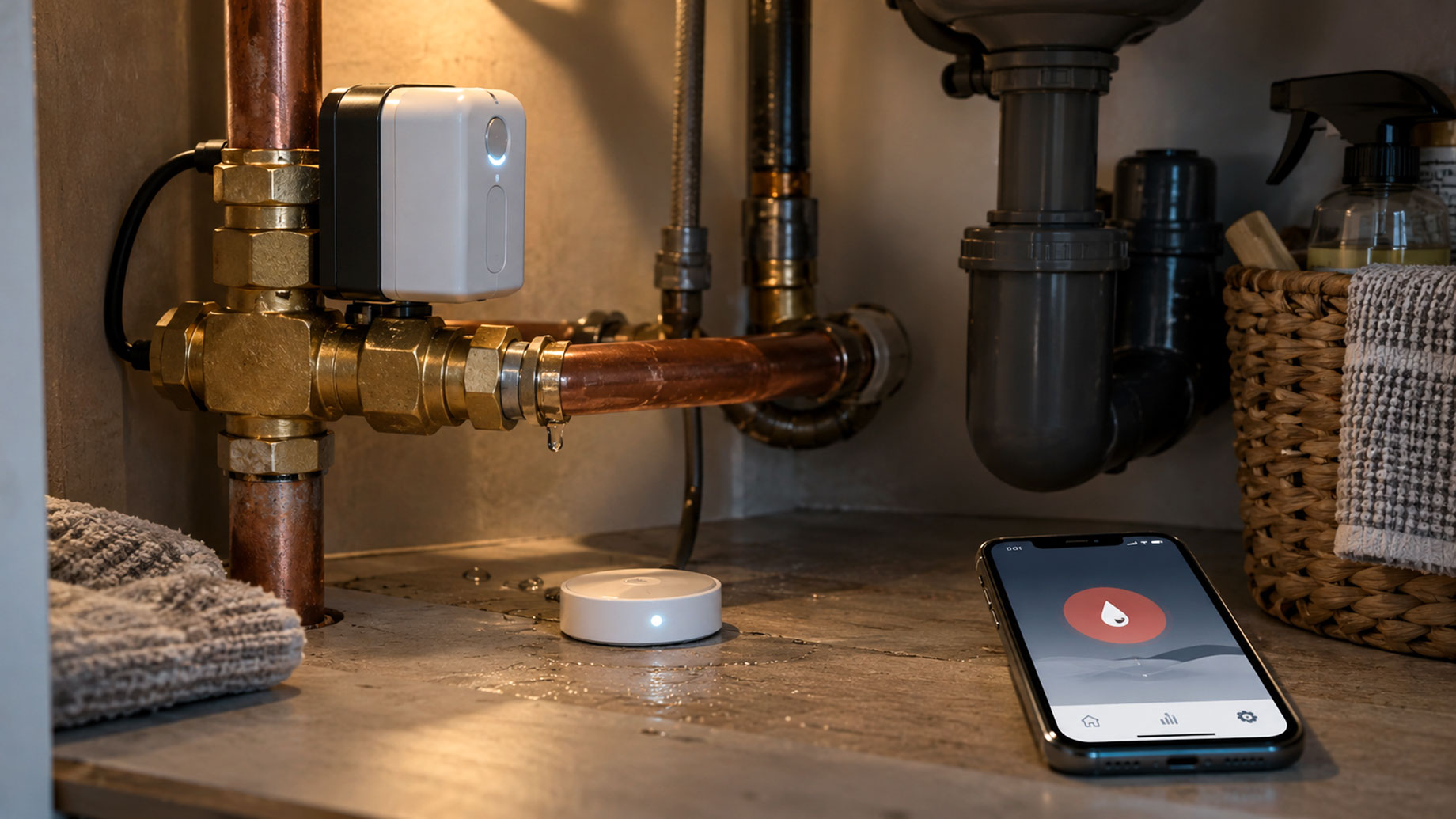
A hidden leak can run for weeks before it becomes obvious enough to notice, quietly wasting water and slowly causing damage behind a wall or under a floor the entire time. By the time a homeowner spots a water stain or a spike in their utility bill, the damage has often already progressed well beyond what a quick repair can fix.
Smart plumbing systems address this exact problem by monitoring water usage and flow patterns continuously, catching irregularities that indicate a leak long before it would otherwise become visible or obvious through a utility bill.
Quick Answer: How Do Smart Plumbing Systems Detect Leaks?
Smart plumbing systems use flow sensors installed at the main water line or specific fixtures to monitor water usage patterns continuously. When the system detects unusual flow, water running when no fixtures are in use, or a pattern inconsistent with normal household usage, it sends an alert to the homeowner’s phone and, in some systems, automatically shuts off the water supply to prevent further damage.
Why Continuous Monitoring Catches What Homeowners Miss
Most leaks don’t announce themselves clearly. A slow drip inside a wall, a slightly worn valve, or a small crack in a pipe can leak consistently without producing any visible sign for weeks or months. Homeowners typically don’t discover these issues until a water stain appears, a floor starts to feel soft, or a utility bill arrives noticeably higher than usual, by which point meaningful damage has often already occurred.
Smart plumbing systems solve this by monitoring water flow around the clock, rather than relying on a homeowner to notice a problem visually or through a monthly bill. These systems establish a baseline of normal household water usage and flag any pattern that falls outside that baseline, whether it’s a toilet running continuously, a slow leak at a fixture, or unusual flow at times when no one should be using water at all.
The automatic shutoff feature found in many systems adds another layer of protection beyond simple detection. Rather than just alerting a homeowner who might be traveling or otherwise unavailable to respond immediately, some systems can shut off the main water supply automatically when a serious anomaly is detected, limiting the damage a burst pipe or major leak could cause before anyone has the chance to intervene manually.
Key Benefits of Smart Plumbing Technology
- Early leak detection. Continuous monitoring catches leaks based on flow pattern anomalies, often well before a leak would become visible or noticeable through a utility bill.
- Reduced water waste. Catching leaks early significantly reduces the total water wasted compared to a leak that runs undetected for weeks or months.
- Lower risk of major water damage. Systems with automatic shutoff capability can limit damage from a burst pipe or major leak even when a homeowner isn’t home to respond.
- Remote monitoring and alerts. Smartphone notifications mean homeowners can be alerted to a potential issue even while traveling, rather than discovering a problem only upon returning home.
Buying Guide: What to Look For in a Smart Plumbing System
| Factor | Why It Matters |
|---|---|
| Installation location | Whole-home systems installed at the main line detect issues anywhere in the house, while fixture-specific sensors monitor individual appliances |
| Automatic shutoff capability | Systems with automatic shutoff limit damage even when a homeowner can’t respond immediately to an alert |
| Smartphone app integration | Confirm the system provides clear, real-time alerts and usage data through a reliable mobile app |
| Sensitivity and false alarm rate | Ask about how the system distinguishes normal usage spikes from genuine anomalies to avoid frequent false alerts |
| Professional installation requirements | Some systems require professional installation, particularly whole-home main line systems, which affects upfront cost |
| Compatibility with existing plumbing | Confirm the system works with your home’s specific pipe material and configuration |
| Ongoing subscription or monitoring fees | Some systems include ongoing costs for monitoring or advanced features beyond the initial purchase |
If you’re specifically concerned about a particular appliance, a water heater or washing machine connection, for example, a fixture-specific sensor may be a more targeted and affordable starting point than a whole-home system.
Common Mistakes to Avoid
- Assuming a smart plumbing system replaces regular maintenance entirely. These systems catch leaks early, but they don’t replace the value of periodic professional inspection for other plumbing issues.
- Choosing a system without confirming installation requirements. Some whole-home systems require professional installation at the main water line, which affects both cost and the type of professional you’ll need to hire.
- Ignoring the system’s alert settings after installation. A system that generates frequent false alarms often gets ignored over time, undermining its actual usefulness.
- Overlooking ongoing costs. Some systems include subscription fees for advanced monitoring features, which should factor into the overall cost comparison between options.
Expert Tips
Consider your household’s specific risk areas before choosing between a whole-home system and fixture-specific sensors. Older homes with aging pipes throughout may benefit more from whole-home monitoring, while newer homes might only need targeted sensors near specific appliances.
Ask directly about the system’s false alarm rate and how it distinguishes between normal usage spikes, filling a bathtub, running a washing machine, and genuine leak indicators, since a system prone to false alarms tends to get ignored over time.
If you travel frequently or spend extended time away from home, prioritize a system with automatic shutoff capability, since remote alerts alone won’t help if you’re unable to respond quickly to a detected issue.
Why Choose A Professional Contractor
Understanding how smart plumbing systems actually detect and prevent water damage is exactly the kind of practical guidance a professional plumbing contractor provides homeowners considering this technology. Rather than treating smart home plumbing features as a novelty, the focus stays on how these systems genuinely reduce water waste and catch problems before they escalate into costly repairs.
Homeowners get clear information on choosing between whole-home and fixture-specific systems, understanding installation requirements, and evaluating which features matter most for their specific home and usage patterns.
FAQs
How quickly can a smart plumbing system detect a leak?
This varies by system, but many can detect unusual flow patterns within minutes to hours, significantly faster than a leak would typically become visible through traditional signs.
Do smart plumbing systems require professional installation?
Whole-home systems installed at the main water line often require professional installation, while some fixture-specific sensors are designed for simple DIY installation.
Can a smart plumbing system actually stop a leak, or does it just alert me?
Many systems include automatic shutoff capability, which can stop water flow to the affected area or the entire home when a significant anomaly is detected, not just send an alert.
How much water can a smart plumbing system actually save?
This depends heavily on how quickly a leak would otherwise be noticed, but catching a leak within hours instead of weeks can meaningfully reduce total water waste over the leak’s lifespan.
Are there ongoing costs after purchasing a smart plumbing system?
Some systems include subscription fees for advanced monitoring or additional features, so it’s worth confirming total cost, including any ongoing fees, before purchasing.
Can these systems tell the difference between normal water usage and an actual leak?
Yes, most systems establish a baseline of normal household usage patterns and flag genuine anomalies, though sensitivity and false alarm rates vary between products.
Is a smart plumbing system worth it for a newer home with updated plumbing?
It can still be worthwhile, since even newer plumbing can develop leaks from fixture failures or installation issues, and early detection remains valuable regardless of pipe age.
Conclusion
Smart plumbing systems shift leak detection from a reactive discovery, a water stain, a high utility bill, to a proactive, continuous monitoring process that catches problems early. For homeowners looking to reduce water waste and avoid the kind of damage that comes from an undetected leak running for weeks, this technology addresses a real gap that traditional plumbing maintenance alone doesn’t cover.
