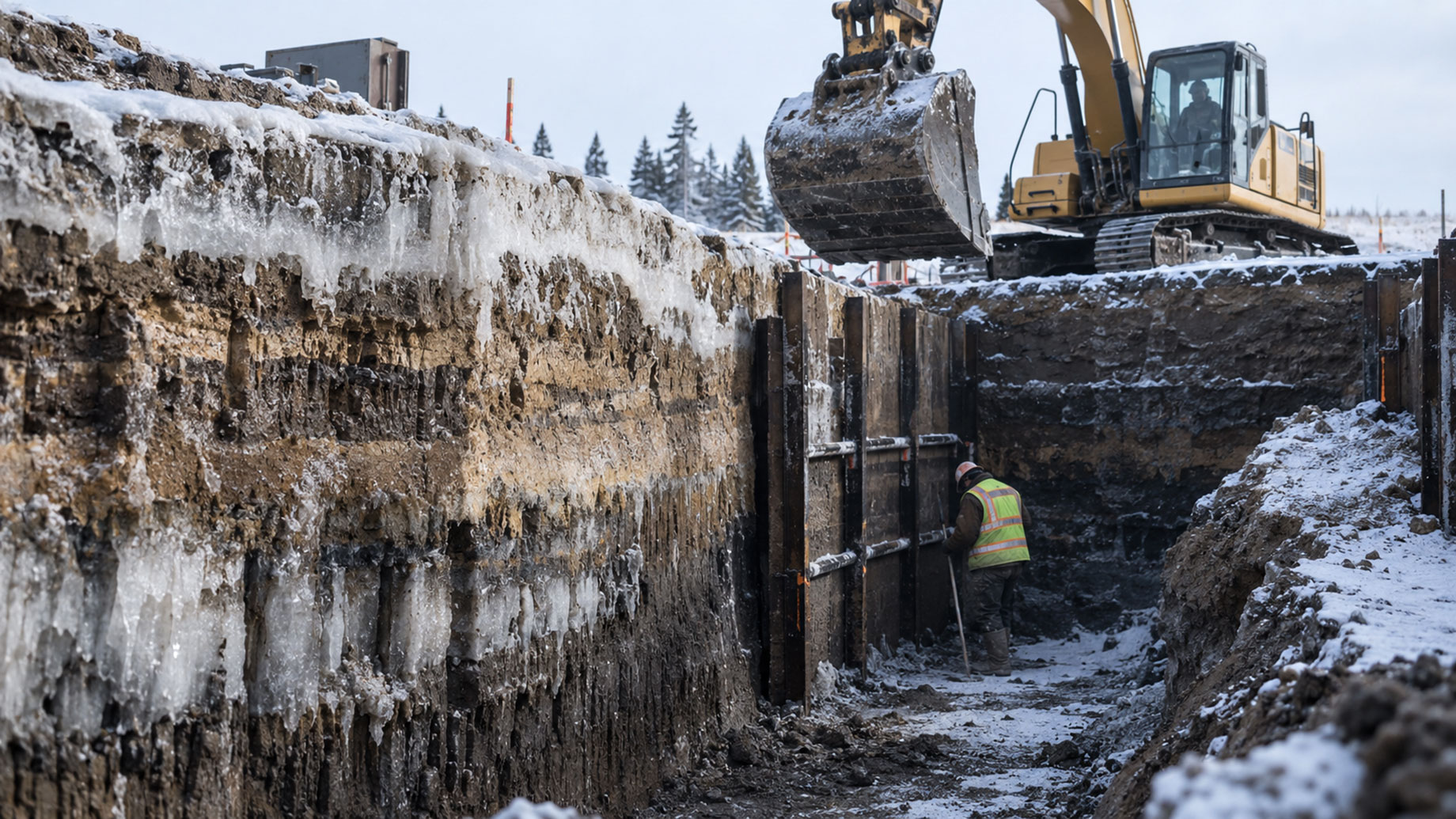
Anyone who has planned a winter excavation knows the drill. The schedule looks fine on paper in October, then the first hard freeze arrives and the ground itself becomes part of the problem. Cold weather does not stop geotechnical construction, but it changes the rules in ways that catch even experienced project teams off guard. Understanding how frost and frozen ground actually behave, and how they interact with excavation support, foundations, and ground improvement work, is one of the best investments a project team can make before winter sets in.
What Freezing Actually Does to Soil
Frozen ground is not just cold dirt. When soil temperatures drop below freezing, water in the pore spaces turns to ice and the soil effectively locks together. That sounds like a benefit, and sometimes it is. A frozen slope can stand steeper than it would in summer, and haul roads over frozen ground can carry loads that would rut the same ground in spring.
The problems show up at the boundaries and in the transition zones.
First, frost penetrates from the surface downward, and it does not penetrate evenly. Depth of frost depends on air temperature history, snow cover, soil type, moisture content, and exposure. A shaded cut slope next to a heated building can behave completely differently from an open parking lot fifty feet away. Teams that assume a single uniform frost depth across a site end up surprised.
Second, frozen ground is often strongest right up until it thaws. The dangerous period is the freeze-thaw cycle, not the deep freeze. Water migrates toward the freezing front as soil freezes, which can build up ice lenses. When those lenses melt, the soil above and below the frost line can lose strength quickly. Slopes that held all winter sometimes fail in late February or March during the first thaw.
Third, frost heave moves things. Silts and fine sands with access to water are the classic heave-prone soils. Heave can lift grades, damage temporary works, distort formwork, and load structures in ways they were never designed for.
How Cold Weather Affects Common Geotechnical Systems
Every major geostructural system has its own cold-weather sensitivities. A few worth understanding before you commit to a winter schedule.
- Excavation support and shoring. Digging through a frozen crust is slow and hard on equipment. Ripper teeth and breakers that slice through unfired clay in September struggle against ground that behaves like rock in January. Below the frost line, conditions may be normal, which means production rates swing wildly with depth. Shotcrete facing, a common component of soil nail and anchored walls, also needs protection in cold weather. Shotcrete gains strength through hydration, and hydration slows dramatically when the material gets too cold. Accelerators, heated enclosures, insulated blankets, and careful mix design all help, but they add cost and coordination.
- Tiebacks and soil nails. Grouting in freezing conditions demands the same attention. Grout that freezes before it cures loses strength permanently. Heated water, heated mixing areas, and thermal protection of the cured zone are standard cold-weather grouting practices, but they require planning and materials on site before the temperature drops, not after.
- Deep foundations. Drilled shafts and driven piles generally proceed through winter fine, but the surrounding ground matters. Frozen soil can grip casing and make extraction difficult. Concrete placed against frozen ground cures slowly at the interface, and cold concrete takes longer to reach design strength. Pile driving through frost can damage the pile or the ground if the frozen layer is thick and dense.
- Soil mixing and ground improvement. These methods depend on predictable soil behavior and cement reaction. Cement hydration slows in cold ground, and frozen inclusions or lenses can produce inconsistent mixing. Cold-weather soil mixing is done successfully all the time, but it usually calls for adjusted mix designs and realistic strength-gain timelines.
- Dewatering and groundwater. Frozen discharge lines, ice buildup at wellheads, and reduced infiltration through frozen surface soils all complicate dewatering in winter. A system that ran effortlessly in November can need daily attention by January.
The Schedule Realities Nobody Puts in the Baseline
Here is the part that matters most to preconstruction teams. Cold weather rarely stops geotechnical work entirely. What it does is add friction, and friction adds up.
Production rates drop. Excavation through frost, extra shotcrete protection, heated enclosures, and slower grout curing all stretch cycle times. A wall installation that took four days per level in fall may take six in deep winter.
Weather windows get shorter. Crews may only get productive hours in the middle of the day. A two-day storm can cost four days of schedule once you account for thaw, cleanup, and re-mobilization of heated equipment.
Material logistics tighten. Heated water, blankets, accelerators, and temporary enclosures all need to be ordered, stored, and managed. Suppliers run thin during regional cold snaps when every project in the area needs the same materials at once.
Testing gets slower. Strength gain in concrete and grout stretches out in the cold, which can delay verification and subsequent operations if the schedule assumed warm-weather cure rates.
None of this is a reason to avoid winter work. It is a reason to plan for it honestly. Projects that treat winter as a known condition, with realistic production assumptions and cold-weather provisions priced into the baseline, routinely finish on schedule. Projects that treat winter as an anomaly absorb the surprises as overruns.
Practical Steps for Teams Planning Cold-Season Work
A few practices separate smooth winter geotechnical programs from painful ones.
- Get frost information early. Regional frost depth maps are a starting point, but site-specific conditions matter more. Soil type, groundwater, and exposure drive actual frost behavior. A geotechnical engineer can help translate generic data into project-specific expectations.
- Sequence around the weather. If excavation support must happen in winter, plan the most weather-sensitive elements, like shotcrete and grouting, for the most protected or mildest windows. Consider whether temporary heating or enclosure costs are worth the schedule protection.
- Protect fresh work. Blankets, insulated forms, heated enclosures, and windbreaks are cheap compared to the cost of replacing work that froze before it cured.
- Watch the thaw, not just the freeze. Monitor slopes, temporary works, and adjacent structures during thaw cycles. The springtime strength loss in frost-affected soils is a real failure mode, and it catches teams that only planned for cold.
- Build the friction into the schedule. If winter production is realistically 70 percent of summer production, schedule it that way. Optimistic baselines do not make the ground thaw faster.
The Bottom Line
Frozen ground changes the physics, the production rates, and the risk profile of subsurface work, but it does not have to change the outcome. The teams that succeed in winter are the ones that respect frost as a design condition rather than a nuisance, plan cold-weather measures into the work instead of around it, and partner with specialists who have managed these conditions before. Whether you are budgeting a winter excavation or sequencing shoring through a shoulder-season freeze, the ground will do what the ground does. The difference between a schedule that holds and one that slips is usually decided months before the first frost, in the planning.
