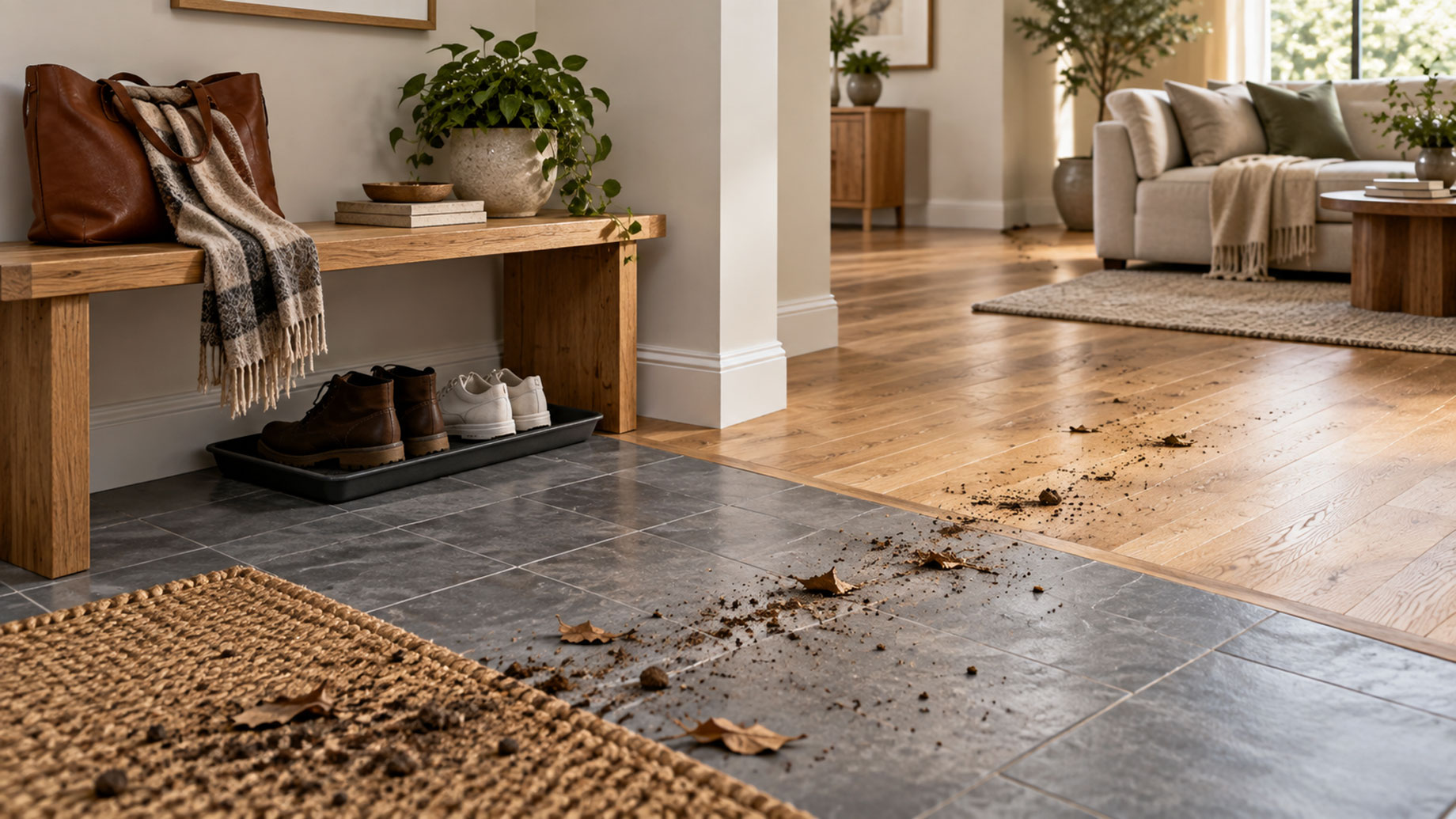
An entryway rarely keeps all outdoor dirt at the door.
Shoes carry grit inside. Bags touch benches, counters, and floors. Jackets brush against walls. Someone steps around a pile of footwear, then continues into the kitchen or living room with whatever the entry failed to contain.
The result is a relay.
Dirt starts outside, reaches the threshold, moves through stored belongings, and continues toward the next room.
Cleaning the entry effectively means finding where that relay should stop. The best place is usually before outdoor debris reaches the first major living space.
Treat the Threshold as the First Transfer Point
The threshold is where outdoor and indoor conditions meet.
Loose soil, grit, leaves, and other small debris often collect immediately inside the door. Some remains on a mat, while some travels beyond it on shoes.
Start by inspecting this narrow strip.
Look beneath and around the mat rather than assuming the mat captured everything.
A clean-looking hallway farther inside does not mean the threshold is clean. It may simply mean debris has settled in a concentrated band close to the door.
A Mat Is a Collector, Not a Complete Solution
Entry mats reduce what travels farther, but they also become storage places for debris.
Fine grit works into the fibers.
Hair gathers along the edges.
Particles can fall beneath the mat when it shifts.
Lift it periodically and inspect the floor underneath.
Clean the mat according to its material and care instructions, then deal with the exposed flooring separately.
A mat works best when the material it captures is actually removed rather than allowed to accumulate and escape again.
Shoe Storage Creates a Second Debris Zone
Shoes do not stop carrying dirt the moment they leave someone’s feet.
A shoe rack, tray, bench, or floor corner can develop its own debris pattern.
Check beneath footwear and along the edge of the storage area.
Fine grit often collects where shoes are picked up and returned.
If shoes are stored in several places, the dirty zone can spread across the entry rather than remaining contained.
Keeping footwear within one defined area makes both storage and floor cleaning easier.
Look at the First Few Steps Beyond the Shoes
The first indoor steps reveal whether the entry is doing its job.
Inspect the floor directly beyond the shoe area.
If grit continues into the hallway, kitchen, or living room, the entry is not fully containing it.
That does not necessarily mean the whole adjoining room needs cleaning.
Follow the visible trail only as far as it continues.
This keeps a small entry problem from automatically becoming a full-floor project.
Bags Create a Different Kind of Transfer
Bags usually do not carry dirt in exactly the same way as shoes.
A backpack may touch the ground outside and then land on a chair.
A work bag might move from a car floor to an entry bench and later to a dining table.
Reusable shopping bags can travel between several surfaces during one trip.
Notice where bags are normally placed after entering.
Those landing spots may need attention even if they sit above the floor and several feet away from the doorway.
Check the Bag Landing Surface
Many homes have an informal drop point.
It may be a bench, console table, kitchen chair, or section of counter.
Look at that surface as part of the entry system.
If bags regularly land there, inspect it for dust, grit, marks, or crumbs.
Then check immediately below.
Small debris can fall from bag bottoms or pockets onto the floor.
The landing surface and the floor beneath it often form one small cleaning zone.
Separate Movable Objects From the Residue They Leave
An entry becomes much easier to clean once belongings and dirt are treated as two different problems.
Shoes belong on the rack. Bags belong at their normal drop point. Loose personal items need to be put where the resident wants them.
Once those objects stop moving, the remaining problem is physical residue. In a cleaning arrangement involving Houston Cleaning Services, that distinction keeps the focus on the grit at the threshold, marks around the drop surface, and debris on the adjoining floor rather than turning entry cleaning into personal-item organization.
The boundary keeps the task clear without ignoring the places those objects have affected.
Watch the Path Around Obstacles
An overcrowded entry changes how people walk.
If several pairs of shoes block the direct route, people step around them.
That detour can shift debris toward the wall, underneath a bench, or into another room.
Look at the route people actually take rather than the one the floor plan suggests.
A narrow dirty strip beside stored items may simply be the path everyone has been using.
Clear access before cleaning so the floor can be reached without weaving around obstacles.
Do Not Forget the Space Under the Bench
Entry benches create useful storage, but they also hide debris.
Shoes get pushed underneath.
Bags may rest against the legs.
Hair and grit collect beyond normal sightlines.
Move lightweight items first and inspect the accessible floor beneath the bench.
There is usually no need to move a heavy built-in piece.
Reach what can be accessed safely and make the hidden strip part of the entry zone rather than allowing it to become permanent storage for dust.
Door Hardware Has Its Own Pattern
The floor is not the only surface involved in arrivals.
Door handles, lock areas, and nearby switches receive repeated contact.
Check these surfaces separately from the threshold.
They may need attention even on days when the floor is relatively clean.
Use methods suitable for the finish and avoid introducing unnecessary moisture into locks, electronic components, or openings.
The contact pattern comes from hands rather than shoes, so it belongs to a different part of the entry cleanup.
Let the First Interior Room Act as a Warning Line
Every entry should have a point where outdoor debris noticeably decreases.
That might be where tile changes to wood, where a hallway opens into the living room, or where the entry ends and the kitchen begins.
Use that transition as a warning line.
If grit repeatedly appears beyond it, the capture zone near the door may need more frequent attention.
If the next room stays clean, the entry is successfully containing most of the debris.
Clean the Entry Before the Adjoining Floor
Order matters when two floor areas connect.
Handle the threshold, mat, shoe area, and hidden debris beneath movable entry items first.
Then clean the adjoining floor.
This allows anything pulled outward from the entry to be collected during the final pass.
Doing the next room first can create repeat work when fresh grit is later released from under a mat or shoe rack.
Work from the dirty transfer zone toward the cleaner interior.
Adjust the Entry After High-Traffic Days
The relay becomes more active when more people use the door.
Visitors, deliveries, errands, children’s activities, or repeated trips outdoors can increase the amount of movement through the entry.
Check the zone after unusually busy periods.
The threshold and shoe area may need attention sooner than usual even though the rest of the home is still in good condition.
Cleaning frequency should respond to traffic rather than remaining fixed simply because a particular day is normally assigned to floors.
Keep Storage From Becoming Part of the Dirt Route
Entry storage should help stop movement, not extend it.
If shoes spill beyond the rack, bags cover the walkway, or coats force people around obstacles, dirt gains more chances to travel.
The solution does not require a perfectly styled entry.
It only needs enough order to keep the main path open and outdoor belongings reasonably contained.
Once movement becomes predictable, the cleaning pattern becomes easier to see.
Stop the Relay Before the Next Room
An entryway works best as a capture zone.
The threshold receives the first debris. The mat catches part of it. Shoes create another collection point, while bags transfer residue to benches, counters, and nearby floors.
Follow those transfers in order.
Clean beneath the mat, around footwear, below bag landing points, and along the first indoor walking path. Then finish the adjoining floor only after the entry has released its hidden debris.
The goal is not to keep an entry perfectly clean all day.
It is to stop ordinary outdoor dirt from being passed from one surface to the next until the room beyond the doorway becomes part of the same mess.
