Having music play through every room of your home sounds simple. The reality involves some interesting technology choices. Here’s how whole-home audio systems are designed and installed.
Most people have experienced music playing from a phone or a single Bluetooth speaker. Whole-home audio takes a different approach: delivering music to any room you choose, all controlled from a single interface, with the flexibility to play the same thing everywhere or different things in different zones. The experience is genuinely different from juggling multiple speakers or moving a single unit around.
The technology behind this has gotten more accessible over the past decade, but there are still meaningful differences between the various approaches, and the choices you make at the design stage affect both the quality of the experience and how well the system holds up as technology changes.
Wired vs. Wireless Systems
There are two fundamental architectures for whole-home audio: systems that run audio signals through in-wall speaker wire to in-ceiling or in-wall speakers, and wireless systems that use network-connected speakers in each room. Wired systems generally deliver better audio quality and more reliable performance, since they’re not competing for wireless bandwidth. Systems built around Control4 home automation can integrate both approaches and tie them into a unified control interface.
Wireless systems like Sonos and similar platforms are more practical in existing homes where running wire through walls is expensive or disruptive. They’ve improved significantly in reliability and audio quality and are a legitimate choice for most homes. Purpose-built wired systems with quality amplification still have an edge in audio performance for listeners who care about it.
Zones and How They Work
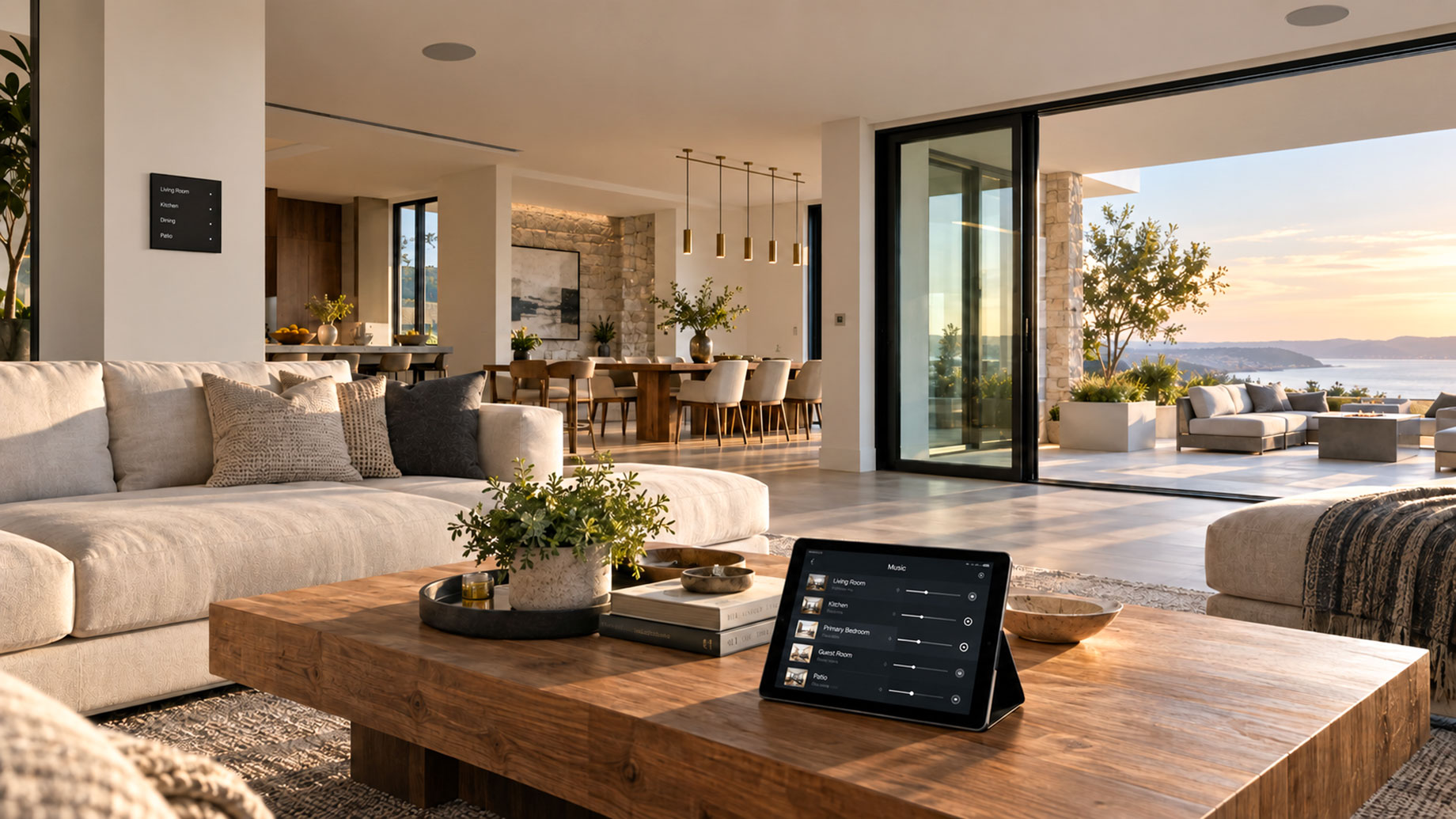
In a multi-zone audio system, each zone is an area that can be independently controlled. A zone might be a single room, a group of rooms, or an outdoor space. You can play different music in different zones simultaneously, or group zones together to play the same source across multiple areas. Zone count and the flexibility of zone grouping are key considerations when designing a system.
Each zone needs amplification, either from a central multi-zone amplifier or from amplified speakers in each zone. Central amplification is common in wired systems and keeps the electronics in one accessible location. Distributed power is more typical in wireless systems where each speaker includes its own amplifier.
Sources: What Feeds the System
Sources are what the system plays. Streaming services like Spotify, Apple Music, Tidal, and others are the primary source for most people today. The system needs a way to access these, either through dedicated streaming hardware or through a device connected to the network. Local music storage, whether on a NAS drive or similar device, is still popular with people who have large music libraries in lossless formats.
A well-designed system makes switching between sources intuitive. Being able to tell a voice assistant to play a specific playlist in the kitchen, or to use a touchscreen panel to start a different station in the living room, is the kind of convenience that people discover they value much more than expected once they have it.
Speaker Selection and Placement
In-ceiling speakers are the most common choice for wired whole-home audio because they blend into the room without taking up floor or shelf space. Speaker placement in a room affects both coverage and sound quality. Two speakers positioned correctly in a room will fill that space much more effectively than a single speaker, even a larger one.
Outdoor speakers add significant enjoyment to patios, pool areas, and gardens when installed properly. These need to be rated for outdoor use to handle weather exposure, and they benefit from thoughtful placement to project sound effectively across the area without requiring ear-splitting volume levels.
Control Interfaces and User Experience
The control interface is what determines whether people in the house actually use the system regularly or occasionally. Complicated systems with steep learning curves get used by the person who knows how to operate them and no one else. Intuitive interfaces that the whole family can figure out get used constantly.
Modern systems support control through mobile apps, dedicated touchscreens, voice assistants, and physical keypads near switches. The best setups use a combination: a wall keypad for simple one-touch control of the most common scenarios, an app for more detailed control, and voice for hands-free operation. Getting this mix right for the specific household is part of what a good installation involves.
Integration With the Broader Home System
Whole-home audio becomes more valuable when it’s integrated with other home systems. Automatically reducing music volume when someone calls the doorbell, pausing audio when the alarm is triggered, or setting scenes that include music as part of the morning routine alongside lighting and temperature are all possible with integrated systems. These integrations move audio from a single-purpose feature to part of a more cohesive home experience.
Installation by a company with experience in whole-home audio specifically, rather than a general electronics installer, tends to produce better results in terms of both audio quality and system reliability. The details of amplifier sizing, wire gauge, impedance matching, and room acoustics are things that experience makes more intuitive.
Wrapping Up
Whole-home audio rewards upfront investment in good design. The difference between a system that the household genuinely loves and one that sits mostly unused often comes down to whether the right architecture was chosen for the home, whether the control interface is intuitive for all the people using it, and whether the audio quality in each room is actually enjoyable. Getting those things right from the start, rather than trying to retrofit a better solution later, is what makes whole-home audio a feature people are glad they invested in.
Frequently Asked Questions
How much does a whole-home audio system typically cost?
The range is extremely wide. Entry-level wireless systems for a few rooms can be done for a few thousand dollars with off-the-shelf components. A professionally designed and installed wired system with quality speakers and amplification across a whole house, integrated with home automation, can run from fifteen thousand to much more depending on scope. The investment scales with the number of zones, the quality of components, and the complexity of the control system.
Can a whole-home audio system be added to an existing home?
Yes, but with some additional complexity compared to new construction. Running wire through finished walls requires either accessing wall cavities from above or below, or using a low-impact wiring method that keeps runs within walls. Wireless systems avoid most of this complexity. The installation cost in an existing home is typically higher than in new construction for wired systems, but the finished result can be just as good.
