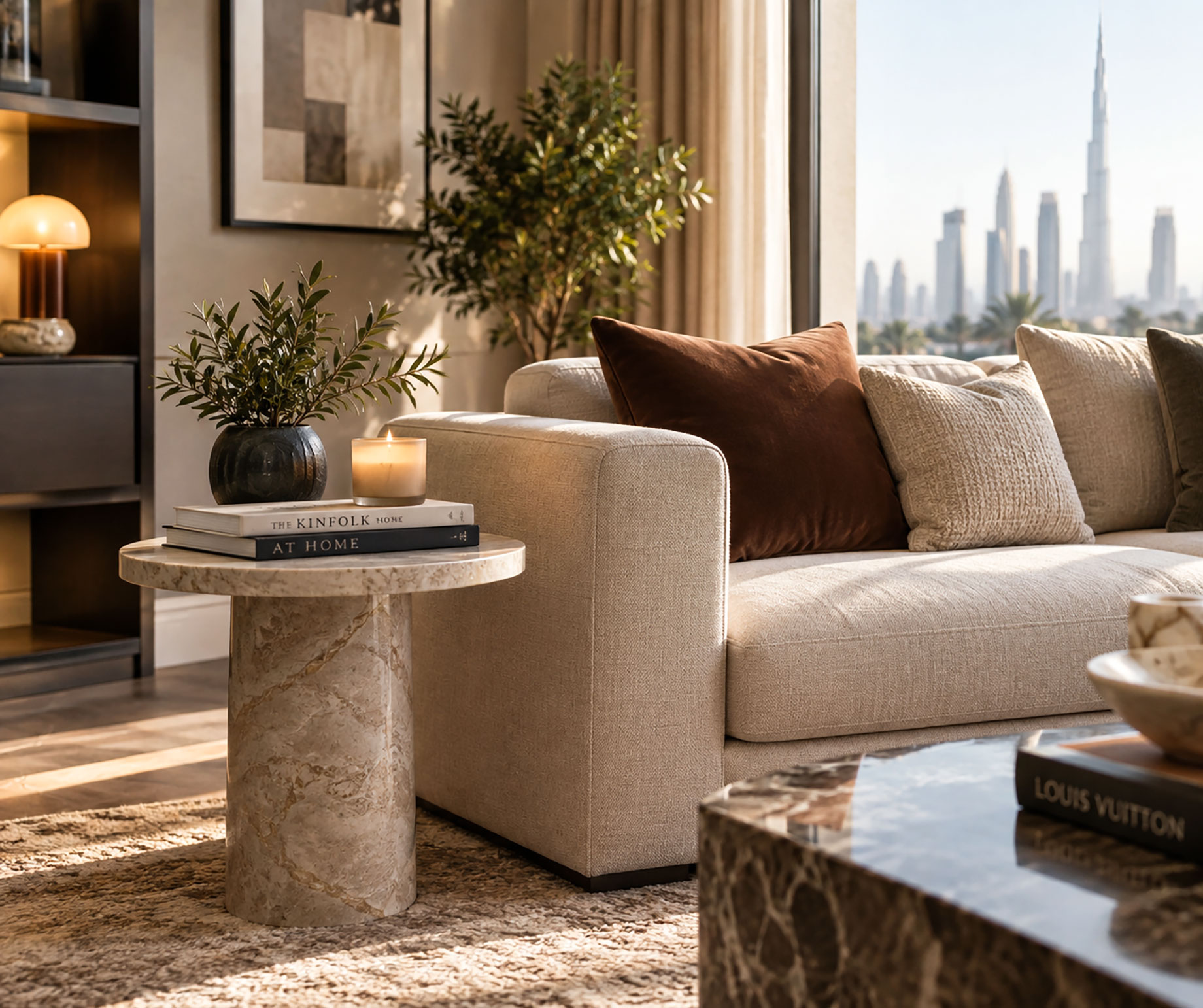
The side tables in Dubai’s luxury living rooms are usually the last piece people think about. The sofa is chosen first. Then the coffee table. The rug. The lighting. And eventually, there is an empty spot beside the seating that needs something in it.
That is often where the wrong table ends up. And that is exactly what makes a living room look out of proportion.
A side table that is too tall gets in the way of your arm. One that is too deep interrupts the room. One that is too small simply disappears beside a generous sofa.
The better approach is to choose the table as part of the seating arrangement, not as a standalone piece. In today’s blog, we will share actionable tips to help you choose a side table for your living room that’s just right.
Start Where the Table Will Be Used
Sit on the sofa and reach over to where the table will sit. That will tell you pretty quickly whether the height feels right. In most cases, the tabletop works best at about the same height as the sofa arm, or slightly below. You also have some room to play with, depending on the sofa and the space.
Leave enough room for people to pass without bumping into the table every time they move through the room. In a smaller apartment, that may mean choosing a narrower piece. In a larger open-concept living room, a substantial side table can sit comfortably beside a deep sectional. So always measure the actual space before you fall in love with the table.
Let the Shape Change the Conversation
A room made up almost entirely of straight lines can benefit from something round.
A circular side table beside a structured sofa softens the arrangement and makes a narrow passage easier to navigate. Designers and homeowners often use the same contrast when working with large sectionals and angular furniture.
Square and rectangular tables have their own strengths. Their straight edges work naturally against walls, corners and other linear furniture, and they can give you more usable surface without requiring a dramatically larger footprint.
While shopping, keep in mind that your side table’s shape doesn’t have to match the coffee table. In fact, it can be more interesting when it doesn’t.
Look at the Room Before Choosing the Material
Material changes how much visual weight a side table brings into the room.
A delicate metal frame can keep a heavy seating arrangement feeling open. A solid stone side table can do the opposite, giving a lighter sofa somewhere to visually land.
Natural stone works especially well when the room already has other natural materials. A marble side table can pick up the movement of a stone coffee table without copying it exactly. Travertine brings a quieter texture, with natural pores and tonal variation that work especially well alongside linen, timber and warm neutral upholstery.
With natural stone, the surface is part of the design. Veining and variation are not inconsistencies to hide; they are what make each piece individual. That is one reason luxury side tables are increasingly treated as more than occasional furniture. The right piece can act almost like a small architectural element within the room.
Choose the Table for What You Need Beside You
A table next to a reading chair has a different job from one beside a sofa used mainly for conversation. You may need space for a lamp, a book and a drink beside the chair. At the end of a sofa, a smaller table can do the job perfectly well when all you need is somewhere to place a drink or your phone.
This is where size must follow use. So instead of choosing a substantial table, choose one that offers you the space that you actually need.
Always remember a large tabletop is not automatically more useful if you never need the extra surface. Similarly, an overly minimal table can become frustrating when you have nowhere to put the things you reach for every day.
Do You Need One or Two?
Two matching side tables can frame a sofa beautifully, especially in a symmetrical living room. But you don’t always need a pair.
If one side of the sofa sits beside a walkway, a wall or another piece of furniture, adding a second table can make the arrangement feel crowded. In that case, one well-placed table can give you everything you need without filling the space unnecessarily.
You can also use two different tables. Homeowners and designers often mix pieces rather than choosing an identical pair. A round marble table on one side and a smaller wooden table on the other can work well when their proportions feel balanced, and they share a detail, such as a similar finish, colour or material.
And Then There Is the Finish
This is where personal taste can have the final word.
Warm wood can soften a room. Darker finishes can add depth. Glass can keep the edges visually light. Marble and travertine bring the character of natural stone into a much smaller footprint.
For homes in Dubai and across the UAE, the range of side tables in Dubai also means there is no shortage of finishes and silhouettes to choose from. The challenge is not finding one. It is finding the piece that makes sense with the furniture you already have.
Before buying, sit in the seat it will accompany. Reach for the surface. Walk past it. Then look at it beside the sofa and coffee table, not by itself. That is usually enough to tell you whether the table belongs there.
Frequently Asked Questions
How tall should a side table be next to a sofa?
A side table generally works best when its surface is around the same height as the sofa arm or slightly below it. The easiest way to check is to sit on the sofa and see whether the table is comfortable to reach.
How much space should I leave between a sofa and a side table?
Keep the table close enough to use comfortably, but leave enough room for the sofa arm, cushions and movement. A small gap is usually enough. If the table sits beside a walkway, prioritise circulation rather than forcing a specific measurement.
Should a side table match the coffee table?
No. They can match, but they do not need to. Instead, connect them through one or two shared details, such as the material, finish, colour or overall style.
Do side tables have to match each other?
No. Matching pairs create symmetry, but two different tables can make a room feel more layered.
Is a round or square side table better for a living room?
Neither is better. It all depends on the space you have. Round tables work well where people move closely around the furniture because they have no projecting corners. Square and rectangular tables work well in corners or against walls because their straight edges use the available space better.
Do I even need a side table if I already have a coffee table?
Not necessarily. A coffee table can cover most everyday needs in a conversational seating arrangement. A side table becomes useful when you want a drink, lamp, book or other item within easy reach without having to lean forward.
What kind of side table works in a small living room?
Go for a compact table, ideally around 35–45 cm wide. A round or oval top is easier to work around in small spaces.
