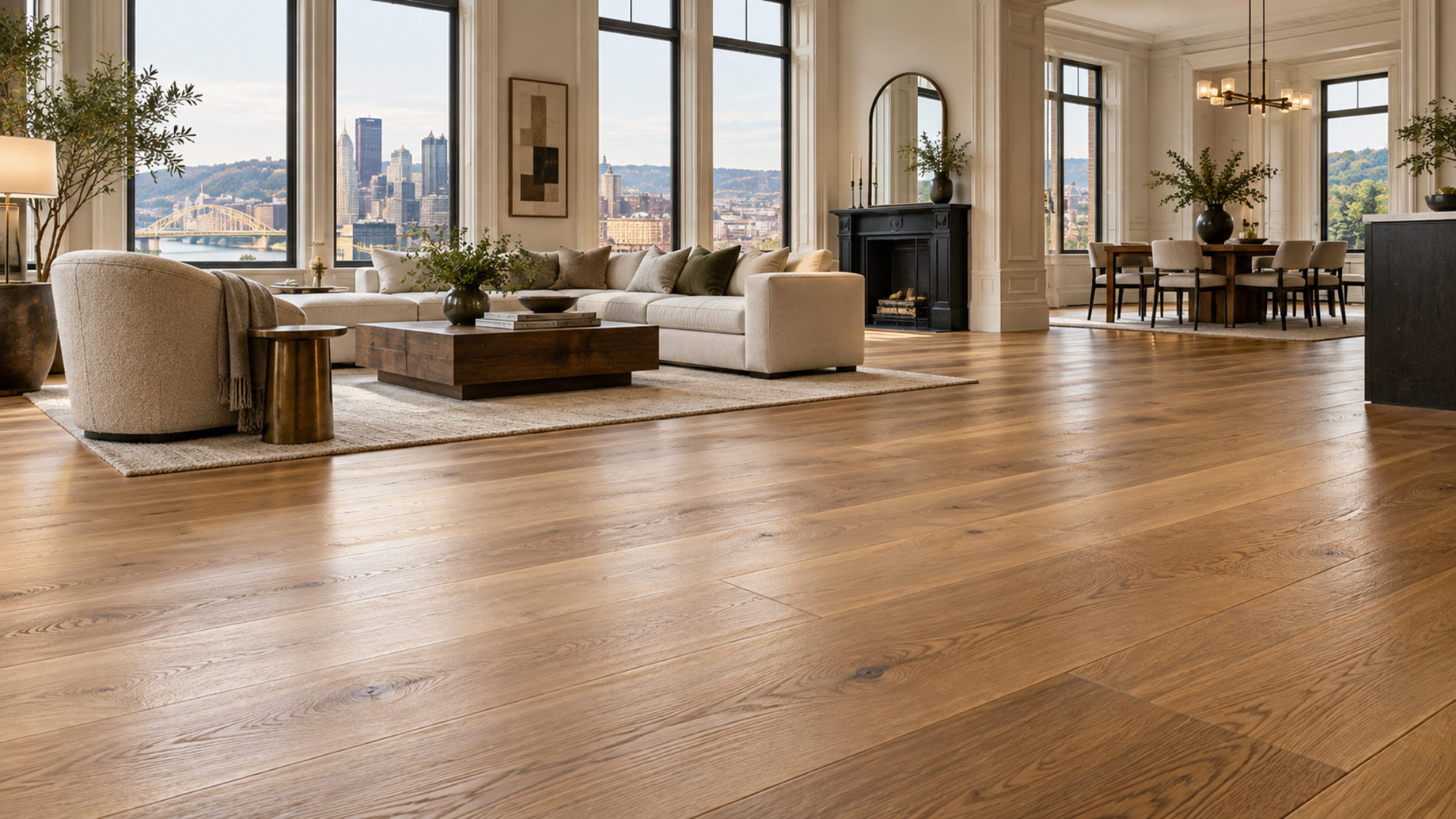
Walk into any well-designed home and your eyes register the floor before you consciously notice it. Flooring is the single largest design surface in a house, and in the luxury market it quietly signals quality more than almost any other finish. It also happens to be one of the smartest places to put your renovation dollars. For Pittsburgh homeowners weighing beauty against resale, the right floor delivers both.
The financial case is unusually strong. Refinishing hardwood floors recovers an estimated 147% of its cost, and new wood flooring returns about 118%, according to the National Association of Realtors’ 2022 Remodeling Impact Report, the highest cost recovery of any project studied. With Pittsburgh’s median sale price near $270,000 and still climbing, per Redfin, flooring is a rare upgrade that pays you back.
Why flooring shapes a luxury home’s first impression
Buyers and guests form an opinion within seconds, and continuous, high-quality flooring is what makes a home feel expensive. A consistent floor material flowing from room to room makes spaces read larger and more cohesive, a principle you see in every contemporary loft and high-end renovation. Cheap or mismatched flooring does the opposite, undercutting even expensive furniture and finishes.
Luxury today is less about flash and more about material honesty: wide-plank wood, natural stone, and tactile wool. The floor sets the palette and the mood for everything you place on top of it. Get it right, and the rest of the room falls into place.
What the numbers say about flooring and resale value
Flooring is not just an aesthetic choice; it is a measurable asset. Around 54% of homebuyers say they would pay more for a home with hardwood floors, and NAR estimates buyers pay roughly $6,500 more for new wood flooring and about $5,000 more for refinished hardwood. Homes with hardwood broadly sell for 2.5% to 5% more than comparable homes without it. The payoff is emotional as well as financial: NAR handed new wood flooring and refinishing a perfect 10 out of 10 “Joy Score,” and 64% of owners reported a greater sense of enjoyment at home afterward.
Demand is scaling too. The U.S. flooring market is projected to reach $134.9 billion by 2033, according to IMARC Group. Here is how the top projects compare.
| Flooring project | Cost recovered | Why it pays off |
|---|---|---|
| Refinish hardwood floors | 147% | Highest ROI of any remodel studied |
| Install new wood flooring | 118% | ~$6,500 buyer premium |
| New luxury vinyl plank | Strong | Water-resistant, budget-flexible |
| New tile or natural stone | Strong | Durable, premium in wet areas |
Why local flooring expertise protects your investment
The material is only half the equation; installation quality decides whether your floor looks flawless in ten years or fails in two. Subfloor prep, moisture testing, proper acclimation, and precise seams separate a luxury result from an expensive mistake. That is where local knowledge earns its keep, because a crew that understands Pittsburgh’s homes and climate will steer you away from costly missteps.
Working with established Pittsburgh flooring specialists gives you that edge. Molyneaux Home has served the region since 1930 as a fourth-generation, family-owned business, carries an A+ BBB rating and a 4.8-star average across more than 1,030 reviews, and runs seven showrooms around the metro. Local specialists also stand behind their warranties and help you weigh materials against your timeline, budget, and resale goals protection you rarely get from a big-box counter. Many also offer free in-home estimates, flexible financing, and furniture moving, so a whole-home project stays predictable from first quote to final walk-through. Before a whole-home sale, that expertise pays off, as any quick-sale guide will confirm.
The best flooring types for luxury Pittsburgh homes
No single material wins every room. Match the floor to the space, the traffic, and the way you live. These five carry the most weight in a high-end home.
- Solid hardwood the resale champion and the classic luxury signal. Oak, walnut, and maple age beautifully and can be sanded and refinished for decades. Nothing else matches its warmth or its buyer demand.
- Engineered wood real wood veneer over a stable plywood core. It handles Pittsburgh’s humidity swings and below-grade rooms far better than solid planks, while looking identical underfoot.
- Luxury vinyl plank (LVP) waterproof, warm, and remarkably convincing. It suits kitchens, mudrooms, and busy family zones where spills and traffic would punish real wood.
- Natural stone and porcelain tile marble, slate, and large-format porcelain bring durability and drama to entryways and baths. Sealed properly, they last generations and feel unmistakably high-end.
- Wool and natural-fiber carpet quiet, soft, and genuinely luxurious in bedrooms and media rooms. Wool resists wear naturally and insulates against Pittsburgh winters, making it a true premium pick.
Mixing two or three of these wood in living areas, tile in wet rooms, wool in bedrooms is the hallmark of a considered home.
How the leading luxury flooring materials compare
Use this quick comparison to shortlist materials before you visit a showroom.
| Material | Water resistance | Durability | Luxury appeal | Best rooms |
|---|---|---|---|---|
| Solid hardwood | Low | High, refinishable | Very high | Living, dining, bedrooms |
| Engineered wood | Medium | High | High | Basements, main floors |
| Luxury vinyl plank | Waterproof | High | Medium–high | Kitchens, mudrooms, baths |
| Porcelain or stone | High | Very high | Very high | Entryways, baths, kitchens |
| Wool carpet | Low | Medium | High | Bedrooms, media rooms |
A smart room-by-room flooring plan for luxury homes
The most polished homes zone their materials by how each room is used.
- Entryway and foyer: porcelain or natural stone shrugs off grit, snowmelt, and heavy traffic.
- Kitchen and mudroom: waterproof luxury vinyl plank or tile handles spills and winter boots.
- Living and dining: solid or engineered hardwood delivers warmth and the strongest resale pull.
- Bedrooms: wool carpet or wood layered with rugs keeps things quiet and soft.
- Basement: engineered wood or LVP is built for below-grade moisture.
- Bathrooms: porcelain or stone tile brings a waterproof, spa-like finish.
Matching flooring to Pittsburgh’s climate and homes
Pittsburgh’s housing stock and weather demand a thoughtful approach. The region’s freeze-thaw winters, humid summers, and abundance of older homes with basements all affect what belongs underfoot. Solid hardwood shines on main and upper levels, but below grade, moisture makes engineered wood or luxury vinyl the safer, longer-lasting pick.
Many Pittsburgh homes are a century old, with settled subfloors and character worth preserving. Refinishing original hardwood is often smarter than replacing it you keep the patina and capture that 147% return. For new construction and prefab-forward builds like today’s luxury modulars, engineered and large-format materials install fast and perform predictably. Always account for our four seasons when choosing acclimation, underlayment, and finishes.
Flooring trends elevating Pittsburgh interiors now
Today’s luxury floors lean natural, wide, and warm. A few directions dominate the region’s high-end renovations:
- Wide, long planks in warm oak tones, replacing the cool grays of the last decade.
- Large-format porcelain and book-matched stone for seamless, gallery-like rooms.
- Herringbone and chevron layouts that add craftsmanship and quiet movement.
- Sustainable, engineered options with FSC-certified wood and low-VOC finishes.
- Matte, low-sheen finishes that hide scratches and flatter both historic and modern homes.
These choices suit Pittsburgh’s mix of century-old character homes and sleek new builds alike, which is why they keep surfacing in the area’s best interiors.
Frequently asked questions about Pittsburgh flooring
Which flooring adds the most value in Pittsburgh?
Hardwood leads. Refinishing existing hardwood recovers about 147% of its cost, and new wood flooring returns roughly 118%, the strongest of any remodel NAR studied.
Is hardwood a good idea in a Pittsburgh basement?
Usually not. Below-grade moisture favors engineered wood or waterproof luxury vinyl plank, which resist humidity far better than solid planks.
How much can new floors raise my home’s value?
Homes with hardwood typically sell for 2.5% to 5% more than comparable homes without it, and many buyers will pay a premium outright.
