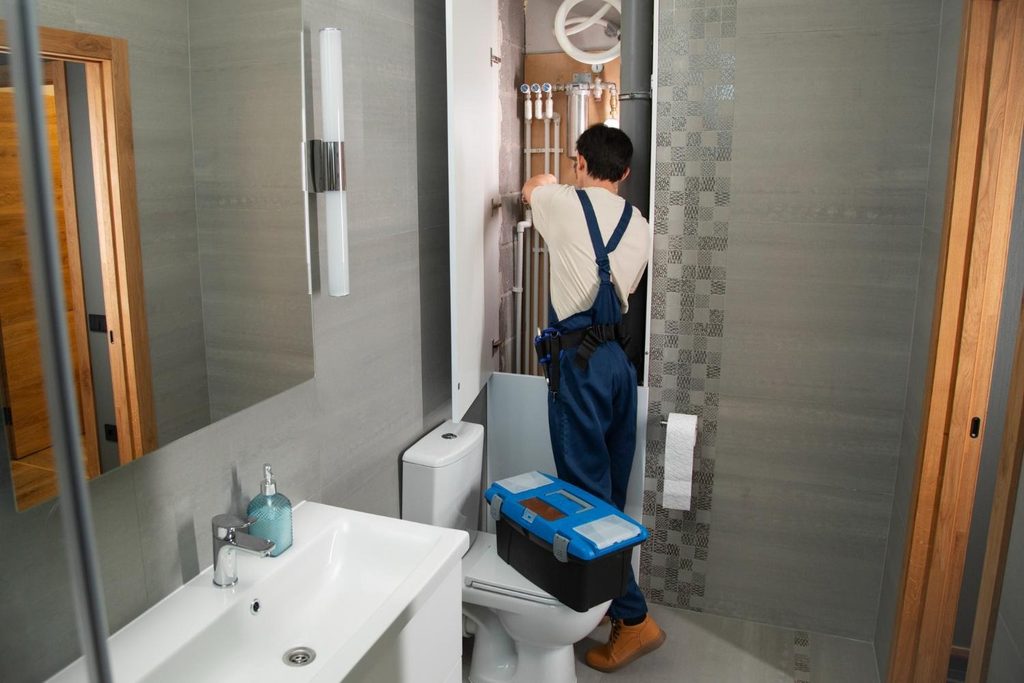
A renovated bathroom looks its best on handover day. That is also the last moment anyone can see the parts that determine whether it survives a decade.
Everything that actually fails in a wet area sits underneath the finished surface. The membrane, the falls, the junctions, the penetrations around wastes and taps.
By the time a problem announces itself, usually as a stain on the ceiling below or a soft patch of skirting in the next room, the tiling has to come off to reach it. That is why wet area work is the one part of a renovation where the invisible detail costs more than the visible one.
Wet Areas Are Defined by Use, Not by Room Name
The term covers more ground than most homeowners assume. In Australian practice a wet area is any space containing a water tap or shower, or exposed to regular wetting.
That takes in the bathroom and the ensuite, but also the laundry and the kitchen. A kitchen sink cabinet with a slow leak behind it produces the same rot and the same mould as a failed shower base, just more slowly and with less warning.
Treating those rooms as a single category during planning is the difference between one waterproofing scope and three separate afterthoughts.
What the Standard Actually Requires
Waterproofing in Australian homes is governed by AS 3740, most recently revised in 2021, which sets out the materials, design and installation requirements for domestic wet areas. It is referenced by the National Construction Code, which gives it legal force through state building law.
The detail worth knowing is how far the protection has to extend. Under the 2021 revision, shower wall linings must be waterproofed to a minimum of 1800mm above the finished floor level, or 50mm above the shower rose, whichever is higher.
Membranes themselves must comply with AS/NZS 4858, and where a surface finish drains to a floor waste, the membrane beneath it has to be graded to that waste as well. Waterproofing that falls short of the standard is defective building work regardless of how the finished room looks.
This is also why licensing matters more here than in most trades. Firms like Iconic Renovations & Co. handling kitchen and bathroom renovations in Sydney should publish a contractor licence number, and Iconic Renovations & Co lists licence 301036C alongside Master Builders Association membership, which is the minimum documentation any homeowner should be able to check before signing.
One point catches people out on partial renovations. If the work disturbs the existing membrane, and retiling or relocating a waste both do, the wet area has to be brought up to current standard rather than patched.
Falls to Waste: The Detail Nobody Inspects
Water only leaves a floor if the floor is shaped to send it somewhere. Get the fall wrong and water sits, which is how you end up with permanently damp grout, efflorescence along the joints and eventually a saturated substrate.
The failure is rarely dramatic. It looks like a shower that never quite dries, or a corner that stays darker than the rest of the floor hours after use.
Drainage problems elsewhere in the system compound it, and the early signals are audible rather than visible. Coverage of gurgling drains makes the point that noise from a waste line usually indicates restricted airflow or a developing blockage, and that ignoring it invites mould and structural damage rather than merely a slow drain.
Ventilation Is the Second Failure Point
Waterproofing keeps liquid water out of the structure. It does nothing about vapour, and vapour is what grows mould on ceilings and inside wall cavities.
An extraction fan that vents into a roof space rather than to outside air simply relocates the problem, which is a surprisingly common finding in older renovations. Running the fan for a period after the shower ends, rather than switching it off with the light, is what actually clears the moisture load.
Kitchens have the same issue with a different source. Cooking generates significant vapour, and a recirculating rangehood filters grease without removing any of it from the room.
The Surface Layer Still Decides Daily Conditions
All of that governs the structure. What sits on top governs how damp the room feels between uses, and the two are related more than people expect.
A fabric bath mat holds water in its fibres for hours in a room with limited airflow, which keeps the floor beneath it damp and adds continuously to the humidity the ventilation has to remove. It is a small contributor next to a failed membrane, but it is the one running every single day.
Diatomite is the usual alternative, a microporous material formed from fossilised algae that absorbs water on contact and evaporates it rather than storing it. Natureva’s range is a reasonable reference point for the category, since the brand publishes specifics most sellers avoid.
Their stone bath mat collection by Natureva is rated to hold up to 150 percent of its weight in moisture and to dry completely within 10 to 15 minutes, with a textured non-slip base and weekly wiping as the entire maintenance routine. The range was named a finalist in the Clean Conscious Awards 2026 for bathroom products and carries asbestos-free verification, which is worth confirming with any diatomite product.
What to Ask Before Work Starts
Ask who is performing the waterproofing and what licence they hold, because it is frequently subcontracted away from the head builder.
Ask for the waterproofing certificate and photographs of the membrane before tiling begins. Once the tiler arrives, that evidence no longer exists.
Ask where the extraction fan discharges, and confirm it is to outside air rather than into the roof cavity.
Conclusion
The visible half of a renovation is the half you choose. The half that determines whether it lasts is decided in the week before the tiles go on, by people you may never meet.
Insist on documentation for the membrane, the falls and the ventilation discharge. Those three things account for most wet area failures and all three are cheap to verify beforehand.
Everything after that is finishes, and finishes can be changed. A membrane cannot.
FAQ
1. What is AS 3740 and does it apply to a partial renovation?
AS 3740 is the Australian Standard for waterproofing domestic wet areas, referenced by the National Construction Code. It applies whenever work disturbs the existing waterproofing, so retiling or relocating a waste triggers it even on a partial job.
2. How high do shower walls need to be waterproofed?
Under the 2021 revision of AS 3740, shower wall linings require waterproofing to at least 1800mm above the finished floor level, or 50mm above the shower rose, whichever is higher.
3. Why does my newly renovated bathroom still smell damp?
Usually ventilation rather than waterproofing. Check that the extraction fan discharges to outside air rather than into the roof space, and run it for a period after showering rather than switching it off with the light.
4. Do stone bath mats actually work better than fabric?
They dry far faster, which is the relevant difference. Diatomite absorbs water into microscopic pores and releases it by evaporation, so the surface stops being damp within minutes rather than holding moisture for hours the way fabric does.